Upcoming NAHRO e-Briefing on HUD Year in Review


On February 7, 2017, img_0015NAHRO will present, Moving Forward: A Review of 2016 Regulation and
Legislation
, part of NAHRO’s Housing Rules!! series.

The NAHRO Policy team will discuss
many areas that HUD and Congress addressed during 2016 and NAHRO reviewed in detail
in NAHRO’s Regulatory and Legislative Year in Review – 2016, which will provide a solid regulatory and legislative foundation as we work with the new Administration and new Congress to keep our affordable housing agenda moving forward.

Registration information for this e-Briefing and other professional development offerings is available through the NAHRO Professional Development calendar.

Regulatory Freeze Memo Issued

On January 20, the Trump Administration issued a “Regulatory Freeze Pending Review” memo that applies to all Federal agencies, including the U.S. Department of Housing and Urban Development (HUD). This memo is similar to memos issued by previous administrations as they come into office, and NAHRO had expected this regulatory freeze.

Generally, the regulatory freeze requires agencies to withdraw any regulations that have not yet been published in the Federal Register and to extend the effective date by 60 days of any regulations that have not become effective as of January 20, 2017. The Director of the Office of Management and Budget (OMB) can issue exceptions to the regulatory freeze in emergency situations and to address urgent health, safety, financial, or national security issues.

The regulatory review not only applies to regulations but also any “guidance document.” A “guidance document” is any substantive action or an agency statement that states a policy on a statutory, regulatory, or technical issue that is normally published in the Federal Register.

NAHRO will continue to monitor the effects of the regulatory freeze and has reached out to HUD staff on how this regulatory freeze will affect specific regulations. As more information becomes, available NAHRO will share it with our members through The NAHRO Blog and the Monitor.

For any specific questions or concerns, please contact Georgi Banna, NAHRO’s Director of Policy and Program Development, at gbanna@nahro.org. As always for the most up-to-date information of the affordable housing and community development regulations and legislation, follow The NAHRO Blog and check the NAHRO website.

Five Communities Awarded $132 Million in Choice Neighborhoods Grants

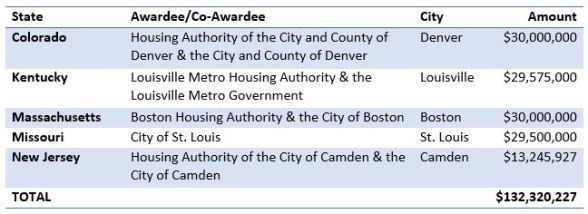
On December 12, HUD announced that five U.S. communities will receive a combined total of $132 million in FY 2016 Choice Neighborhoods Initiative (CNI) grant funds. The goal of the CNI is to aid struggling communities with severely distressed public housing or HUD-assisted housing by reinvesting in the community’s housing, residents, and neighborhoods.

These five communities will receive funding under the CNI’s Implementation Grant component, which supports communities that are ready to implement their neighborhood revitalization plan, or “Transformation Plan.” All five awardees are also past Choice Neighborhoods Planning Grant recipients.

The following communities will receive Implementation Grants:

cni-2016-awards

According to HUD’s press release, the awardees will replace 1,853 severely distressed public housing units with nearly 3,700 new mixed-income, mixed-use housing units, and leverage every $1 in Choice Neighborhood funding with an additional $5 in public and private funding for their project proposals. Together, the awardees and their partners are expected to leverage a combined total of $636 million through other public/private sources and indirectly stimulate another $3.3 billion in their local economies.

Read a summary of each grants here.


New Mapping Tool Shows What HUD Investments Your Community Receives

On December 6, HUD launched the Community Assessment Reporting Tool (CART) – a new online and mobile-friendly tool that offers the public real-time information on HUD investments across a community. This interactive reference and mapping tool uses geospatial technology to show a variety of  property- and grant level detail by city, state, county, metropolitan area, or congressional district levels. According to HUD, CART cuts down the time that it typically takes to generate this information from several days to minutes.

CART includes information on many of HUD’s major programs, including:

  • Community Planning and Development Competitive and Formula Grants
  • Rental Assistance through HUD’s Multifamily programs, Housing Choice Vouchers and Public Housing properties
  • Housing Counseling
  • Signature programs – Promise Zones, Strong Cities Strong Communities and Rental Assistance Demonstration.
  • Census demographic information

CART also allows users to build custom community maps using thematic layers (i.e., voucher concentration, poverty rate) and property layers (i.e., location of public housing buildings, CDBG and HOME activities).Access CART online at: egis.hud.gov/cart

NAHRO Provides Recommendations to the HUD 2017 Transition Team

Today NAHRO provided members of President-elect Trump’s HUD transition team with the NAHRO Transition 2017 recommendations. All recommendations and positions in this document have been previously approved by our standing committees and the NAHRO Board of Governors. We also intend to make ourselves available to the new transition team and supply them with any and all information and assistance they may require from us to make the transition at HUD under the Trump Administration as smooth as possible.

The transition recommendations can be used as you reach out to your local HUD officials, your elected officials who will be seated in the new Congress, the media and your own state and local officials in a united effort to move a responsible and responsive housing agenda forward at HUD and on Capitol Hill. In addition to this document, the association will also be producing the NAHRO 2017 Regulatory and Legislative Agenda, which will be drafted over the coming weeks with input from NAHRO membership and leadership and will be available at the NAHRO 2017 Washington Conference.

NAHRO’s Transition 2017 recommendations for HUD may be viewed here.

Five HOTMA Self-Implementing Provisions

On September 26, Principal Deputy Assistant Secretary Lourdes Castro Ramirez sent an e-mail to PHA executive directors identifying the self-implementing provisions of the Housing Opportunity Through Modernization Act of 2016 (HOTMA). All the other Housing Choice Voucher or Public Housing provisions will require HUD promulgated notices or regulations.

Five HOTMA Self-Implementing Provisions

  1. Reasonable Accommodation Payment Standards – PHAs may establish, without HUD approval, a payment standard of up to 120 percent of the Fair Market Rent (FMR) as a reasonable accommodation for a person with a disability. The Streamlining Rule already provided this flexibility.
  2. Establishment of Fair Market Rent
    1. HUD may publish FMRs directly to their website, skipping the Federal Register, but must publish a notice in the Federal Register that they are published. Changes how interested stakeholders comment on FMRs and requests that HUD reevaluate the FMRs in a jurisdiction before those rents become effective.
    2. PHAs will no longer be required to reduce payment standards as a result of a FMR reduction for families continuing to reside in a unit under a housing assistance payment (HAP) contract at the time of the FMR reduction. The regulation at 24 CFR 982.505(c)(3) requiring the new decreased payment standard be applied to program participant families at their second regular reexamination is no longer applicable. PHAs must “adopt policies in their Administrative Plans that further explain this provision.” HUD will issue additional guidance in the future.
  3. Family Unification Program (FUP) for Children Aging out of Foster Care
    1. FUP-eligible youth may receive FUP assistance up to 36 months. Applies to current as well as new FUP-assisted youth.
    2. Expands eligibility requirements for FUP-eligible youth. Expanded eligibility applies to the following:
      1. Youth aged  18 to 24 that are homeless or at risk of being homeless, and
      2. for those that left foster care at age 16 or older, or those that are within 90 days of leaving foster care.
    3. “At risk of being homeless” is defined at 24 CFR 576.2.
  4. Preference for U.S. Citizens or Nationals in Guam – Only applies to Guam. Establishes a preference for U.S. Citizens or Nationals in receiving financial assistance.
  5. Exception to PHA Resident Board Member Requirement – provides an exception for certain jurisdictions from resident board member requirements. Provision has been in effect through multiple appropriations acts.

PHA AFH Tool updated by HUD

An updated Public Housing Authority (PHA) Analysis of Fair Housing (AFH) Tool that takes into account public comments HUD received has been posted for public inspection. HUD continues to state that they are committed to issuing an additional AFH Tool specifically for Qualified-PHAs (QPHA.) To that end, the PHA AFH Tool is intended to be used by non-QPHAs and QPHAs that are collaborating with non-QPHAs.

HUD has made a number of updates to the PHA AFH Tool. The NAHRO Policy Team will continue to review and provide additional analysis of this notice. Below is a brief list of the PHA AFH Tool updates:

  1. QPHA Insert – This insert is to be used by QPHAs that collaborate with non-QPHAs and covers the required analysis of the QPHA’s service area.
  2. Contributing Factors – HUD added and made small changes to the descriptions of contributing factors.
  3. Disparities in Access to Opportunities – The number of questions has been reduced and references to PHA waiting lists have been removed.
  4. Disability and Access – Two additional question have been added to the tool that relate to interaction of PHAs and individuals with disabilities.
  5. Instructions – Various sections of the instructions have been updated to provide clarity.
  6. Fair Housing Analysis of Rental Housing – This section only applies to PHAs that administer a Housing Choice Voucher program and not to PHAs that are Public Housing only.
  7. Enhancements for PHAs in the Data and Mapping Tool – Specific maps and date related to PHAs are planned along with enhancing the functionality of the maps.

This notice requests comment be submitted within 30 days of issuance. HUD is requesting comment on the notice generally and on 15 specific questions, listed at the end of the notice. NAHRO members should review this notice and provide their comments to HUD. NAHRO will also be providing comment on behalf of our members.

Public inspection of the updated PHA AFH Tool can be done at: https://s3.amazonaws.com/public-inspection.federalregister.gov/2016-22594.pdf.

HUD to Publish List of Regulatory Waivers Granted for the Second Quarter of CY 2016

On Monday, HUD will publish in the Federal Register a list of regulatory waivers that the agency has granted for the second quarter of calendar year 2016.

The pre-publication list can be found here.

(9/12/16 Edit – The published list in the Federal Register can be found here.)

NAHRO Attends Two-Day Research Advisory Committee Meeting on MTW Expansion

NAHRO attended the two day public meeting of the Moving To Work (MTW) Research  Advisory Committee held on September 1, 2016 and September 2, 2016. While a complete summary of the entire two-day meeting is outside the scope of this blog post, the Committee made some preliminary determinations of the policy interventions for the new MTW cohorts.

Each cohort will receive standard MTW flexibilities, except for where those flexibilities may conflict with a policy intervention being tested. The following policy interventions were the ones that the Committee determined HUD should further examine when moving forward with the expansion:

  1. General MTW Flexibilities – Cohort of 30 agencies (possibly two cohorts of 15 agencies each) which would be given all general MTW flexibilities. Would be restricted to only small agencies and would be compared to a control group of small agencies to test the effects of the “standard MTW package.”
  2. Rent Reform – This cohort would test the efficacy and tenant impact of stepped rent and possibly also flat rent and tiered rent.
  3. Project-Based Voucher Caps –  This cohort would test the effects of removing or increasing PBV caps.
  4. Sponsored-Based Housing – A cohort that would test the effect of sponsored-based housing. It is unclear what specific type of sponsor-based housing or the vulnerable population affected would be. The Committee was split on whether to recommend this.
  5. Landlord Incentives – This cohort would test a “satchel” of flexibilities (e.g., increased payment standards, cash to landlords, inspection flexibilities, etc.) to determine their combined effect. Agencies will be able to pick and choose which tools in the “satchel” they utilize.
  6. Place-Based Model – This cohort would try to measure the effects of place-based strategies towards housing. The was discussed very quickly at the end of the two-day long meeting.

These were the Committee’s recommendations to HUD about how it should move forward, but these policy interventions are not necessarily the ones with which HUD will choose to move forward. Everything is subject to change.

This was my recollection of the end of the two-day long meeting, but if you attended the meeting, either in-person or by phone, and want to add something, please feel free to leave a comment on this post.

Additional information will be posted on HUD’s MTW Expansion website located here.

September is Attendance Awareness Month

As schools get into full swing this month, September is Attendance Awareness Month. For schools to work as centers of learning, it is important for students to be in class. Attendance Works focuses on the importance of student attendance and tracking student attendance data. PHAs and community development organizations can be an important partner with families and schools to insure increased school attendance and therefore improved educational outcomes for the children living in affordable housing..

As part of Attendance Awareness Month, Attendance Works is hosting a webinar on using attendance data.

Thursday, September 8, 2016: Ensuring an Equal Opportunity to Learn: Leveraging Chronic Absence Data for Strategic Action, 11-12:30 pm (PT) / 2-3:30 pm (ET). Register now.

In June 2016, the U.S. Office for Civil Rights released its first national count of students who were chronically absent. The data showed a staggering 6.5 million students were chronically absent, which means that they missed so much school that their ability to read well and gain fundamental skills and knowledge for college and career was hampered. In the 500 most heavily impacted districts, over 30% of students were chronically absent.

Join experts Hedy Chang, Executive Director of Attendance Works and Dr. Robert Balfanz, Director of the Everyone Graduates Center at Johns Hopkins University as they release a major national study analyzing the data and more importantly, showing how leaders at the local, state and national levels can take strategic action to monitor and address chronic absence in order to ensure an equal opportunity to learn and succeed.

 The webinar will provide suggestions and tips on to become engaged in attendance awareness month activities such as displaying an attendance poster at housing sites, establishing or expanding programmatic interventions such as a mentoring program, etc.

More information on Attendance Awareness Month and Attendance Works can be found at: http://awareness.attendanceworks.org/.