FMRs, SAFMRs, and Volatility

Our friends at the National Housing Conference (NHC) and the Public Housing Authorities Director’s Association (PHADA) have written a blog post with a series of beautiful maps on historical Small Area Fair Market Rent (SAFMR) volatility on NHC’s Open House Blog. Here’s a map from the blog post on the Washington-Arlington-Alexandria HUD Metro Fair Market Rent (FMR) area.

https://nahroblog.org/wp-content/uploads/2016/08/d5a51-washington-arlington-alexandria252c2bdc-va-md2bhud2bmetro2bfmr2barea.jpg

I recommend looking at the blog post to read their take on SAFMRs and volatility and to see the other maps.

Here are a couple of points that I would like to note to further this conversation.

The methodology for calculating Fair Market Rents (and SAFMRs) is changing

In calculating the final FY 2016 FMRs HUD switched from a “historical-based annualized change in gross rent trend factor [to] a forward-looking forecast . . . [that] uses a model that forecasts national rent and utility [Consumer Price Index] indices based on economic assumptions used in the formulation of the President’s Budget.”[1] Since the methodology has changed, we need a time horizon of a few years to see if the volatility remains as bad a problem as before the methodological change.

Additionally, Peter Kahn, the Director of HUD PD&R‘s Economic Market Analysis Division, has stated the following:

We are looking at ways throughout the proposed ’17 FMR process of addressing that . . . variability in general. When the proposed ’17 FMRs are out, the . . . you can read that preamble and see that we are trying to take steps to address that variability. (See the YouTube clip where he said that here.)

Will HUD be successful in addressing this volatility? I don’t know, but it’s good that they’re aware of the problem and are taking steps to address the issue.

The passage of the Housing Opportunity Through Modernization Act of 2016 (HOTMA) may give PHAs a tool in managing volatility of payment standards based on both FMRs and SAFMRs

HOTMA has a provision that allows PHAs to hold harmless households that live in areas that receive lower FMRs. Section 107(b) of HOTMA states that “no public housing agency shall be required as a result of a reduction in the fair market rental to reduce the payment standard applied to a family continuing to reside in a unit for which the family was receiving assistance . . . at the time the fair market rental was reduced.” It is NAHRO’s understanding that this provision will apply to payment standards based on FMRs and SAFMRs.

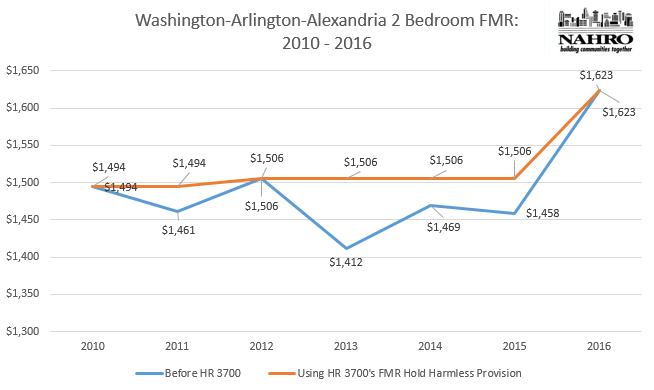
The chart below shows how if a provision allowing for payment standards to be held harmless was in place between 2010 and 2016, then volatility may have been reduced in some instances. The blue line shows the actual Washington-Arlington-Alexandria FMR for 2 Bedroom units. The orange line shows what a payment standard based on that FMR would have been, had it been held harmless.
WashDCHoldharmlessFMRChart-2010-2016

The HOTMA provision has the ability to reduce volatility in certain instances, though holding FMR payment standards harmless may have budget implications. Another point to remember is that when the payment standard starts being held harmless matters. In the chart above, if the payment standard starts being held harmless in 2013, then the volatility that results from increases in the FMR will still occur.

Although the chart above shows a payment standard based on a FMR being held harmless, the same principle would apply to payment standards based on SAFMRs.

[1] – 80 Fed. Reg. 77,124 (December 11, 2015).

HUD Publishes Notice on Availability of $5 million for TPVs in Low-Vacancy Areas

Today, HUD published a notice (PIH 2016-12) titled “Funding Availability for Tenant-Protection Vouchers for Certain At-Risk Households in Low-Vacancy Areas — Fiscal Year 2016.” The notice makes available the $5 million set-aside  for “certain at-risk households in low-vacancy areas for Fiscal Year (FY) 2016” from the $130 million appropriated for Tenant Protection Vouchers (TPVs) in general.

The $5 million in TPV assistance is available for the purpose of assisting “residents residing in low-vacancy areas and who either are or may have to pay rents greater than 30 percent of household income” because of the following:

  1. The maturity of a HUD-insured, HUD-held or section 202 loan that would have required the permission of the Secretary prior to loan prepayment;
  2. The expiration of a rental assistance contract for which the tenants are not eligible for enhanced voucher or tenant protection assistance under existing law; or
  3. The expiration of affordability restrictions accompanying a mortgage or preservation program administered by the Secretary.

The TPV assistance may be provided as either enhanced vouchers or project-based voucher (PBV) assistance.

NAHRO’s next issue of The Monitor (members only) will have additional details on the notice.

The full notice can be read here.

NAHRO submits Small Area FMR Comments

NAHRO has submitted comments on HUD’s notice titled “Establishing a More Effective Fair Market Rent System; Using Small Area Fair Market Rents in Housing Choice Voucher Program Instead of the Current 50th Percentile FMRs.”

HUD’s proposed rule would mandatorily impose the use of Small Area Fair Market Rent (SAFMR) areas in 31 metropolitan areas, if it were implemented as currently written.

In NAHRO’s comments, we stated that PHAs should have the discretion to use either SAFMRs or FMRs depending on what made sense in a PHA’s rental housing market. NAHRO’s reasons to oppose the mandatory imposition of SAFMRs in certain areas can be divided into three broad categories: tenant welfare concerns; tenant choice concerns; and administrative burden concerns. NAHRO also noted that additional research needed to be done before mandatorily implementing SAFMRs and responded to specific solicitations about the rule from HUD.

Read NAHRO’s SAFMR comments here.

Read the proposed rule here.

Read NAHRO’s prior post on HUD’s SAFMR proposed rule here.

NAHRO meets with HUD PIH Leadership

Georgi John HUD 16-8-9

NAHRO’s Acting CEO, John Bohm, and the NAHRO Policy Team members; Georgi Banna, Eric Oberdorfer and Tushar Gurjal; along with PHADA and CLPHA met with HUD’s Public and Indian Housing Principal Deputy Assistant Secretary (PDAS), Lourdes Castro-Ramierz, and many of the PIH department leadership.

Among the topics discussed were the priorities for implementing the Housing Opportunities Through Modernization Act (HOTMA/HR 3700); upcoming HUD rules such as Smoke-Free Housing, Small Area Fair Market Rents (SAFMRs), HCV Administrative Fee Formula; Moving to Work (MTW) Expansion; and Triennial Recertifications; and the current priorities of NAHRO, PHADA, CLPHA and HUD. NAHRO and CLPHA were also thanked for their current and continued work in affordable housing and education and the improvement of educational outcomes for the children our members serve.

NAHRO is committed to keeping open and productive lines of communication and will continue to share the thoughts and concerns of our members with HUD.

HUD Publishes Integrity Bulletins for CPD Formula Grantees

The HUD Offices of the Inspector General (OIG) and Community Planning and Development (CPD) have developed Integrity Bulletins that cover topics representing issues that CPD formula grantees often struggle with: procurement and contracting; sub-recipient oversight; conflicts of interest; internal controls; documentation and reporting; and financial management.

The four Integrity Bulletins available include:

UPCS-V: Updated Decision Trees

HUD has posted updated UPCS-V Decision Trees on the HUD REAC Oversight and Evaluation (OED) website.

Feedback on either the UPCS-V Decision Trees or the UPCS-V Protocol (version 1.0) can be sent to OED@hud.gov.

The updated Decision Trees can be found here.

HUD Information Collection: Alternative Inspections – Housing Choice Voucher Program

On Monday, HUD will publish in the Federal Register a 30-Day Notice of Proposed Information Collection titled “Alternative Inspections – Housing Choice Voucher Program.” The purpose of this information collection is to allow PHAs to submit a request to HUD to use an alternative inspection standard under Section 8 other than the alternative HOME and LIHTC standards (which do not require a request to HUD). The notice allows for an additional 30 days of comment.

Read the full pre-publication copy of the notice here.

HUD Publishes Housing Trust Fund Income Limits and Guidance on Environmental Provisions

In May 2016, HUD announced the first-ever National Housing Trust Fund (HTF) allocations to states, amounting to nearly $174 million in available funds for FY 2016. HUD recently published the HTF Income Limits for FY 2016, which are calculated using the following methodologies:

  • The formula that HUD uses for calculating the income limits for the Section 8 program, in accordance with Section 3(b)(2) of the U.S. Housing Act of 1937, as amended. These limits are based on HUD estimates of median family income, with adjustments based on family size.
  • The Federal Poverty Line as determined by the U.S. Department of Health and Human services, published annually in the Federal Register.

In years in which the total amount available for allocations is below $1 billion (as is the case for FY 2016), the income limit reports will only display the limit for extremely low income families or families with incomes at or below the poverty line (whichever is greater) and will not include the very low income limit. The HTF FY 2016  Rent Limits are also available online, both limits became effective on July 1, 2016.

Additionally, HUD has made available new guidance entitled, “Requirements for Housing Trust Fund Environmental Provisions.” This notice describes the Environmental Provisions for new construction and rehabilitation that are required for HTF projects under the Property Standards at 24 CFR § 93.301(f)(1) and (2).

UPCS-V Version 1.0 Protocol Posted

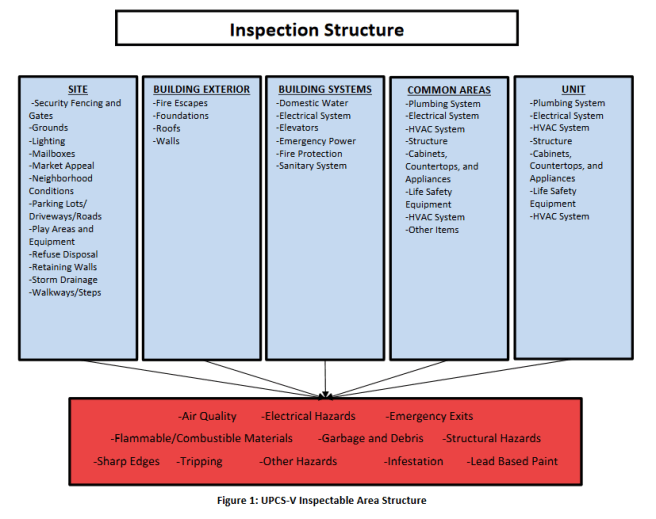
HUD REAC has publicly posted Version 1.0 of the UPCS-V protocol. NAHRO is currently in the process of reading through the protocol, but here is a quote and chart from page 8 of the document about the UPCS-V inspection structure.

UPCS-V contains five inspectable areas: building exterior, unit, building systems, common areas, and site. UPCS-V is primarily centered on the unit, but includes items within the other four areas that negatively affect the habitability of the unit or the health and safety of its tenants.

Each inspectable area has one or more  inspectable items. An inspectable item is a component of an inspectable area that is to be evaluated under the UPCS-V protocol (see Figure 1 for the association of inspectable areas and items.) During an inspection, an inspector must evaluate all applicable inspectable items within each inspectable area for defects.

UPCS-V-Inspection-Structure

Read the entire 1.0 version of the protocol here.

UPCS-V Conference Call Recording Now Available

HUD REAC’s Oversight and Evaluation Division (OED) has made available a recording of the UPCS-V conference call with UPCS-V Demonstration participants.

The link to the recording can be found on OED’s webpage.

A direct link to the recording can be found here.