
New Markets Tax Credits (NMTC) help localities build stronger neighborhoods by investing in housing, schools, and other vital projects that are targeted at helping low-income communities. Between 2003 and 2015, $42 billion in direct NMTC authority has generated almost $80 billion in capital for local businesses and revitalization projects. NMTC investment has resulted in the creation or retention of over 750,000 jobs, and the financing of over 178 million square feet (sq. ft.) of commercial real estate and almost 14,000 affordable housing units. NMTCs are a proven and effective tool for generating private-sector investments in communities in need. This is one in a series of articles that show how public housing authorities (PHAs) and community development agencies have successfully used federal tax credits and tax-exempt bonds to build and/or preserve public housing and affordable housing and to increase the sustainability of communities. Continue reading
Why the 4% LIHTC Matters: Walla Walla Housing Authority
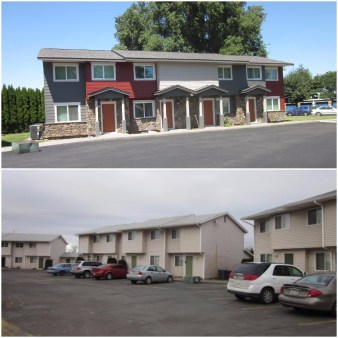
Before (bottom) and after (top) pictures of Emerald Family Properties buildings. Photo credits: Walla Walla Housing Authority
The Low-Income Housing Tax Credit (LIHTC) is one of the most effective tools for creating new and critically needed affordable housing, and accounts for the vast majority of all affordable rental housing created in the United States. This is one in a series of articles that show how public housing authorities (PHAs) and community development agencies have successfully used federal tax credits and tax-exempt bonds to build and/or preserve public housing and affordable housing, and to increase the sustainability of their communities.
Walla Walla Housing Authority: Emerald Family Properties
Walla Walla (Wash.) County has the largest affordable housing gap in the state of Washington, and so the pressure is high to keep existing public and affordable housing. Recently, the Walla Walla Housing Authority (WWHA) used a combination of 4 percent LIHTCs and tax-exempt bonds to revitalize and preserve the Emerald Family Properties, an 84-unit family development with two- to five-bedroom units in nine neighborhoods. The financing package allowed the housing authority to upgrade both the interiors and the exteriors of the units, and to increase energy efficiency in a way that would lower the utility costs for the residents. Emerald Family Properties has project-based vouchers attached to its units, and thus is able to serve very low-income families as well as those of moderate income.
“This project never would have pointed in the 9 percent LIHTC credit round, so the 4 percent LIHTC and tax-exempt bonds are essential financing tools that we use to address our community’s housing needs,” said WWHA Executive Director Renée Rooker. “Over the past five years, we have developed 245 units serving elderly individuals, veterans, persons with disabilities, and families by utilizing 4 percent LIHTCs and tax-exempt bonds. Besides Emerald Family Properties, we will have completed 80 more units in the next couple of weeks. None of this could have transpired without these financing tools.”
For more information about this project or to share your organization’s 4 percent LIHTC success story, please contact nahro@nahro.org.
HUD Releases Guidance on Demo/Dispo Asset-Repositioning Fee (ARF)
On November 8, HUD released Notice PIH-2017-22 titled “Guidance on Eligibility for Asset-Repositioning Fee (ARF) when Public Housing Units Are Approved for Demolition, Disposition, or Transitioned to Homeownership.” The Notice applies to all PHAs administering Public Housing, including MTW PHAs.
PHAs that transition projects or entire buildings within a project out of the public inventory may be eligible for ARF, which is an add-on to Operating Subsidy eligibility. ARF supplements costs associated with administration of demolition and disposition, tenant relocation, and minimum protection and services associated with such efforts. It is not intended for individual units within a multi-unit building.
The guidance discusses which units would be considered eligible for ARF, the timeline for homeownership and non-homeownership ARF, how to identify unit months for units eligible to receive ARF, how to calculate ARF amounts, how to determine the ARF funding period versus the Operating Subsidy funding year, how to use ARF when a PHA demolishes and/or disposes of different buildings in one project in multiple phases, and how to adjust the rolling base if some units in a project are ARF eligible and others are not.
Tax Reform Proposal Retains LIHTC, Still Devastates Affordable Housing
The House Ways and Means Committee this week released its long-await tax reform legislation, the Tax Cuts and Jobs Act (HR 1). While the bill retains the Low-Income Housing Tax Credit (LIHTC), one of only two business credits preserved, it eliminates several other taxes and bonds that are critical to community development and affordable housing. If passed as-is, the Tax Cuts and Jobs Act would be devastating for communities.
The committee is scheduled to begin mark-up of the bill on Monday, November 6 at 12:00 pm ET, a process that is likely to last several days. This means there is very little time to ask lawmakers to propose changes- contact your Representatives now to tell them to preserve the parts of tax code that are so critical to communities.
The text of the bill is available here and supporting documents are available here.
What’s in the Bill
- Low Income Housing Tax Credit: Maintains the credit
- Corporate Tax Rate: Cut from 35 percent to 20 percent
- New Market Tax Credit: Eliminates
- Private Activity Bonds: Eliminates
- Historic Preservation Tax Credit: Eliminates
- Mortgage Interest Deduction: Caps at $500,000 for new mortgages, savings not re-invested in affordable housing
The Low-Income Housing Tax Credit is preserved, but the 4 percent remains unauthorized. Also missing from the Tax Cuts and Jobs Act is language proposed by Rep. Pat Tiberi (R-Ohio) and Rep. Richard Neal (D-Ma.) in their Affordable Housing Credit Improvement Act (HR 1660). Though NAHRO thanks the Ways and Means Committee for retaining the 9 percent credit, NAHRO opposes other changes to bonds and the corporate tax rate will undermine the effectiveness of the program and essentially eliminate the 4 percent credit.
Private Activity Bonds (PABs) are tax-exempt bonds issued by state and local governments to drive private investments in community development, housing (Housing Bonds), infrastructure and educational projects. The bill would remove the tax exemption for PABs, including multifamily Housing Bonds, which helps finance almost half of all affordable homes produced and preserved by LIHTC.
PABs are responsible for almost half of all affordable homes produced by LIHTC annually, and it is a critical tool that must be preserved. Although the public housing inventory is an integral component of our nation’s infrastructure, chronic underfunding of the Capital and Operating Funds has placed the inventory at risk, with a mounting capital needs backlog of well over $26 billion. PHAs often turn to LIHTC to preserve and revitalize their distressed public housing inventory. A one-pager by the ACTION Campaign on the use of LIHTC for preservation and the impact of Rep. Tiberi’s and Rep. Neal’s bill is available here.
NAHRO members typically seek out 4 percent Housing Credits over the 9 percent because they are non-competitive and more accessible. However, to use the 4 percent Housing Credit, projects must be funded in part with tax-exempt bonds. The House bill’s elimination of tax-exempt bonds could completely devastate the production of affordable housing by NAHRO members.
The Tax Cuts and Jobs Act could also severely handicap the Rental Assistance Demonstration (RAD) program, which depends on LIHTC for its success. RAD allows PHAs to leverage public and private debt and equity to address the capital needs backlog of their public housing portfolios. In RAD, units move from a public housing to a Section 8 platform with a long-term contract that must be renewed, ensuring that the units remain affordable to low-income households. HUD data thus far shows LIHTC has been included in the financing for almost half of all RAD transactions, amounting to over 73,000 units being converted. Additionally, of all of the LIHTC-financed properties participating in RAD, 70 percent of those projects specifically depend on the 4 percent Housing Credit. As a cost-neutral program, Congress has supported RAD by expanding its current cap on conversions to 225,000 units, but eliminating PBAs will undermine their support for RAD.
NAHRO opposes the bill’s repeal of this tax exemption since it would severely hinder the financing of LIHTC projects that provide safe, decent, and affordable housing for our nation’s growing share of low-income renter families.
New Markets Tax Credits (NMTC) help localities build stronger neighborhoods by investing in housing, schools, and other vital projects, and are targeted at helping low-income communities. Over the last 25 years, about $51 billion in NMTC authority have generated $42 billion in local investments, resulting in the creation or retention of over 700,000 jobs, and the financing of over 178 million square feet of commercial real estate and almost 14,000 affordable housing units. NMTCs has proven to be an effective tool for generating private sector investments in communities in need, while still remaining a net positive program for the economy. NAHRO supports the continuation of this program.
Historic Tax Credits also have a proven track record of stimulating economic growth while also preserving our valuable national architectural heritage. We believe that these three important instruments for infrastructure creation and preservation should remain part of our economic development toolbox, and hope that they will be restored in later versions of the bill.
What’s Next
The Ways and Means Committee will begin mark-up of the bill on Monday afternoon. Debate of the legislation and amendments are expected to last up to four days.
Leadership is currently working on changes to the bill to secure votes and ensure it meets the procedural requirements for budget reconciliation in the Senate. The President has also urged lawmakers to include a repeal of the individual health care mandate, a move that could politically complicate its passage. Still, House leadership is optimistic that the bill will pass with few Republican defections before Thanksgiving.
The path through the Senate is less clear; Senator Rand Paul (R-Ky.) voted against the passage of the budget resolution that included the framework for this tax reform legislation and several other Republican Senators have expressed concern about the bill. However, because the Tax Cuts and Jobs Act is being moved forward under the budget reconciliation process, only a simple majority is needed to approve the legislation. Leadership is aiming to have the bill to the President’s desk before adjourning for the holiday recess in December.
As the bill moves forward, NAHRO will provide coverage through the blog, Direct News emails, and @NAHRONational on Twitter.
Jenny Hsu also contributed to this article.
HUD REAC Posts October 2017 UPCS-V Conference Call
HUD Real Estate Assessment Center (REAC) Oversight and Evaluation Division (OED) posted their quarterly conference call with UPCS-V Demonstration participants. UPCS-V is the inspection protocol that HUD is developing to replace Housing Quality Standards (HQS), which is the current inspection protocol used for the Housing Choice Voucher program.
The 10/25/17 UPCS-V conference call can be found here.
HUD Issues 19 CPD Waivers to Help Disaster Recovery
In order to aid communities and accelerate disaster recovery for those impacted by Hurricanes Harvey, Irma and Maria, HUD has announced a package of 19 regulatory and administrative waivers for the following Community Planning and Development (CPD) programs: The Community Development Block Grant (CDBG) Program, HOME Investment Partnerships (HOME) Program, Housing Opportunities for Persons with AIDS (HOPWA) Program, and Emergency Solutions Grant (ESG) Program.
According to HUD, this waiver package represents the largest collections of regulatory and administrative waivers ever issued by the Department at one time. State and local grantees located in major disaster declared areas can now access a waiver through a new simplified notification process. HUD’s flexibilities include: Continue reading
HUD Publishes Additional Guidance on Implementing HOTMA Voucher Provisions
Yesterday, October 30, HUD published notice PIH 2017-21 (HA) titled “Implementation Guidance: Housing Opportunity Through Modernization Act of 2016 (HOTMA) – Housing Choice Voucher (HCV) and Project-Based Voucher (PBV) Provisions.” The notice provides additional guidance on HUD’s previous Federal Register notice implementing HOTMA’s changes to the definition of PHA-owned housing and changes to the project-based voucher program. It also incorporates HUD’s previous technical corrections notice.
This notice provides guidance on the following topics:
- PHA-Owned Units;
- PHA-Owned Units and Independent Entities;
- Percentage Limitation (Program Cap) and PHA Submission Requirements;
- PBV Percentage Limitation – 10 Percent Increase for Eligible Units;
- Income-Mixing Requirement (Project Cap);
- Units Not Subject to Percentage Limitation (Program Cap) or Income-Mixing Requirement (Project Cap);
- Priority of PBV HAP Contracts;
- PBV Biennial Inspections;
- Adding Units to PBV HAP Contract Without Competition;
- PBV Contract Termination or Expiration without Extension;
- Attaching PBVs to Certain PHA-Owned Projects Without Following a Competitive Process;
- Project-Basing Family Unification Program and HUD-VASH Vouchers;
- Appendix – PBV Program Cap Calculation Instructions;
- Appendix – PHA Plan, Administrative Plan, and Other PBV Topics;
- Appendix – Reporting; and
- Appendix – HCV, Homeownership, and PBV Inspection Requirements.
NAHRO is still in the process of reading through the notice and will provide additional information to our members.
The notice can be found here.
HUD Publishes Guidance on Implementing HOTMA Inspection Provisions
On October 27, HUD published PIH 2017-20 (HA) titled “Housing Opportunity Through Modernization Act of 2016 (HOTMA) – Housing Quality Standards (HQS) Implementation Guidance.” The notice provides additional guidance on two previously implemented provisions that theoretically should allow PHAs to approve a unit and execute a HAP contract with a landlord more quickly.
The two provisions may help PHAs in tight rental markets. The first provision allows PHAs to approve an assisted tenancy and make Housing Assistance Payments (HAP) on units that fail to meet Housing Quality Standards (HQS) Inspection protocol, but only have non-life-threatening deficiencies. The second provision allows PHAs to approve assisted tenancies of a unit prior to the HQS inspection if the property has passed an alternative inspection within the past 24 months.
The notice discusses the following topics:
- Implementing the approval of assisted tenancy for units with non-life-threatening HQS deficiencies provision;
- HUD definition of non-life-threatening and life-threatening conditions;
- Incorporating life-threatening conditions for all inspections;
- Documenting the presence or absence of life-threatening conditions;
- Notification of owners and tenants;
- Effective date of HAP contract;
- Housing Assistance payments;
- Administrative plans;
- Notification of HUD;
- Section Eight Management Assessment Program (SEMAP);
- Implementing the Alternative Inspections Provision;
- Eligible alternative inspection methods;
- Timing of the initial HQS inspection;
- Approval of assisted tenancy and execution of HAP contract;
- Housing assistance payments;
- Notification of owners and tenants;
- Administrative plans;
- Notification of HUD; and
- SEMAP.
The notice also includes helpful charts and tables. Particularly useful is a chart in the notice that provides examples of life-threatening conditions and explains where to record them on the HUD Inspection Form. Additionally, the notice includes four flowcharts, which visually explain how to use the provisions. The notice is logically structured, clearly written, and makes good use of charts–my compliments to the HUD staffers who put it together.
NAHRO members will receive additional coverage of this notice.
The full notice can be found here.
HUD-VASH Voucher Registration of Interest Deadline Extended
HUD has published a new notice titled “EXTENSION to Register Interest for HUD-VASH Vouchers.” The notice states that the deadline to register interest for HUD-VASH vouchers has been extended to December 1, 2017. In a previous blog post, NAHRO detailed the application process.
The PIH Notice can be found here.
NAHRO Urges Congress to Include LIHTC in Tax Reform
NAHRO sent the following message to all members of Congress, their Legislative Directors, and tax Legislative Assistants this morning. As the tax reform debate takes shape, NAHRO will continue to participate in the conversation on Capitol Hill and engage with our industry partners as a steering committee member of the ACTION Campaign.
NAHRO also thanks its members who joined a letter to lawmakers outlining priorities for tax reform. Over 2,100 organizations joined nationwide, including more than 30 NAHRO members. To send a copy of the letter to your members of Congress and support LIHTC in the tax reform debate, visit NAHRO’s Action Center.
Dear Senator/Representative,As you begin your tax reform discussions in earnest, the National Association of Housing and Redevelopment Officials (NAHRO) is pleased to share information with you on the important work local housing and redevelopment agencies do to utilize the Low Income Housing Tax Credit (LIHTC) to preserve and redevelop decent, safe, and affordable housing in communities of quality.We are happy to see that the credit, as well as legislation to improve the utility and effectiveness of LIHTC, are already being considered for inclusion as part of tax reform legislation during the fiscal year 2018. Specifically, the Affordable Housing Credit Improvement Act (S. 548 and HR 1661), which contains reform initiatives that will also responsibly address the nation’s current rental housing crisis.LIHTC is a critical tool that has been used since 1986 to finance affordable housing opportunities for families at 60 percent of area median income. The credit has also been used in combination with other federal resources, including Community Development Block Grants (CDBG) and HOME Investment Partnership program funding to meet the affordable housing needs of the country. Additionally, LIHTC has been crucial to those undertaking HUD’s Rental Assistance Demonstration (RAD), which empowers local housing authorities to refinance existing public housing using a combination of private capital, low income tax credits, and other resources.NAHRO and the ACTION Campaign, of which NAHRO is a Steering Committee member, together thank Congressional leadership and the administration for recognizing the value of LIHTC in the “Unified Framework for Fixing Our Broken Tax Code” and for urging lawmakers to also make the following modifications to modernize our affordable housing delivery system:
- Retain the tax exemption on multifamily Housing Bonds,
- Enact the Affordable Housing Credit Improvement Act (S. 548/H.R. 1661), and
- Make adjustments to LIHTC to ensure its production potential is not negatively impacted by other changes in tax reform.
See the ACTION Campaign’s recent letter to Congress and the Administration, and thank you to the more than 30 NAHRO members who have joined these efforts in the past month.ACTION has also put together a fact sheet showing how the Affordable Housing Credit Improvement Act would specifically support the preservation of public housing. See the Senate version here, the House version here, and much more in the ACTION Campaign’s Advocacy Toolkit.Our ability to continue to provide safe, decent affordable housing for vulnerable families relies in large measure on our ability to act expeditiously on tax reform legislation that will assist local housing agencies in their efforts to meet local housing needs.NAHRO and ACTION stand ready to assist you and your staff should you have questions or if we can be of general assistance. Please contact Tess Hembree (thembree@nahro.org or 202-5807225).Thank you in advance for your time and consideration!John F. BohmSenior DirectorNAHRO Congressional Relations
 The NAHRO Blog: Legislative & Policy Updates from Washington, DC