HUD Publishes Integrity Bulletins for CPD Formula Grantees

The HUD Offices of the Inspector General (OIG) and Community Planning and Development (CPD) have developed Integrity Bulletins that cover topics representing issues that CPD formula grantees often struggle with: procurement and contracting; sub-recipient oversight; conflicts of interest; internal controls; documentation and reporting; and financial management.

The four Integrity Bulletins available include:

HUD Announces In-Person MTW Expansion Advisory Committee Meetings

HUD will host the MTW Expansion Research Advisory Committee for their 2 day, in-person meeting on Thursday and Friday, September 1 and 2. The in-person meeting will be held on Thursday, September 1, 2016 from 9:00 a.m. to 5:30 p.m. Eastern Daylight Time (EDT) and Friday, September 2, 2016 from 8:00 a.m. to 4:00 p.m. (EDT) at HUD Headquarters, 451 7th Street, SW, Washington, DC 20410. The meeting is open to the public and is accessible to individuals with disabilities.

The purpose of the meetings will be to discuss the framework and associated research methodologies for potential policies that HUD may require new MTW PHAs to test as a condition of admittance to the program. The Committee will discuss MTW Objective #1 (cost-effectiveness) and MTW Objective #2 (self-sufficiency)  on day 1, and will continue discussing MTW Objective #2 and Objective #3 (housing choice) on day 2. There will be time for public comment throughout the course of the meetings. NAHRO previously submitted comments to HUD on MTW policy proposals for the expansion and provided public comments during the Advisory Committee’s conference call last July (members only).

With advance registration, the public is invited to attend both days of the meeting in-person or by phone. Registration will be open from August 22 – August 26 here.

The agenda for the meetings can found here.

UPCS-V: Updated Decision Trees

HUD has posted updated UPCS-V Decision Trees on the HUD REAC Oversight and Evaluation (OED) website.

Feedback on either the UPCS-V Decision Trees or the UPCS-V Protocol (version 1.0) can be sent to OED@hud.gov.

The updated Decision Trees can be found here.

HUD Information Collection: Alternative Inspections – Housing Choice Voucher Program

On Monday, HUD will publish in the Federal Register a 30-Day Notice of Proposed Information Collection titled “Alternative Inspections – Housing Choice Voucher Program.” The purpose of this information collection is to allow PHAs to submit a request to HUD to use an alternative inspection standard under Section 8 other than the alternative HOME and LIHTC standards (which do not require a request to HUD). The notice allows for an additional 30 days of comment.

Read the full pre-publication copy of the notice here.

Full Time Workers and Housing Affordability

The blog of the Harvard Joint Center for Housing Studies has a great post on how the affordable housing supply is not meeting the needs of many full time workers in many cities. The post has a chart comparing the income needed to afford one bedroom units at Fair Market Rents (FMRs) with median full time wages. Here’s a portion of the chart.

JCHSChartAffordabiltyForWorkers

The FMRs used are the ones estimated by HUD for 2015. As many Housing Choice Voucher Program Managers know, HUD FMRs frequently undervalue the true prices of rental markets, so the true difference between wages and the income needed to afford units at FMRs may be greater than this chart suggests.

The full blog post with the full chart can be found here.

Why Don’t HCV Program Participants Live Near Better Schools?

I saw in a Furman Center e-mail a link to a research paper titled “Why Don’t Housing Voucher Recipients Live Near Better Schools? Insight from Big Data.” While I haven’t gone through the entire paper, here’s a short excerpt from the abstract:

We find that families with vouchers are more likely to move toward a better school in the year before their oldest child meets the eligibility cutoff for kindergarten, suggesting salience matters. Further, the magnitude of the effect is larger in metropolitan areas with a relatively high share of affordable rental units located near high-performing schools and in neighborhoods in close proximity to higher-performing schools. Results suggest that, if given the appropriate information and opportunities, more voucher families would move to better schools when their children reach school age.
Read the entire paper here.

HUD Updates Resource Locator App

HUD recently updated their Resource Locator app. The app, which is available for both Android and Apple products as well as a web-based version, maps HUD field offices, affordable housing property management companies, and public housing authority representatives to answer housing availability inquiries and general housing questions. The app includes information about commonly requested housing-related resources from HUD field and regional offices throughout the country; location data and contact information for HUD Field and Regional Offices, PHAs, Multifamily Housing, LIHTC apartments, USDA Rural Housing, Homeless client referral contacts; and provides maps linked via Facebook, Twitter, Google+, email, and text messages. The app uses GIS and Browser Location Detection to show local resources and users can export search results to Excel and generate a custom PDF resource guide. The HUD Resource Locator mobile app is available via Apple iTunes, Google Play Marketplace and through the web browser.

UPCS-V Version 1.0 Protocol Posted

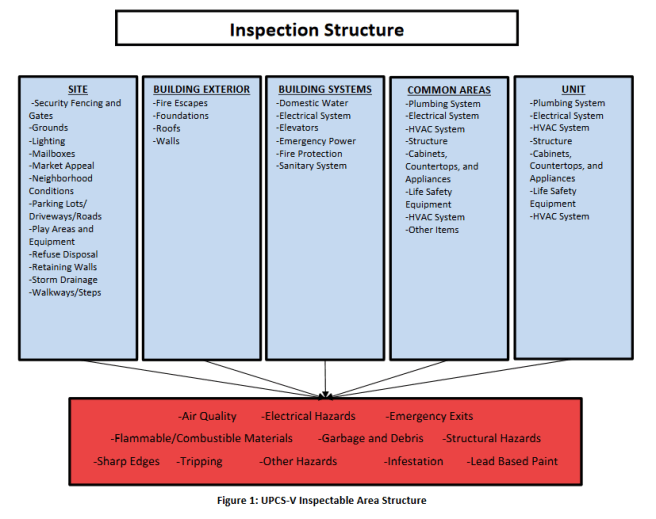
HUD REAC has publicly posted Version 1.0 of the UPCS-V protocol. NAHRO is currently in the process of reading through the protocol, but here is a quote and chart from page 8 of the document about the UPCS-V inspection structure.

UPCS-V contains five inspectable areas: building exterior, unit, building systems, common areas, and site. UPCS-V is primarily centered on the unit, but includes items within the other four areas that negatively affect the habitability of the unit or the health and safety of its tenants.

Each inspectable area has one or more  inspectable items. An inspectable item is a component of an inspectable area that is to be evaluated under the UPCS-V protocol (see Figure 1 for the association of inspectable areas and items.) During an inspection, an inspector must evaluate all applicable inspectable items within each inspectable area for defects.

UPCS-V-Inspection-Structure

Read the entire 1.0 version of the protocol here.

UPCS-V Conference Call Recording Now Available

HUD REAC’s Oversight and Evaluation Division (OED) has made available a recording of the UPCS-V conference call with UPCS-V Demonstration participants.

The link to the recording can be found on OED’s webpage.

A direct link to the recording can be found here.

New Proposed Administrative Fee HUD FAQ posted

HUD has posted a new proposed administrative fee frequently asked questions (FAQ) document on its Housing Choice Voucher New Administrative Fee Formula Proposed Rule webpage. The new FAQ answers four questions:

  1. How is the benefit load calculated?
  2. How will the formula be applied to MTW sites?
  3. How are “per unit fees” and “total funding” calculated under the proposed rule formula and the existing formula?
  4. What does HUD mean by fee “received” under the current formula? How does proration fit in to the comparisons between the proposed formula and the existing formula?

Read the FAQ here.

For additional HUD analysis tools of the new proposed administrative fee formula, see our prior post.