HUD Soliciting Comments on Income Limits for Public Housing Residents

On November 29, HUD will publish a solicitation of comments regarding the implementation of income limits for public housing residents. A provision limiting incomes for public housing residents was included within the Housing Opportunity Through Modernization Act (HOTMA) of 2016 (members only). Section 103 of the bill contains language oriented to limit the tenancies of over-income residents in a responsible, effective way that still provides significant discretion to PHAs. The language in HOTMA places the threshold for over-income families as those with incomes over 120 percent of area median income (AMI) for the most recent two consecutive years. If a family meets this threshold, PHAs have the option of either charging the higher of the fair market rent for the unit or the monthly subsidy (operating and capital fund), or terminating the tenancy within 6 months. Language in HOTMA also provides the Secretary the discretion to establish different income limitations based on local construction costs or unusually high or low incomes, vacancy rates, or rents. Prior to HOTMA’s passage, HUD also solicited comments on income limitations for public housing residents via an advanced notice of proposed rulemaking (members only).

HUD is soliciting comments on its proposal to use its calculation of very low-income (VLI) to determine income limits. VLIs are preliminarily calculated as 50 percent of the estimated area median family income. VLI limits include several adjustments to align the income limits with program requirements including: high housing cost adjustments, low housing cost adjustments, state and non-metro median family income adjustments, and ceiling and floors for changes. HUD is proposing to use the VLI as the basis for the 120 percent income limit by multiplying the VLI limit by a factor of 2.4. Areas without a VLI adjustment would result in an income limit of 120 percent of AMI. Areas with an adjustment would be higher or lower than 120 percent AMI, depending upon the adjustments made.

Comments are due Thursday, December 29 at midnight.

Upcoming Climate Corps for Affordable Housing Webinar

NAHRO would like to share information on an upcoming Climate Corps for Affordable Housing Webinar provided by HUD, Environmental Defense Fund (EDF), and TDA next Monday, November 21st at 2 PM (EST).


 Climate Corps for Affordable Housing

On October 4, 2016, HUD announced a proposed reporting requirement that will require all Public Housing Authorities and owners of HUD-assisted multifamily housing to benchmark their portfolios’ utility usage.  The notices can be found at  https://www.gpo.gov/fdsys/pkg/FR-2016-10-04/pdf/2016-23979.pdf and https://www.gpo.gov/fdsys/pkg/FR-2016-10-04/pdf/2016-23978.pdf; the 60-day public comment period ends December 5, 2016.  Benchmarking will give affordable housing owners and operators a better understanding of the overall utility consumption and costs associated with their properties and enable them to more efficiently and effectively manage their portfolios.

To help owners with the greatest need for technical assistance in complying with the benchmarking requirement, HUD is partnering with the Environmental Defense Fund (EDF) and TDA Consulting to bring you the Climate Corps for Affordable Housing Summer Fellowship program.  The program will embed 12 fellows with affordable housing organizations across the country for the summer of 2017 and will be offered at no cost to host institutions, which will be chosen on the basis of need.  This free, full-time technical assistance will allow affordable housing organizations to get ahead of the curve on this upcoming HUD requirement.

Please join us for a webinar to further explain the details of this exciting new opportunity on MONDAY, NOVEMBER 21 @ 2 PM ET.

To register, please click here.

Report: Homelessness in the U.S. Continues to Decline

Earlier this week, HUD published Part 1 of the 2016 Annual Homeless Assessment (AHAR) Report, providing Congress with local estimates of sheltered and unsheltered persons experiencing homelessness on a single night in January 2016. According to the report, on a single night in 2016, there were 549,928 persons experiencing homelessness – a 14 percent decrease from 2010 and a 3 percent decrease over the past year. This decline was especially prevalent among families with children, Veterans, and individuals with long-term disabling conditions. Despite the downward trend of homelessness nationally, 13 states and the District of Columbia still saw an increase in their share of homelessness between 2015 and 2016.

The AHAR is typically released in two parts: Part 1 provides Point-in-Time (PIT) estimates that offer a “snapshot” of homelessness as reported by Continuums of Care (CoCs) across the U.S.; Part 2 offers in-depth detail on the characteristics of the homeless. The PIT methodology is regarded as a reliable estimate of the general size of the homeless population; however, it is important to note that it does not count every single homeless person, nor does it measure the number of people who are at risk of homelessness.

****

paperphoto

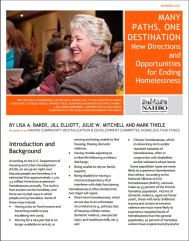
NAHRO members have long been on the front lines of preventing and ending homelessness. Read this recent NAHRO white paper to learn about public housing authority (PHA) collaborations and new directions and opportunities for ending homelessness.Case studies include: effectively ending veteran homelessness in Houston, Texas; implementing medical respite to save lives and reduce costs in Fargo, North Dakota.; and using a model for working with the chronically homeless in encampment settings by the City of West Sacramento, Yolo County, California.

HUD Final Rule Provides Expanded Housing Protections for Survivors of Violence

Today, HUD published a final rule in the Federal Register that provides expanded housing protections for survivors of violence and fully codifies the provisions of the Violence Against Women Reauthorization Act of 2013 (VAWA 2013) into HUD’s regulations. At its core, VAWA 2013 prohibits housing providers from denying or terminating housing assistance on the basis that an applicant or tenant is a survivor of violence.

The rule’s regulations become effective on December 16, 2016, and compliance with the rule with respect to completing an emergency transfer plan and providing emergency transfers, and associated recordkeeping and reporting requirements, is required no later than June 14, 2017.

Read more about the rule’s provisions in our blog post, published last month. A more in-depth analysis of the rule is also available in the NAHRO Monitor (members only).

[Note: After the final rule’s publication, HUD discovered an incorrect compliance date in the rule’s preamble, with respect to completing an emergency transfer plan and providing emergency transfers, and associated recordkeeping and reporting requirements. The compliance date was incorrectly listed as May 15, 2017, while the regulatory text provided the correct date of June 14, 2017. This blog post has been updated to reflect the correct compliance date of June 14, 2017]

HUD Releases Guidance on Full Flexibility for Eligible Small PHAs

On November 14, HUD Issued Notice PIH 2016-18 titled Guidance on Full Flexibility for Eligible Small PHAs. The notice provides guidance on the full flexibility of capital funds and operating funds for public housing agencies (PHAs) which own or operate less than 250 public housing units small PHAs and are not designated as a troubled PHA (eligible small PHAs).

Eligible small PHAs are allowed to use up to 100% of a Capital Fund Program (CFP) grant for Operating Fund Program (OFP) activities if the PHA does not have debt service payments, significant capital needs or emergency needs. Regulations require eligible small PHAs to plan and budget for significant CFP needs prior to using capital funds for operating fund expenditures. Eligible small PHAs seeking to exercise full flexibility must have an approved CFP 5-Year Action Plan that indicates the amount of each grant they intend to use for operating fund expenditures. In addition, eligible small PHAs seeking to exercise full flexibility must submit a capital fund budget for each year. Eligible small PHAs must complete a thorough assessment of their capital needs prior to completing the 5-Year Action Plan and accurately reflect those needs in the capital fund submission.

Eligible small PHAs may exercise full flexibility to use operating funds for eligible CFP activities included in an approved CFP 5-Year Action Plan and budget submitted to HUD. HUD anticipates shifting from paper submission of CFP 5-Year Action Plans and budgets to an automated submission through the upcoming Energy Performance and Information Center (EPIC). In order to account for capital expenditures funded with operating funds and operating reserves (including excess cash), PHAs must enter the project’s annual financial report into the Financial Assessment Subsystem (FASS).

Eligible small PHAs that elect to fully use their operating funds for capital fund expenditures must continue to follow statutory and regulatory requirements, including those related to the conduct of public hearings, Resident Advisory Board consultation, consideration of comments, board approval, and environmental reviews.

HUD Releases Small Area FMR Final Rule

HUD will release the Small Area Fair Market Rents in Housing Choice Voucher Program Values for Selection Criteria and Metropolitan Areas Subject to Small Area Fair Market Rents Final Rule in the Federal Register tomorrow (November 16). HUD will also release a Notice in the Federal Register that would set the selection values for Small Area FMRs (SAFMRs). Subsequent SAFRMs will be specified through the Federal Register notice providing the public the opportunity to comment as new SAFMR designations are made. More information on HUD’s proposed rule (released June 2), can be found here (members only), and NAHRO’s comments can be found here (members only). NAHRO will hold a webinar on the final rule on Monday, December 19. Save the date and stay tuned for additional information.

In additional to other changes, the final rule includes additional criteria by which SAFMRs will be set. The final rule adds the vacancy rate of an area as a criterion and excludes metropolitan areas with a certain ACS vacancy rate from being designated a SAFMR area. The final rule also adds a threshold for the voucher concentration ratio to better target communities where voucher concentration is most severe.

As a result of the additional criteria, 7 Metropolitan Statistical Areas (MSAs) have been exempted from complying with the SAFMR final rule that were included in the proposed rule. These MSAs are:

  • Nassau County-Suffolk County
  • New York, NY
  • Oakland-Hayward-Berkeley, CA
  • Oxnard-Thousand Oaks-Ventura, CA
  • San Jose-Sunnyvale-Santa Clara, CA
  • Tacoma-Lakewood, WA
  • Virginia Beach-Norfolk-Newport News, VA

NAHRO will provide a detailed analysis of the final rule in the coming days. The final rule will go into effect 60 days after its publication date. 

Senior Housing Focus: Aging in Place Webinar


NAHRO would like to share information on an upcoming webinar conducted by Community Catalyst on aging in place for low-income and chronically ill seniors. Below is the invitation from Community Catalyst for their webinar on Thursday, December 1, 2016, at 1pm to 2:30pm eastern time.


Aging in Place: Integrating Health and Housing for Low-Income and Chronically Ill Seniors

Thursday, December 1, 2016 1:00 pm – 2:30 pm EDT

RSVP Here

This is the third webinar in a series Community Catalyst is hosting to engage with national, regional, state and local partners who are working or want to start working in the health and housing space.

This call will provide an overview of the issue from what is being discussed and worked on from the federal, state and local levels, featuring leaders in these areas.

Speakers will discuss the growing research and recognition that the aging population requires more effective integration of housing and health care systems and highlight impact that affordable housing has on older adults’ ability to live at home and in the community. There will be ample time for questions and answers between participants and speakers, allowing for dialogue and learning for those working in both the health and housing areas.

This webinar will feature:

In response to the growing national and local discourse about the connections between housing and health outcomes, we at Community Catalyst see a clear interest in identifying the role health policy advocates can play in protecting and expanding access to quality, affordable and appropriate housing for vulnerable populations. In addition to the demonstrable connections between housing and health outcomes, housing is a fundamental human right that is under threat in many communities.

Please RSVP here to participate on December 1st.

We hope you will join us in this opportunity to connect stakeholders working on initiatives related to aging in place for low-income and chronically ill seniors with those from other sectors to address housing issues.

Carol Regan, Senior Advisor

Center for Consumer Engagement in Health Innovation

This Community Catalyst Learning Community webinar is part of an ongoing effort to help advocates from across the country share best practices, explore new ideas and learn from each other’s experiences. The Learning Community connects advocates, giving them a needed forum to effectively collaborate with and learn from their peers.

Friday Night Wrap-Up: 2016 Congressional Election Results

As the dust settles in DC, the only thing that is clear about President-Elect Trump is that no one has a firm grasp on how he will run his executive branch or what his plans for the Department of Housing and Urban Development might be. I know there is a lot of information coming out of DC about what the new Administration will do or how to respond, but we believe at this point that it is simply too soon to judge.

Trump spent Wednesday meeting with his top advisers in New York City to begin the process of establishing his transition team and drafting short lists for cabinet positions. Yesterday, the President-Elect and his Vice President traveled to Washington to meet with President Obama in the White House and Congressional leaders on Capitol Hill. In keeping with Trump’s heavy emphasis on social media during the campaign, the transition team has set up a Twitter account- @TransitionTeam2017.

We are hearing a lot of rumors about who has been selected to serve on the transition team and who might be on the short-list for the HUD Secretary. We have our ear to the ground and are involved in these conversations, but at this time it’s a little premature to name anyone as the sources are likely rumors. That said, the names we are hearing are familiar to us and are similar to lists from prior Republican administrations, including individuals who have worked at HUD previously.

Weeks prior to the election, we began the process of drafting NAHRO’s transition memo for the HUD transition team. In it we outline who we are as an organization, what you as our members do and the impact you have on your communities, and our goals and priorities for the incoming administration. We’re working to finalize the memo now and expect to have it ready to send to the transition team this week. We’ll also share it with NAHRO members once it’s finalized.

Despite choosing a to send a Washington outsider who has never held elected office to the White House,  Americans largely decided to stick with their incumbent members of Congress. This is important because while there is a lot of uncertainty over how President-Elect Trump will run his executive branch and how the dynamics of having a Republican in the Oval office will change Washington, we are very familiar with the incoming 115th Congress. Our allies are still in office, most of the committees of jurisdiction are likely to remain the same, and we have a sense of the Congressional leadership and its goals. President-Elect Trump undoubtedly has major changes in store for us, but we are very knowledgeable about the incoming 115th Congress and we are ready for it.

The relative stability of the Congress means there is also likely to be stability within the committees (with the exception of Financial Services). However, Republicans are only allowed to serve two terms as Chair and two terms as Ranking Member of a committee, so that will trigger shifting between committees that will impact committee composition. Also, the number of seats a party receives on a committee is determined by the size of their majority, and since Republicans did lose a small amount of their majority, that will also impact committees.

Senate Results

The wave that Democrats were optimistic would propel them into the majority in the Senate never materialized and so far they have only managed to pick up two seats (Louisiana’s Senate race will be decided by a run-off election on December 3). As of today, the Senate is split 51-48 with a Republican majority. There will only be six new Senators taking office in January: Kamala Harris (D-Cali.), Catherine Cortez Masto (D-Nev.), Tammy Duckworth (D-Ill.), Todd Young (R-Ind.), Chris Van Hollen (D-Md.), and whoever is elected in Louisiana to replace the retiring Sen. David Vitter (R). It is possible that additional seats will open up in the Senate if sitting members join the Trump administration.

Appropriations Committee

Only two Senators on the Appropriations Committee will be departing Congress: Sen. Mark Kirk (R-Ill.) and current Ranking Member Barbara Mikulski (D-Md.). Chairman Thad Cochran (R-Miss.) will remain chair in the 115th Congress, but the Ranking Member position is open. Since Sen. Patrick Leahy (D-Vt.) is likely to keep his top position on the Judiciary Committee, Sen. Patty Murray (D-Wash.) appears to be first in line for the job. Assuming she does not run for a leadership role within the Democratic Party, it is likely she would take the job. If she doesn’t, Sen. Dianne Feinstein (D-Cali.) is likely to take over. We believe the current Transportation, Housing and Urban Development leadership of Chairwoman Susan Collins (R-Maine) and Ranking Member Jack Reed (D- R.I.) will keep their jobs, though that could change if there is shifting between committees or subcommittees.

Banking, Housing and Urban Affairs

Similarly, the Banking, Housing and Urban Affairs Committee has only two members leaving Congress: Sen. Kirk and Sen. Vitter. The current Chairman Richard Shelby (D-Ala.) is term-limited, so Sen. Mike Crapo (R-Idaho) is likely to take the top spot. We believe current Ranking Member Sherrod Brown (D-Ohio) will remain in his position. I haven’t heard much about whether the leadership of the Housing , Transportation, and Community Development will change, but unless they shift to other subcommittees, Chairman Tim Scott (R-S.C.) and Ranking Member Robert Menendez (D-N.J.) I would think are likely to stick around.

House Results

Democrats were always skeptical about their ability to take the majority, but most believed they could net between 10-20 seats. So far, they’ve only managed to pick up seven seats, though four are still too close to call.  At this point, there will be 53 new members of Congress joining us here in Washington in January, which is about 12 percent of the House.

Appropriations

In total, there will be six members of the Appropriations Committee leaving Congress, split evenly between the parties. The three Republicans are: David Jolly (R-Fla.), Scott Rigell (R-Va.), and Ander Crenshaw (R-Fla.). The three departing Democrats are: Sam Farr (D-Cali.), Chaka Fattah (D-Pa., technically he left Congress over the summer), and Steve Israel (D-N.Y.). Chairman Hal Rogers (R-Ky.) made it clear months ago that he has no intention of asking for a term-limit wavier to keep his top spot on the committee, and conventional wisdom is that Rodney Frelinghuysen (R-N.J) will take over. Ranking Member Nita Lowey (D-N.Y.) is likely to stay on in her position.

Financial Services

Between retirements and election losses, there will be significant turnover on the Financial Services Committee, largely from the majority. Republicans will see eight members leave the committee: Scott Garrett (R-N.J.), Randy Neugebauer (R-Texas), Mike Fitzpatrick (R-Pa.), Lynn Westmoreland (R-Ga.), Robert Hurt (R-Va.), Stephen Fincher (R-Tenn.), Marlin Stutzman (R-Ind.), and Frank Guinta (R-N.H.). Democrats only have three members leaving Congress: Ruben Hinojosa (D-Texas), John Carney (D-Del.), and Patrick Murphy (D-Fla.). We believe Chairman Jeb Hensarling (R-Texas) and Ranking Member Maxine Waters (D-Cali.) will remain in their positions. Hensarling’s name has appeared on the short-list for Secretary Treasury. Though he very quickly expressed strong disinterest in the position, it is possible he will have a position within the Trump administration. We also believe the Housing and Insurance Chair Blaine Luetkemeyer (R-Mo.) and Ranking Member Emanuel Cleaver (D-Mo.) are likely to keep their positions, which is promising given the progress they were able to make last year.

Lame Duck

The current, 114th Congress returns to Washington this week following the election for the lame duck session. On Wednesday, House Republicans will meet in private to hash out their leadership candidates, which should be interesting. It appears that Speaker Paul Ryan (R-Ohio) will retain the speakership, but I’ve learned over and over again in this city to never completely rule out a surprise. House Democrats will meet on Thursday.

It’s still unclear what impact the election will have on finalizing spending for FY 2017, but we’ll keep you updated as we learn more. Regardless, our message of finalizing THUD spending that we’ve been pushing since they passed the CR in September remains unchanged.

John and I are also spending the lame duck connecting with members of Congress who will be influential in housing and community development in the 115th Congress (and, of course, wrapping up the lame duck session). Keep an eye out for emails from us as we may need your advocacy assistance.

HUD Releases RAD Civil Rights Requirements Notice

On November 10, HUD released PIH Notice 2016-17 (HA), titled Rental Assistance Demonstration (RAD) Notice Regarding Fair Housing and Civil Rights Requirements and Relocation Requirements Applicable to RAD First Component – Public Housing Conversions. The Notice impacts agencies participating in the First Component of RAD, and explains HUD’s front-end civil rights review process, strengthens tenant rights and protections in the areas of resident notification and increases relocation housing options. According to NAHRO conversations with HUD, the intent of the Notice is to bring transparency and clarity to the RAD conversion process while simultaneously strengthening tenants rights and protections.

The Notice makes certain changes to the RAD timeline which should increase usability of the program. HUD will now begin approving front-end Civil Rights reviews before financial reviews are submitted so that any potential Civil Rights concerns are addressed before funding is secured. The Notice also provides clarity as to the circumstances in which HUD will perform a deep-dive analysis of an agency’s front-end review or not. This information is included to clarify certain requirements set forth in PIH 2012-32 (HA) REV-2, issued June 15, 2015. More information on PIH 2012-32 (HA) REV-2 can be found here (members only).

Although the Notice is around 80 pages, much of it covers existing Civil Rights statutes for RAD participants who may not be familiar with Fair Housing requirements.

The Notice also stresses that “meeting HUD’s process and review requirements never constitutes compliance with such laws. The obligation to comply with applicable Fair Housing, other Civil Rights, and relocation laws remains with the PHA and project owner.”

HUD will host a webinar Q&A on the Notice on Thursday, November 17 from 2-4PM EST. Register here.

HUD to Hold COCC Listening Session in Los Angeles

NAHRO encourages all PHAs, especially those on the West Coast, to attend the HUD COCC (Central Office Cost Center) listening session on December 7, 2016 in Los Angeles, CA. Previous COCC listening sessions have been held in Alabama, Michigan and the District of Columbia. NAHRO has participated in a HUD COCC listening session and HUD shared substantive information in addition to listening to the concerns and questions of PHAs. These listening session are not part of the formal rulemaking process and is an opportunity to have a discussion with HUD on the COCC and the fee system.

PHAs interested in attending the COCC listening session in Los Angeles on December 7, 2016 will need to register at the following website: http://www.hud.gov/emarc/index.cfm?fuseaction=emar.registerEvent&eventId=2944&update=N.

Below is the Los Angeles COCC Listening Session information and agenda that was received from HUD.


In consideration of those PHAs that are located on or closer to the West Coast, HUD has decided to offer an additional COCC Listening Session in Los Angeles, CA on Wednesday, December 7, 2016.  Registration information for the Los Angeles, CA session is provided below.   

Background: In response to an OIG audit report, HUD is considering changes to the amount and types of fees a PHA’s Central Office Cost Center (COCC) can charge and the eligible uses of these funds by the COCC.  These changes could significantly impact the more than 600 PHAs that operate under asset management using the COCC model.  To more fully understand the impact of such changes when developing possible new rules, procedures, and guidance on the COCC, HUD has chosen to hold listening sessions in several cities, including Los Angeles, CA.

We welcome your PHA’s participation.

Detailed information on the COCC listening session and registration information is provided below.  Note: The listening session is in person only; there is no audio or video broadcasting of the sessions.

D.J. Lavoy,

Deputy Assistant Secretary

PIH-Real Estate Assessment Center


Who Should Attend? The target audience for this listening session is Executive Directors, Chief Financial Officers, and Public Housing Directors of PHAs that operate under asset management using a COCC.  PHAs also are encouraged to share this information with their fee accountants and auditors.  HUD will be sending a separate email to invite fee accountants, auditors, and financial consultants to the listening session.

Listening Session Registration. Registration is limited to no more than two (2) participants from the same PHA or organization.  To register for the Los Angeles session, please click on the link below.

http://www.hud.gov/emarc/index.cfm?fuseaction=emar.registerEvent&eventId=2944&update=N

The event will be held at HUD’s Los Angeles, CA Field Office.  Take the elevator directly to the 4th floor to Room 4054.

Los Angeles Federal Building

300 North Los Angeles Street, Suite 4054

Los Angeles, CA 90012

Note: Attendees will be asked to go through a metal detector and place their personal items through an x-ray machine.  With this in mind, please give yourself an extra 15 to 20 minutes to go through security and consider what you bring with you.

COCC Listening Session Agenda. A draft agenda for the COCC listening session is provided below.

COCC Listening Session – Draft Agenda
# Topic Time
1 Onsite Registration 8:30 – 9:00
2 Welcome and Background 9:00 – 9:30
3 Reasonableness of Fees and Fee Type 9:30 – 10:15
4 Re-federalization of Fees 10:15 – 10:45
5 Break 10:45 – 11:00
6 Eligible Uses of Fee Income 11:00 – 12:00
7 Lunch 12:00 – 1:00
8 Accounting and Reporting 1:00 – 2:15
9 Break 2:15 – 2:30
10 Transition Items 2:30 – 3:30
11 Next Steps / Closing 3:45 – 4:00

Lodging/Parking Information. For attendees who may need overnight accommodations or parking, this information is provided at the link below.  This hotel list is provided for your convenience.  HUD does not endorse or recommend any hotel.

https://drive.google.com/file/d/0B1BC9D4S6JWMcmEwYWhOYjd6eGM/view?usp=sharing