HUD Publishes Cash Management Notice for HCV Program

Yesterday, March 23, HUD published PIH-2017-06, a notice titled “Cash Management Requirements for the Housing Choice Voucher Program.” This notice replaces the previous cash management notice (PIH 2011-67) and “revises the cash reconciliation timeframes and provides additional guidance to MTW PHAs.”

While NAHRO will provide additional coverage of the notice in its the next issue of its newsletter, the Monitor, here are few points from the notice.

  • Monthly disbursements are based on the most recent validated Voucher Management System (VMS) Housing Assistance Payment (HAP) costs. Disbursements may be scheduled for one or multiple months at a time. Disbursements will be made on the first business day of the month. The notice provides an example document showing how PHAs will be notified of disbursements.
  • HUD assesses national program cost trends and may include small increases or decreases to disbursement amounts to account for increases or decreases in national leasing or other costs.
  • PHAs whose monthly costs exceed the scheduled disbursements may submit a request for additional advance to their Financial Analyst at the Financial Management Center (FMC).
  • Disbursements will be scheduled for deposit in a PHA’s bank on the first business day of the month.
  • At least twice a year HUD will compare a PHA’s actual costs to funds disbursed plus other program revenues (e.g., fraud recoveries). Future disbursements will be adjusted accordingly. HUD will address disbursement shortfalls at a reconciliation at the end of the calendar year. In the end-of-the-year reconciliation, if HAP expenses were less than total HAP disbursement combined with other program revenue and Restricted Net Position (RNP), there will be an offset.
  • HUD will process prior period adjustments once in the next year.
  • The notice provides a sample document HUD will use following each interim and year-end cash reconciliation.
  • Incremental vouchers (i.e., first time vouchers) such as HUD-VASH or tenant protection vouchers will have their funding disbursed in equal monthly amounts according to the effective date and expiration dates of their contracts.
  • Excess HAP and RNP are to be deposited in an interest-bearing account and at least once a year, PHAs are required to remit that interest to the Treasury.
  • PHAs are still able to access their program reserves for eligible HAP needs whenever necessary by contacting their Financial Analyst at FMC.

MTW Agencies

MTW agencies are subject to cash management requirements. Non-HAP expenses funded from HAP are not considered for the monthly HAP disbursement calculations. Any MTW PHA that needs more than the calculated amount should contact their Financial Analyst at the FMC for additional disbursement, which may include eligible MTW non-HAP expenses.

Additional coverage on the notice will be forthcoming for members. The notice can be read here.
 

NAHRO Releases 2017 Legislative and Regulatory Agenda

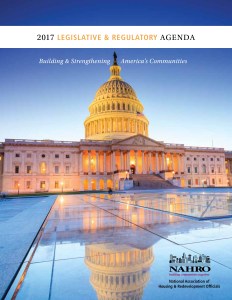
2017 Leg Agenda CoverAs the 2017 Washington Conference begins this week, we are proud to present NAHRO’s 2017 Legislative and Regulatory Agenda.

This year’s agenda builds on our previous Transition 2017, Legislative and Regulatory Year in Review – 2016 documents. It also serves as an extension of our outreach to the new Congress, which introduces NAHRO and its positions. The 2017 Legislative and Regulatory Agenda provides specific priorities and positions that will guide the NAHRO legislative and regulatory roadmap for the coming year.

This agenda is not intended to catalogue all the efforts and policies that NAHRO will actively pursue in 2017. There are many issues — including ones that may rise in priority as federal policymakers act over the course of the year — that will feature prominently in NAHRO’s efforts on behalf of its members and the communities they serve.

Our most vulnerable citizens find a safe harbor and a place to call home in the work of public housing authorities and community development agencies. NAHRO members will continue to meet the challenge of building stronger communities and ensuring that all Americans have a stable, affordable place to call home in which they can live, grow and thrive.

Please read, review, and share NAHRO’s 2017 Legislative and Regulatory Agenda, and feel free to use it to develop and coordinate your agency, local, county, state and regional legislative and regulatory advocacy plans for 2017.

New and updated legislative and regulatory information is available on the Congressional Relations and Policy & Program Development webpages on the NAHRO website and on the NAHRO Blog.

HUD Issues Notice on Temporary Census Income

On March 7, HUD issued a Notice PIH 2017-5, “Income exclusion under temporary Census employment and Census access.” The notice emphasizes the importance of accurate census data to the HUD programs and discusses how PHAs and other certain HUD grantees must handle a family’s temporary census income along with providing census workers access to buildings.

HUD regulations require temporary, sporadic, nonrecurring income not to be included in the family income calculation. The notice states, “Under this exclusion, PHAs exclude temporary income payments from the U.S. Census Bureau, defined as employment lasting no longer than 180 days per year and not culminating in permanent employment.” This provision applies to all PHAs and HUD grantees that calculate family income under 24 CFR 5.609.

This notice also reminds building managers to provide census workers access to properties. Specific mention of providing census workers access to properties with federally assisted tenants is also made in the notice.

Smoke-Free and Lead-Free HUD Rules e-Briefing – March 14

On March 14, NAHRO will host an e-Briefing on Healthy Federally Assisted Housing: Smoke-Free Public Housing and Lead-Free Housing Rules. Below is a flyer with all of the details. Register online at www.nahro.org/training-calendar.

NAHRO Healthy Housing eB Flyer

HUD Publishes PIH Notice on Limiting Payments to Influence Federal Transactions, Anti-Lobbying, and Disclosure Requirements

On March 3, HUD published PIH-2017-04 (HA) titled “Limitations on Payments to Influence Federal Transactions for PIH Programs and PHA Anti-Lobbying Certification and Disclosure Requirements.” According to this notice, PHAs are required to submit the following, if they have received over $100,000 in federally appropriated funds:

  • Certification of Payments to Influence Federal Transactions (Form HUD-50071) – for PHAs to certify that they have not and will not make prohibited payments from federally appropriated funds; and
  • Disclosure of Lobbying Activities (SF-LLL) – for PHAs that have used non-federally appropriated funds for influencing or attempting to influence executive or legislative branch personnel in connection with new funding, renewal funding, changing policy, or changing legislation.

PHAs are prohibited from using federally appropriated funds for lobbying activities. PHAs’ contributions to trade associations are not lobbying activities under this notice, nor do the certification and disclosure requirements in this notice apply to PHA contributions to trade associations. The requirements of this notice apply to all PHAs, including MTW agencies.

The notice also outlines record retention and other responsibilities of both PHAs and HUD Field Offices.

Additional information on the notice will be provided to NAHRO members in upcoming coverage.

The full notice can be found here.

Senate Confirms Dr. Ben Carson as HUD Secretary

Earlier today, the United States Senate confirmed Dr. Ben Carson as the 17th Secretary of the United States Department of Housing and Urban Development. He was confirmed on a vote of 58 to 41. NAHRO has invited Secretary Carson to speak at the 2017 NAHRO Washington Conference. NAHRO has also invited the Secretary to listen to the concerns of PHAs and RDAs as part of the countrywide listening tour he mentioned during his confirmation hearing. We look forward to working with him.

[3/3/17 Edit – HUD’s press release can be found here.]

UPCS-V Demonstration Update (February, 2017)

Earlier today, HUD held a conference call for participants of the UPCS-V Demonstration. The call provided an update of what was occurring with the Demonstration and the next steps in the process.

There are 234 agencies that are participating in the UPCS-V Demonstration. Of these, four agencies are currently doing UPCS-V inspections. Fifteen additional agencies are scheduled to begin doing UPCS-V inspections in April 2017. HUD has been gathering feedback from PHAs to improve the usability of the inspection software and has identified 39 items to improve in the software. Additionally, the protocol and decision trees are being updated from feedback from PHAs. HUD has noted that there are a limited number of electronic devices that will be available for the Demonstration and is prioritizing PHAs who need them and do not have them.

During the call, HUD noted two areas where they were looking for additional feedback. First, HUD would like feedback from landlords. They would like to hear from PHAs about landlord groups in their area. They are also looking to conduct a landlord event–possibly a call or a conference. Second, HUD will hold two IT vendor days in Phoenix, AZ and Jacksonville, FL on April 5th and April 7th respectively. They are encouraging PHAs to attend these events with their software vendors so that HUD is able to “facilitate a conversation.”

Finally, HUD shared this timeline during the update:

  • Past;
    • First PHAs completed inspections of record in January;
    • UPCS-V 2.0 released;
    • Updated software;
    • Updated decision trees;
  • Present;
    • Expand adoption of UPCS-V to larger number of PHAs;
    • In-person and WebEx training;
    • Incorporating weekly updates from weekly trainings;
  • February – June;
    • Increase the number of inspections for statistical valid sample;
    • Understanding potential challenges for PHAs;
    • Release of next version of protocol of refinement of decision trees with PHA input;
    • Continuous software user experience;
    • IT Vendor Day;
  • June – January (2018);
    • Working towards a full online training tool; and
    • Continue training PHAs and evaluating data collected from the Demonstration.

Any questions or feedback can be given to HUD at OED@hud.gov. In the past, HUD has posted a recording of the call and the accompanying slides on their OED website, within a few weeks.

Upcoming NAHRO e-Briefing on HUD Year in Review


On February 7, 2017, img_0015NAHRO will present, Moving Forward: A Review of 2016 Regulation and
Legislation
, part of NAHRO’s Housing Rules!! series.

The NAHRO Policy team will discuss
many areas that HUD and Congress addressed during 2016 and NAHRO reviewed in detail
in NAHRO’s Regulatory and Legislative Year in Review – 2016, which will provide a solid regulatory and legislative foundation as we work with the new Administration and new Congress to keep our affordable housing agenda moving forward.

Registration information for this e-Briefing and other professional development offerings is available through the NAHRO Professional Development calendar.

NAHRO’s Call for Session Proposals for the 2017 Summer Conference is Now Open.

2017-sc-banner-600x100

NAHRO’s Call for Session Proposals for the 2017 Summer Conference is now open.

Share your experience as a housing and community development professional by submitting a session proposal for consideration as a presentation at the 2017 NAHRO Summer Conference in Indianapolis, IN. We are looking for sessions on current and emerging issues, best practices, and strategies to handle challenges facing the industry.

Session proposals should fall under one of the following identified topic tracks – Public Housing, Section 8/HCV, H/CD Finance, Community Development, Commissioners, Organizational Management and International.

Deadline to submit: March 15 and proposals must be submitted thru NAHRO’s on-line submission tool.

Submissions should be complete with a clear and concise session title, description, three learning objectives and identified panelists.