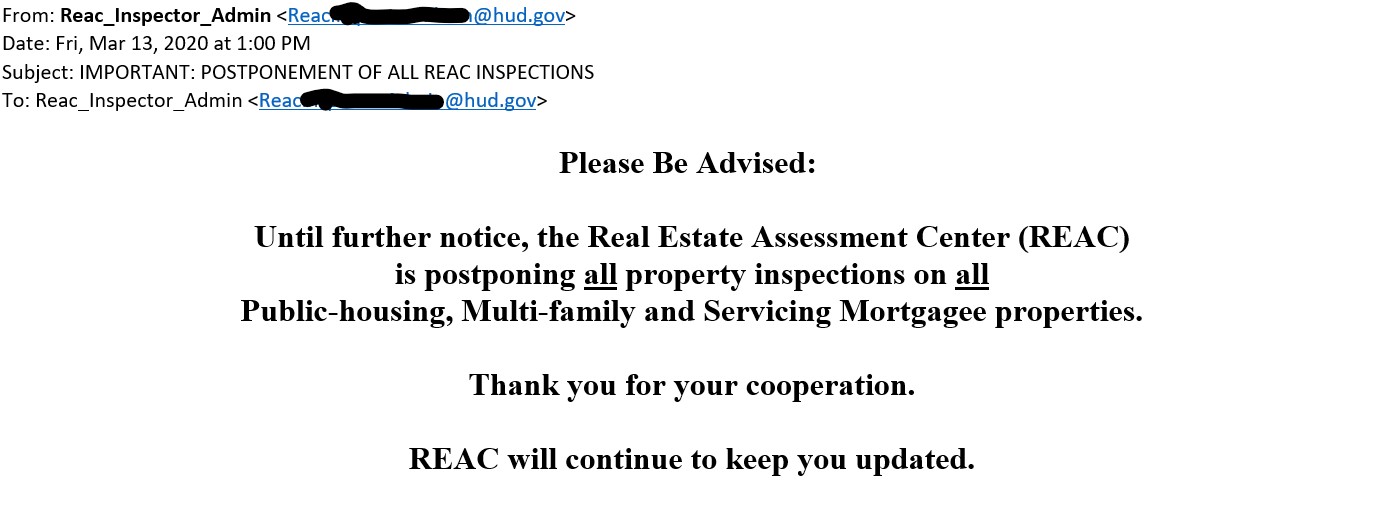
NAHRO has been informed that HUD’s Real Estate Assessment Center (REAC) has postponed all inspections for Multi-Family and Public Housing until further notice.
Below is the email the REAC sent out today.
NAHRO is maintaining a clearinghouse of COVID-19 (coronavirus) information at www.nahro.org/coronavirus and will provide additional information as warrants.
Participants do not need to register in advance, but it is strongly recommended that they join the session 15 minutes in advance of the start time (1:45 pm ET).
To join the session (at the appropriate time) click here.
The National Association of Housing and Redevelopment Officials has created a Coronavirus Resource Page with links to information and resources related to PHAs and the Coronavirus (COVID-19). The page can be found here or at the following web address:
HUD has sent letters to PHAs announcing their 2020 Capital Fund Grant awards. In order to receive their grant awards, PHAs are required to submit an ACC Amendment to HUD. Accepting this amendment does not make any changes to a PHA’s existing ACC. The 2020 ACC Amendment for the Capital Fund Grant awards doesnot incorporate any changes and is the same version of the amendment PHAs signed in 2017.
In a key victory that NAHRO fought more than a year to achieve, the FY 2020 Appropriations Act included an industry-drafted legislative pause to HUD’s attempt to change the ACC contract. The Act prohibited HUD from requiring or enforcing any changes to the terms and conditions of the ACC as a requisite for PHAs to receive funding unless the changes are mutually agreed upon by HUD and the PHA.
On February 28, HUD published Notice PIH-2020-03 titled “Public Housing Operating Fund (OpFund) Grant Eligibility Calculations and Processing for Calendar Year (CY) 2020.” The Notice provides PHAs with instructions for calculating OpFund grants for CY 2020 and establishes submission deadlines.
There are a few changes and additions included in the notice compared to CY 2019. This includes mixed finance modernization, EnVision Center participation, MTW alternative operating subsidy agencies’ submission of form HUD-52723 for CY2020 OpFund grant eligibility, and the General Depository Agreement (GDA) (form HUD-51999).
The Notice explains in detail how OpFund eligibility is calculated, the submission process, and data HUD requires to calculate OpFund grants.
Earlier today, HUD sent an email with links to fact sheets from the Centers for Disease Control and Prevention (CDC) about COVID-19 (popularly known as the coronavirus). The Department encourages PHAs to make the fact sheets available to their program participants. The fact sheets are listed below:
Last week, HUD published a notice in the Federal Register titled “Administrative Guidelines: Subsidy Layering Review for Project-Based Vouchers.” Subsidy layering reviews (SLRs) ensure that excessive public assistance is not used when combining Housing Assistance Payments (HAP) from project-based vouchers with other forms of public assistance from federal, state, or local agencies including through tax assistance or credits. Subsidy layering reviews are not required when a project is already subject to a project-based voucher (PBV) contract (even if it is recapitalized with outside funding) or when PBVs are the only assistance provided to a development. Subsidy layering requirements are required when a PBV project includes other governmental assistance. The Department and, in certain cases, the local Housing Credit Agency are the entities that conduct the review. This notice provides information about subsidy layering reviews with appendices on PHA submissions required, a sample notice of intent to participate in subsidy layering reviews by housing credit agencies, and a sample housing credit agency certification.
Tomorrow HUD will publish in the Federal Register “Economic Growth, Regulatory Relief, and Consumer Protection Act: Initial Guidance on Property Inspections and Environmental Reviews.” The act referred to in the notice is commonly call by its Senate bill number, S. 2155 and S. 2155 will be used in this post to refer to the act. NAHRO worked very closely with Congress to ensure S. 2155 provided statutory and regulatory relief to small PHAs across the country. Additionally, NAHRO also submitted comments to help guide HUD in the implementation of the provisions, many of which HUD incorporated into this notice. NAHRO is thrilled to see the critical provisions of S. 2155 being implemented!
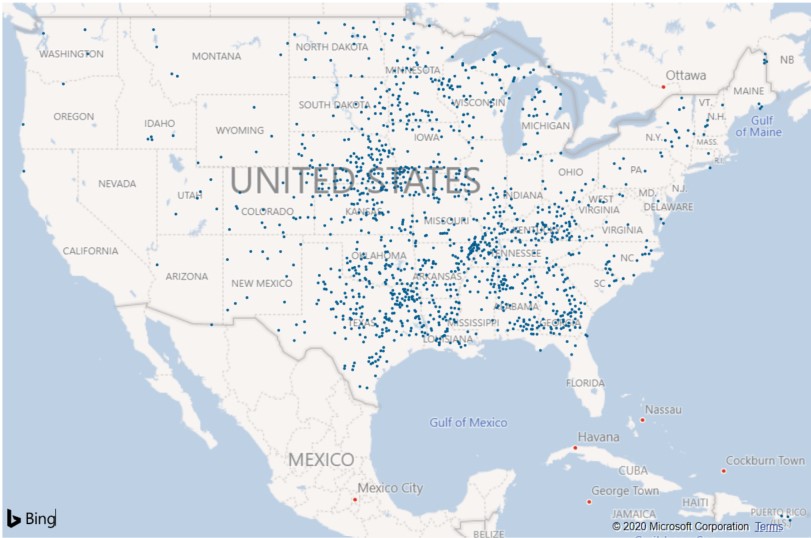
The notice also resolves a key sticking point in the implementation of S. 2155 – what is a small rural PHA? HUD defines “small rural PHA” as a PHA that operates 550 or fewer combined Public Housing and Housing Choice Voucher units and predominantly operates in a rural area. The notice takes NAHRO’s suggestions to exclude Project-Based Rental Assistance (PBRA) units in determining unit count. The notice also draws heavily on NAHRO’s comments on how to define “predominantly operates,” taking two out of three of NAHRO’s suggestions on the definition. “Predominantly operates in a rural area” is defined as having a primary administrative building with a physical address in a rural area OR more than 50 percent of its combined Public Housing units and voucher units under Section 8(o) are in a rural area. Rural area is defined by a Consumer Financial Protection Bureau regulation. Currently there are 1,519 PHAs that qualify as a “small rural PHA” under this definitions and HUD has published a list of small rural PHAs (scroll to bottom on HUD link page).
Map of Small Rural PHAs
The notice also implements potions of the property inspection and environmental review provisions of S. 2155.
Small rural PHAs that operate the Housing Choice Voucher programs can now inspect their tenant-based and project-based vouchers units every three (3) years. This new inspection schedule will begin for the small rural PHA after its next currently schedule inspection. Small rural PHAs must continue to conduct any lead safety inspection that are required under the Lead-Based Paint Poisoning Prevention Act.
Small rural PHAs will now be exempt from Environmental Reviews with respect to development or modernization projects that cost no more than $100,000. This exemption applies to any section 9(d) Capital Fund, section 9(e) Operating Fund, or section 8(o)(13) Project Based Voucher (PBV) eligible work activity by a small rural PHA at a project site with a project cost of $100,000 or less. For project with a cost of more the $100,000, the small rural PHA must complete the appropriate Environmental Review but HUD will use the rulemaking process to proposed streamlined Environmental Reviews.
NAHRO will continue to work with HUD to ensure full implementation of S. 2155, Economic Growth, Regulatory Relief, and Consumer Protection Act.

 The NAHRO Blog: Legislative & Policy Updates from Washington, DC