
On July 12, the HUD Office of Community Planning and Development (CPD) published a notice in the Federal Register announcing HUD’s intention to develop a Notice of Funding Availability (NOFA) for the Disabled and Low-Income Veterans Housing Rehabilitation and Modification Pilot Program (Program), which was authorized by the National Defense Authorization Act for Fiscal Year 2015 (Pub. L. 113–291, approved December 19, 2014), as amended. HUD is also seeking input from interested parties and stakeholders to inform the development of the NOFA so that the funds are “used efficiently and fulfill the statutory purpose.” Continue reading
Veterans
CDBG Impact Story in Fort Collins, Colorado
During National Community Development Week, April 17-22, NAHRO celebrates the hard work of communities across the country by sharing Community Development Block Grant (CDBG) and HOME Investment Partnerships Program (HOME) impact stories, highlighting the importance of these federal affordable housing and community development programs at the local level.
| Project Name | Redtail Ponds Permanent Supportive Housing
|
| Location | Fort Collins, Colorado |
| District | CO-02 |
| Project Year | 2015 |
| Project Description | Redtail Ponds is a 4-story permanent supportive housing (PSH) development that offers 60 apartments for people with disabilities who have experienced homelessness. Multiple support services for those with substance abuse or mental health issues are located on site to help people gain stability in their lives. In a recent press coverage for the development, the columnist appropriately refers to Redtail Ponds as a “window of hope” since this award winning development demonstrates that “the best thing to be done for the homeless is not soup or pallets on a barren floor, but a place to assemble one’s life in peace.” In addition to apartments, Redtail Ponds features a community kitchen, fitness area, computer room, community garden and several common areas for residents to congregate. |
| Use of CDBG Funds | Construction of housing |
| Target Population | Homeless with disabilities and veterans with disabilities |
| CDBG Funds | $1,391,077 |
| Other Funds | Leveraging: LIHTC Equity Investment, Colorado Division of Housing, Colorado Housing and Finance Authority Mortgage. |
| Jobs Created | 40 jobs |
| Project Impact | With its inspiring scenic view of the snow-covered Front Range, this project has provided homes for 60 residents, from 19-80 years old, including 22 veterans. After one year, 95% of the residents remained stably housed, 14 enrolled in employment training and 12 rejoined the workforce.
Quote from a beneficiary: “When I came here and saw my apartment, I cried. I felt like I had gone from being a pauper to a princess virtually overnight. The majority of us here now have become like a family to each other. We care about each other. I have a send of joy and family that I was lacking.” –Cheryl |
| Contact | Housing Catalyst |

Report: Homelessness in the U.S. Continues to Decline
Earlier this week, HUD published Part 1 of the 2016 Annual Homeless Assessment (AHAR) Report, providing Congress with local estimates of sheltered and unsheltered persons experiencing homelessness on a single night in January 2016. According to the report, on a single night in 2016, there were 549,928 persons experiencing homelessness – a 14 percent decrease from 2010 and a 3 percent decrease over the past year. This decline was especially prevalent among families with children, Veterans, and individuals with long-term disabling conditions. Despite the downward trend of homelessness nationally, 13 states and the District of Columbia still saw an increase in their share of homelessness between 2015 and 2016.
The AHAR is typically released in two parts: Part 1 provides Point-in-Time (PIT) estimates that offer a “snapshot” of homelessness as reported by Continuums of Care (CoCs) across the U.S.; Part 2 offers in-depth detail on the characteristics of the homeless. The PIT methodology is regarded as a reliable estimate of the general size of the homeless population; however, it is important to note that it does not count every single homeless person, nor does it measure the number of people who are at risk of homelessness.
****
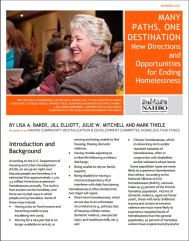
NAHRO members have long been on the front lines of preventing and ending homelessness. Read this recent NAHRO white paper to learn about public housing authority (PHA) collaborations and new directions and opportunities for ending homelessness.Case studies include: effectively ending veteran homelessness in Houston, Texas; implementing medical respite to save lives and reduce costs in Fargo, North Dakota.; and using a model for working with the chronically homeless in encampment settings by the City of West Sacramento, Yolo County, California.
 The NAHRO Blog: Legislative & Policy Updates from Washington, DC