HUD Publishes Lead-Based Paint Proposed Rule

(9/6/16 Update: The published Federal Register notice can be found here. Comments are due by October 31, 2016.)

Tomorrow, HUD will publish its lead-based paint proposed rule titled “Requirements for Notification, Evaluation and Reduction of Lead-Based Paint Hazards in Federally Owned Residential Property and Housing Receiving Federal Assistance; Response to Elevated Blood Lead Levels” in the Federal Register. While NAHRO is still in the process of doing a deeper dive into the proposed rule, here are some of the core requirements being proposed.

  • Program Scope –  The proposed rule will apply to the following 5 sets of programs:
    • Project-Based Assistance Provided by non-HUD Federal Agencies;
    • Project-Based Assistance;
    • HUD-owned and Mortgagee-in-Possession Multifamily Property;
    • Public Housing Programs; and
    • Tenant-Based Rental Assistance.
  • Effective Date –  HUD is considering an effective date of 6 months after publication of the final rule, but is also looking at time periods of either 1 year or 1 month.
  • Elevated Blood Lead Level –  The rule proposes to revise the Lead Safe Housing Rule (LSHR) to adopt the Centers for Disease Control and Prevention’s (CDC’s) approach to establishing a blood lead level for which the CDC recommends environmental intervention. Currently, CDC guidance defines Elevated Blood Lead Level (EBLL) in children under age 6 to be “based on the blood lead level equaled or exceeded by 2.5 percent of U.S. children aged 1 – 5 years.” The current reference range level is 5 or more micrograms per deciliter of lead in the blood. As the CDC is “tying the reference value to the national distribution of blood lead levels, the reference level will continue to decrease whenever progress is made on reducing childhood lead exposure.”
  • Inspection, Evaluation, and Control Activities –  Depending on the program, lead-based paint inspections, inspections for deteriorated paint, and risk assessments including dust-wipe sampling and soil sampling may be required.
  • Abatement Measures –  Public Housing must perform abatement measures to eliminate lead-based paint or lead-based paint hazards during comprehensive modernization.
  • Interim controls and Paint Stabilization –  Depending on the program, additional interim controls (measures designed to reduce temporarily human exposure or likely exposure to lead-based paint hazards) or paint stabilization (repairing physical defects and applying a new coating of paint) may be required.
  • Response to Young Children with Elevated Blood Levels –  If a child under 6 has an elevated blood lead level, the owner or other entity must follow a designated protocol (same for all programs, except non-HUD project-based assistance, for which it is narrower) including:
    • Conducting an environmental investigation;
    • Conducting interim control – measures designed to reduce temporarily human exposure or likely exposure to lead-based paint hazards;
    • Controlling other housing-related sources of lead exposure; and
    • Encouraging occupants to address other non-housing related lead exposure sources.
  • Other units –  If the unit where the child resides is in a building or development with other assisted dwelling units covered by the rule, the owner or other entity must provide documentation to the HUD field office that the owner or other entity has complied with the evaluation requirements. If there is no documentation of compliance with the evaluation requirements, the owner or other entity must conduct a risk assessment and conduct interim controls or conduct a visual assessment and paint stabilization–depending on the program.
  • Comments –  HUD has 4 questions for comment each with subparts.

NAHRO will continue to read and analyze this rule and will provide additional, deeper coverage to its members. Comments will be due 60 days after publication in the Federal Register.

The pre-publication proposed rule can be found here.

HUD’s Press Release on the rule can be found here.

GAO Publishes Report on HUD Management

On August 19, the United States Government Accountability Office (GAO) made publicly available a report it wrote for congressional requesters. The report found that HUD has “not consistently incorporated requirements and key practices  identified by GAO to help ensure effective management into its operations.”

The report identified five management functions and discusses how completely HUD implemented prior GAO recommendations. Selected excerpts can be found below:

Performance planning and reporting – “HUD met most of the requirements in the GPRA Modernization Act of 2010 for its strategic plan and annual performance plan and report . . . [b]ut HUD’s strategic plan does not clearly link HUD’s goals and objectives with federal priority goals.”

Information technology management – “HUD has not demonstrated that it has the capacity to effectively plan for and manage IT projects.”

Human capital management – “HUD has made progress in developing new human capital plans and mostly followed key principle and practices for strategic workforce planning, succession planning, and training planning.”

Financial management – “HUD did not follow seven of eight key practices for financial management.”

Acquisition management – “HUD partially followed key practices for acquisition relating to organizational alignment and human capital.”

The report recommends that HUD take the following eight actions:

  1. Link HUD’s goals and objectives with federal priority goals;
  2. Describe why HUD’s goals were not met and HUD’s plans for achieving them;
  3. Establish procedures and time frames to reach out to Congress and stakeholders to ensure that the strategic plan meets statutory requirements;
  4. Establish a process and schedule to review and update HUD’s human capital strategic plan; strategic workforce plan; and succession plan;
  5. Establish a process and schedule to update policies and procedures to help ensure that policies and procedures for key management functions remain current and complete;
  6. Formalize lines of communication between the Chief Information Officer and the agency head;
  7. Designate entities within program offices for fraud risk management activities; and
  8. Develop written policies for conducting program evaluations.

Thanks to PHADA for bringing this report to our attention.

The full report can be found here. The PDF can be found here.

The highlights page can be found here.

NAHRO meets with HUD PIH Leadership

Georgi John HUD 16-8-9

NAHRO’s Acting CEO, John Bohm, and the NAHRO Policy Team members; Georgi Banna, Eric Oberdorfer and Tushar Gurjal; along with PHADA and CLPHA met with HUD’s Public and Indian Housing Principal Deputy Assistant Secretary (PDAS), Lourdes Castro-Ramierz, and many of the PIH department leadership.

Among the topics discussed were the priorities for implementing the Housing Opportunities Through Modernization Act (HOTMA/HR 3700); upcoming HUD rules such as Smoke-Free Housing, Small Area Fair Market Rents (SAFMRs), HCV Administrative Fee Formula; Moving to Work (MTW) Expansion; and Triennial Recertifications; and the current priorities of NAHRO, PHADA, CLPHA and HUD. NAHRO and CLPHA were also thanked for their current and continued work in affordable housing and education and the improvement of educational outcomes for the children our members serve.

NAHRO is committed to keeping open and productive lines of communication and will continue to share the thoughts and concerns of our members with HUD.

New CRS Report on Federal Spending Trends

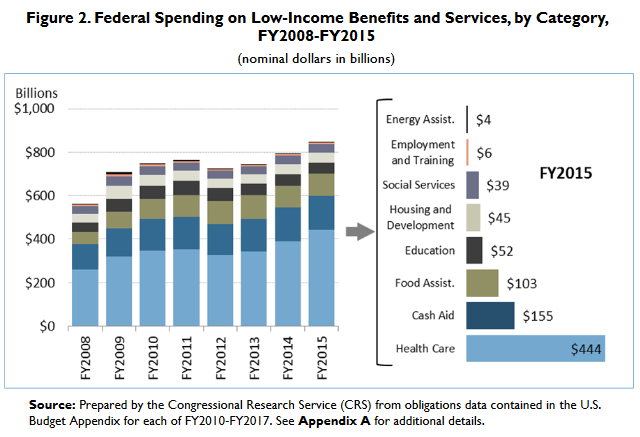
The Congressional Research Service recently created a report titled “Federal Benefits and Services for People with Low Income: Overview of Spending Trends, FY2008-FY2015.” The report is the latest in a series that attempts to identify and discuss programs and services oriented toward low-income populations, while focusing on aggregate spending trends.

The report contains some interesting charts that show how spending on housing compares to other categories of federal spending. The chart below from page 6 of the report shows spending by category. Notice that health care spending dwarfs the other categories, while “housing and development” is in the middle.

Federal-Spending-Chart-FY2015-CRS-Report

Read the full report here.

HUD Offering $2 million in ROSS Grants to Help Students Navigate College and Continuing Education Financial Aid Assistance

On August 2, HUD announced $2 million in grants to “help low-income families and young people apply for federal aid for college and other post-secondary educational opportunities.” The program is being funded through the Resident Opportunities and Self Sufficiency (ROSS) Program. The program will allow up to six public housing agencies (PHAs) to support “Education Navigators.”

HUD’s ROSS for Education Program is known as Project SOAR (Students + Opportunities + Achievements = Results).  It will “support hundreds of young people between the ages of 15 – 20 to apply for [the] U.S. Department of Education’s Free Application for Federal Student Aid (FAFSA).” HUD is also working with the Department of Education to share data about FAFSA completion and is working with the White House’s Social and Behavioral Sciences Team to develop methods to increase completion rates of the FAFSA among students with housing assistance.

Read HUD’s full press release here.

Read HUD’s Notice of Funding Availability (NOFA) here.

Read more about how behavioral economics can be used to “nudge” applicants receiving housing assistance to seek Federal Student Aid here.

MTW Expansion Committee Conference Call and Summary of Policies

As mentioned in a prior blog post, the Moving to Work (MTW) Expansion Committee Conference Call is occurring now [Edit: The call ended at 4 pm]. HUD has also posted a summary of the policy proposals it has received to be potentially studied in MTW cohorts. Here are the numbers to call in:

  • United States –  (800) 230-1766;
  • Outside the United States – (612) 288-0329; and
  • Persons with hearing impairments – (800) 977-8339 and providing the FRS operator with the conference call toll-free number: (800) 230-1766.

The call is until 4 pm today. The next call will be at the following time:

  • July 28, 2016 – Cost-Effectiveness and Incentives to Increase Self-Sufficiency for Families with Children (1 pm to 4 pm).

Read the summary of policy proposals here.

HUD Revises Schedule for PHA Operating Subsidy Revisions

On July 20, HUD released an updated PIH Notice 2016-10 REV.1 “Public Housing Operating Subsidy Eligibility Calculations for Calendar Year 2016” that contains the 2016 Revision Schedule for the HUD-52723 (Opfund Subsidy) and HUD 52722 (UEL). The revised notice contains the revised schedule for the submission of PHA revisions. The time period for PHA submission of revisions has been extended for PHAs.

2016 Revisions Schedule:

Items: Finish lines:
PHA revisions due to FOs. 8/15/2016, COB Mon., Aug 15th
FOs due to FMD 8/29/2016, COB Mon., Aug. 29th
FMD publishes Final Eligibility Report 9/28/2016, COB Wed., Sept. 28th
Final Obligations before Nov. 1st 11/1/2016, COB Mon. Oct. 31

The revised PIH notice is available on the NAHRO Public Housing Resource Center (Login Required) and the HUD website.

PAHRC Releases “Housing is a Foundation” 2016 Report

Today, July 20, PAHRC released its yearly research report for 2016 titled “Housing is a Foundation.” This year’s report focuses on the lack of available housing assistance, the people who receive housing assistance, and the beneficial impacts of housing assistance. The report supplies data to “foster a better understanding of the need for housing assistance and how this assistance helps meet the needs of low-income families and their communities.”

Here’s a great graphic on how helpful rental assistance is on all facets of a household.

https://www.housingcenter.com/sites/default/files/styles/panopoly_image_full/public/general/Summary.png?itok=lOA8Moub

The full report can be read here.

NAHRO Publishes New RAD Toolkit

Last week, NAHRO published the “RAD Toolkit,” a new online resource that serves as a primer for PHAs interested in HUD’s Rental Assistance Demonstration (RAD) program. This educative tool will provide PHAs with a background on RAD, a step-by-step outline of the conversion process and compliance, as well as links to additional resources important to understanding how to close a RAD transaction.

The RAD Toolkit was developed by the NAHRO Community Revitalization and Development (CR&D) Committee Redevelopment Task Force.

NAHRO members can access the toolkit here: www.nahro.org/RAD.

RADTOOLKIT2

MTW Research Advisory Committee – Conference Calls

The Moving to Work (MTW) Research Advisory Committee will be holding two public conference calls. The MTW Research Advisory Committee will advise HUD on how to move forward with the MTW expansion, especially with respect to specific policies to test in the expansion. The calls are open to the public, but members of the public must register to provide comment.

The calls are at the following dates and times [edit: the calls are until 4 pm; previously this post stated they were until 3 pm]:

July 26, 2016 – Increasing Housing Choice for Low-Income Families (1 pm to 4 pm); and

July 28, 2016 – Cost-Effectiveness and Incentives to Increase Self-Sufficiency for Families with Children (1 pm to 4 pm).

Use the following numbers to call-in:

  • United States –  (800) 230-1766;
  • Outside the United States – (612) 288-0329; and
  • Persons with hearing impairments – (800) 977-8339 and providing the FRS operator with the conference call toll-free number: (800) 230-1766.

To register, please click here.

Additional information on the call agendas can be found here.

Our prior blog post on these calls can be found here.