Report: Homelessness in the U.S. Continues to Decline

Earlier this week, HUD published Part 1 of the 2016 Annual Homeless Assessment (AHAR) Report, providing Congress with local estimates of sheltered and unsheltered persons experiencing homelessness on a single night in January 2016. According to the report, on a single night in 2016, there were 549,928 persons experiencing homelessness – a 14 percent decrease from 2010 and a 3 percent decrease over the past year. This decline was especially prevalent among families with children, Veterans, and individuals with long-term disabling conditions. Despite the downward trend of homelessness nationally, 13 states and the District of Columbia still saw an increase in their share of homelessness between 2015 and 2016.

The AHAR is typically released in two parts: Part 1 provides Point-in-Time (PIT) estimates that offer a “snapshot” of homelessness as reported by Continuums of Care (CoCs) across the U.S.; Part 2 offers in-depth detail on the characteristics of the homeless. The PIT methodology is regarded as a reliable estimate of the general size of the homeless population; however, it is important to note that it does not count every single homeless person, nor does it measure the number of people who are at risk of homelessness.

****
paperphoto

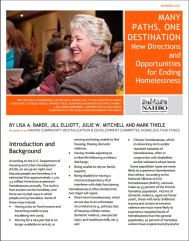
NAHRO members have long been on the front lines of preventing and ending homelessness. Read this recent NAHRO white paper to learn about public housing authority (PHA) collaborations and new directions and opportunities for ending homelessness.Case studies include: effectively ending veteran homelessness in Houston, Texas; implementing medical respite to save lives and reduce costs in Fargo, North Dakota.; and using a model for working with the chronically homeless in encampment settings by the City of West Sacramento, Yolo County, California.

HUD Final Rule Provides Expanded Housing Protections for Survivors of Violence

Today, HUD published a final rule in the Federal Register that provides expanded housing protections for survivors of violence and fully codifies the provisions of the Violence Against Women Reauthorization Act of 2013 (VAWA 2013) into HUD’s regulations. At its core, VAWA 2013 prohibits housing providers from denying or terminating housing assistance on the basis that an applicant or tenant is a survivor of violence.

The rule’s regulations become effective on December 16, 2016, and compliance with the rule with respect to completing an emergency transfer plan and providing emergency transfers, and associated recordkeeping and reporting requirements, is required no later than June 14, 2017.

Read more about the rule’s provisions in our blog post, published last month. A more in-depth analysis of the rule is also available in the NAHRO Monitor (members only).

[Note: After the final rule’s publication, HUD discovered an incorrect compliance date in the rule’s preamble, with respect to completing an emergency transfer plan and providing emergency transfers, and associated recordkeeping and reporting requirements. The compliance date was incorrectly listed as May 15, 2017, while the regulatory text provided the correct date of June 14, 2017. This blog post has been updated to reflect the correct compliance date of June 14, 2017]

HUD Publishes Notice on the Modernization of the Housing Opportunities for Persons With AIDS Program

Last week, HUD published new guidance (notice CPD-16-17) for Housing Opportunities for Persons With AIDS (HOPWA) grantees explaining the changes to the HOPWA program  that resulted from the passing and signing of the Housing Opportunity Through Modernization Act (HOTMA) on July 29, 2016. The passage of HOTMA was a huge victory for NAHRO and its members because it provided housing authorities with the effective tools and mechanisms to improve the operation of their programs. The new law also provided long-awaited amendments to the HOPWA statue that modernizes the program’s allocation formula, and addresses administrative provisions and adds program definitions. HUD’s new notice describes how the HOTMA provisions will effect HOPWA formula allocations for FY 2017 and beyond. The notice also details the program changes that became effective on July 29, 2016 versus the program changes that must be implemented by HUD through future rulemaking.

Learn more about the modernization of the HOPWA program in next edition of the NAHRO Monitor – available November 15, 2016 (members only).

HUD Extends AFH Submission Deadline for Small Local Governments

On October 24, HUD published a notice in the Federal Register announcing the extension of the initial Assessment of Fair Housing (AFH) submission deadlines for small consolidated plan program participants that received a Community Development Block Grant (CDBG) of $500,000 or less in Fiscal Year (FY) 2015 or in a subsequent FY; or in the case of a HOME consortium, whose members collectively received a CDBG grant of $500,000 or less.

Previously, HUD established the first AFH due date for small consolidated plan program participants to be 270 days (approximately 9 months) before the program year for which a new 3-5 year Consolidated Plan is due, starting on or after January 1, 2018. HUD is now extending the initial due date to 270 days before the program year which a new 3-5 year Consolidated Plan is due, starting on or after January 1, 2019 – the same date that qualified public housing agencies (QPHAs – PHAs with a combined unit total of 550 or less) are required to submit their AFHs.

Learn more about HUD’s Affirmatively Furthering Fair Housing (AFFH) Final Rule and subsequent AFH requirements for states, local governments, and PHAs by accessing NAHRO’s AFFH Resource Page (members only).

HUD Family Options Study: HCV Most Effective and Rapid Re-Housing Least Costly

On October 25, HUD’s Office of Policy Development and Research (PD&R) released a report titled Family Options Study: Long-Term Impacts of Housing and Services Interventions for Homeless Families, which seeks to identify the most efficient and cost-effective way to house and serve homeless families with children.capture

The report presents the long-term (37 months) outcomes of HUD’s Family Options Study, which tracked how homeless families in emergency shelters across 12 U.S. communities responded to various homelessness interventions. Between September 2010 and January 2012, over 2,000 families were enrolled and randomly assigned to participate in one of four homelessness interventions: housing subsidy, community-based rapid re-housing, project-based transitional housing, and usual care (defined as any housing or services that a family accesses in the absence of immediate referral to the other interventions).

The study found long-term housing subsidies, typically Housing Choice Vouchers, had the greatest impact on reducing family homelessness and improving non-housing family outcomes (i.e., increased adult well-being, child well-being, food-security, and less economic stress). While not as effective as housing vouchers, rapid re-housing programs were significantly less expensive, with an average per-family monthly cost of approximately $800, compared to voucher at $1,172/month, transitional housing at $2,700/month and emergency shelter programs at $4,800/month.

Read more about HUD’s study and findings here.


HUD Finalizes Rule to Expand Housing Protections for Survivors of Violence

On October 24, HUD announced the impending publication of a final rule that will expand the housing protections for victims of  domestic violence, dating violence, sexual assault, and stalking (hereinafter known as “victim”) regardless of sex, gender identity, sexual orientation, or age. The final rule will fully codify the provisions of the Violence Against Women Reauthorization Act of 2013 (VAWA 2013) into HUD’s regulations.

At its core, VAWA 2013 prohibits housing providers from denying or terminating housing assistance on the basis that an applicant or tenant is a victim. HUD’s final rule expands the universe of HUD rental assistance programs subject to the VAWA 2013 statute beyond Public Housing and Section 8 programs to also include:

  • Housing Trust Fund (HTF) – a program originally not listed under VAWA 2013;
  • HOME Investment Partnerships (HOME) program;
  • Housing Opportunities for Persons With AIDS (HOPWA) program;
  • HUD’s McKinney-Vento Homeless programs;
  • Section 811 Supportive Housing for Persons with Disabilities;
  • Section 202 Supportive Housing for the Elderly;
  • Section 221(d)(3) Below Market Interest Rate (BMIR) Program
  • Section 236 Rental Program

These programs, along with properties assisted through the USDA Rural Housing programs and the Low-Income Housing Tax Credit program, are collectively referred to as “covered housing programs.”

Overall, HUD’s final rule:

  • Codifies the core protections under VAWA 2013 across HUD’s covered programs by ensuring survivors are not denied assistance as an applicant, or evicted or have assistance terminated due to the individual’s victim status, or for being affiliated with a victim.
  • Provides a model emergency transfer plan for housing providers and explains how housing providers must address their tenants’ requests for emergency transfers.
  • Offers protections against the adverse effects of abuse that can often have negative economic and criminal consequences on a survivor. For example, a perpetrator may take out credit cards in a survivor’s name, ruining their credit history. Covered housing providers may  not deny tenancy or occupancy rights based solely on adverse factors that are a direct result of being a survivor.
  • Makes clear that under most circumstances, a survivor need only to self-certify in order to exercise their rights under VAWA, there by “ensuring third party documentation does not cause a barrier in a survivor expressing their rights and receiving the protections needed to keep themselves safe.”

HUD’s final rule is currently pending publication in the Federal Register. Once published, the rule’s regulations will become effective after 30 days.

An in-depth analysis of the final rule can be found in the October 30, 2016 edition of the NAHRO Monitor (members only).


HUD Awards $500 Million in Disaster Recovery Funds; Pledges Expedited Assistance for Southern States

Last week, HUD Secretary Julian Castro awarded $500 million in Community Development Block Grant Disaster Recovery (CDBG-DR) funds to Louisiana, Texas and West Virginia to help recover from severe flooding earlier this year. These recovery funds will help the most impacted counties that experienced the greatest level of damage to their housing stock. CDBG-DR grants can provide support for housing redevelopment, business assistance, and infrastructure repair.

According to HUD’s press release, “[i]n the hardest-hit counties of Louisiana (6 counties), Texas (3 counties), and West Virginia (2 counties), more than 102,000 households experienced some level of damage to their homes including more than 41,000 families who saw the most serious level of damage or destruction and unmet needs.” The following allocations of funds are based on each state’s proportional share of serious unmet housing needs:

Grantee
Amount
State of Louisiana
$437,800,000
State of Texas
$45,200,000
State of West Virginia
$17,000,000
TOTAL
$500,000,000

Also last week, Secretary Castro announced that HUD will expedite assistance to the States of North Carolina, Florida, and Georgia to address the impacts of Hurricane Matthew. The Department will help by: assisting the affected states and local governments in re-allocating existing federal resources toward disaster relief; granting immediate foreclosure relief; making mortgage insurance available; making insurance available for both mortgages and home rehabilitation; offering Section 108 loan guarantee assistance; and providing information to FEMA and the State on housing providers that may have available units in the impacted counties.

Five HOTMA Self-Implementing Provisions

On September 26, Principal Deputy Assistant Secretary Lourdes Castro Ramirez sent an e-mail to PHA executive directors identifying the self-implementing provisions of the Housing Opportunity Through Modernization Act of 2016 (HOTMA). All the other Housing Choice Voucher or Public Housing provisions will require HUD promulgated notices or regulations.

Five HOTMA Self-Implementing Provisions

  1. Reasonable Accommodation Payment Standards – PHAs may establish, without HUD approval, a payment standard of up to 120 percent of the Fair Market Rent (FMR) as a reasonable accommodation for a person with a disability. The Streamlining Rule already provided this flexibility.
  2. Establishment of Fair Market Rent
    1. HUD may publish FMRs directly to their website, skipping the Federal Register, but must publish a notice in the Federal Register that they are published. Changes how interested stakeholders comment on FMRs and requests that HUD reevaluate the FMRs in a jurisdiction before those rents become effective.
    2. PHAs will no longer be required to reduce payment standards as a result of a FMR reduction for families continuing to reside in a unit under a housing assistance payment (HAP) contract at the time of the FMR reduction. The regulation at 24 CFR 982.505(c)(3) requiring the new decreased payment standard be applied to program participant families at their second regular reexamination is no longer applicable. PHAs must “adopt policies in their Administrative Plans that further explain this provision.” HUD will issue additional guidance in the future.
  3. Family Unification Program (FUP) for Children Aging out of Foster Care
    1. FUP-eligible youth may receive FUP assistance up to 36 months. Applies to current as well as new FUP-assisted youth.
    2. Expands eligibility requirements for FUP-eligible youth. Expanded eligibility applies to the following:
      1. Youth aged  18 to 24 that are homeless or at risk of being homeless, and
      2. for those that left foster care at age 16 or older, or those that are within 90 days of leaving foster care.
    3. “At risk of being homeless” is defined at 24 CFR 576.2.
  4. Preference for U.S. Citizens or Nationals in Guam – Only applies to Guam. Establishes a preference for U.S. Citizens or Nationals in receiving financial assistance.
  5. Exception to PHA Resident Board Member Requirement – provides an exception for certain jurisdictions from resident board member requirements. Provision has been in effect through multiple appropriations acts.

HUD Finalizes Rule on Equal Access for Transgender People in CPD Programs

On September 21, 2016, HUD will publish a final rule titled “Equal Access in Accordance with an Individual’s Gender Identity in Community Planning and Development Programs” in the Federal Register. The final rule, which builds upon HUD’s February 2012 Equal Access Rule, will add a new section to HUD’s general program regulations (24 CFR Part 5) requiring HUD CPD program recipients and subrecipients to provide transgender persons and other persons who do not identify with the sex they were assigned at birth with access to program benefits, services and accommodations in accordance with their gender identity.

The final rule will also amend HUD’s definition of “gender identity” so that it more clearly reflects the difference between actual and perceived gender identity and eliminate the current prohibition on inquiries related to sexual orientation or gender identity. Additionally, the final rule makes a technical amendment to the definition of “sexual orientation” to conform with the Office of Personnel Management’s current definition.

Elsewhere in the Federal Register, HUD will be requesting public comment on a proposed document entitled “Equal Access Regardless of Sexual Orientation, Gender Identity, or Marital Status” for owners or operators of CPD-funded shelters, housing, facilities, and other buildings to post on bulletin boards and in other public spaces where information is typically made available.

A link to the proposed document, as well as deeper analysis of the final rule, will be forthcoming for NAHRO members.


SAFMR Demonstration Evaluation and Section 8 Eligibility of Students Guidance

Tomorrow, HUD will publish in the Federal Register two notices dealing with the Housing Choice Voucher (HCV) program. The first is a proposed information collection highlighting a series of interviews for landlords and tenants in areas served by the five PHAs that participated in the Small Area Fair Marker Rents (SAFMR) Demonstration. The second is guidance for the rule that excludes certain individuals enrolled in an institution of higher education from receiving Section 8 funds.

  • Small Area Fair Market Rent Demonstration – HUD is evaluating the SAFMR demonstration. To assist in this evaluation, HUD is looking at how “voucher holders and landlords perceive the shift from traditional area-wide FMRs to SAFMRs.” HUD will interview 70 tenants and 35 landlords in the areas served by the five PHAs in the SAFMR demonstration.
  • Eligibility of Independent Students for Assisted Housing Under Section 8 of the U.S. Housing Act of 1937; Additional Supplementary Guidance – Prior appropriations acts stated that if a college student “is under the age of 24, is not a veteran, is unmarried and does not have dependent child” or is ineligible or has at least one parent that is ineligible for assistance, then no Section 8 assistance can be provided for that student. This notice updates the list of items that PHAs, owners, and managers “are required to verify when determining whether a student’s income alone should be used to determine Section 8 eligibility.” The notice also reduces “barriers for vulnerable youth to receive assistance and continue their education.”

The SAFMR Demonstration pre-publication notice can be found here.

The Eligibility of Independent Students for Section 8 Assistance Guidance pre-publication notice can be found here.