HUD Adds New Requirements to Consolidated Planning

Today, the HUD Office of Community Planning and Development (CPD) published a final rule that will “modernize” the consolidated planning process (24 CFR 91) for CPD formula grantees. The rule adds the concepts of broadband access and vulnerability to natural hazard risks to the Consolidated Plan’s existing housing market analysis. According to HUD, this rule seeks to “promote a balanced planning process that more fully considers the housing, environment, and economic needs of communities.”

Under the new rule, States and local governments must analyze the broadband needs (i.e., broadband wiring and connection to broadband service in the household unit, or the need for additional broadband Internet service providers to increase competition) of housing occupied by low- and moderate-income (LMI) households, including housing in rural areas. The rule also requires States and local governments to assess the vulnerability of housing units occupied by LMI households to increased natural hazard risks, particularly risks associated with climate change.

HUD does not expect the new regulations to result in significant additional expenses and administrative burden to jurisdictions since the requirements are similar to existing planning requirements, and the data necessary is readily available on the internet. HUD plans to input data for both broadband and resilience assessment requirements within the Consolidated Plan pre-populated data tables for use by jurisdictions, though jurisdictions can opt to use other data of their choice. HUD will provide grantees with this data early in Fiscal Year 2018.

Compliance with the requirements of the final rule will apply to Consolidated Plans submitted on or after January 1, 2018. Additional coverage of this final rule will available in the forthcoming edition the NAHRO Monitor (members only).

HUD Forms that Provide Expanded Housing Protections for Survivors of Violence Now Available

As NAHRO previously reported, HUD recently finalized a rule that will provide expanded housing protections for survivors of violence and fully codifies the provisions of the Violence Against Women Reauthorization Act (VAWA) of 2013 into HUD regulations.

HUD has made available the relevant forms necessary under the new rule:

  • Notice of Occupancy Rights under VAWA  (HUD-5380) that certain housing providers must give to tenants and applicants to ensure they are aware of their rights under VAWA and these implementing regulations;
  • New Certification form  (HUD-5382) for documenting incidents of domestic violence, dating violence, sexual assault, and stalking that must be used by housing providers;
  • Model emergency transfer plan (HUD-5381) that may be used by housing providers to develop their own emergency transfer plans; and
  • Model emergency transfer request form (HUD-5383) that housing providers could provide to tenants requesting an emergency transfer under these regulations.

HUD is currently translating these forms into 8 main language.

The final rule become effective on December 16, 2016 and housing providers must now include the Notice of Occupancy Rights and the new certification form with future denials or admissions of assistance notices and future eviction or termination of assistance notices.

Additionally, housing providers have until December 16, 2017 to provide existing tenants with the Notice of Occupancy Rights and the new certification form (via the annual recertification or lease renewal process, or through other means). Compliance with the final rule’s emergency transfer provisions is required no later than June 14, 2017.

Read more about HUD’s implementation of VAWA 2013 in the October 31, 2016 edition of the NAHRO Monitor (members only).

HUD Issues New Certification Requirements for Housing Counselors

On December 14, HUD issued a final rule titled “Housing Counseling Certification” that codifies statutory requirements that housing counseling required under or provided in connection with all HUD programs will be provided by HUD-Certified Housing Counselors. In order to become certified, housing counselors must pass a standardized written examination and work for a HUD-approved housing counseling agency (HCA). The goal of these new requirements is to improve the knowledge and effectiveness of housing counselors that serve HUD-assisted renters, prospective homebuyers, or existing homeowners.

The final compliance date for the certification requirement is three years after the date the certification examination becomes available. HUD will publish a separate Federal Register notice to announce the start of the testing and certification process. However, some of the provisions of the final rule will become effective on January 13, 2017, including:

  • Requirement for agencies that provide homeownership counseling,
  • Requirement related to distribution of home inspection materials,
  • Provision for agencies found to have misused housing counseling program grant funds, and
  • Prohibition against distribution of funds to organizations convicted of violating election laws.

Access HUD’s resource page on the final rule here.

It is important to note that this new rule now covers not only participants in HUD’s Housing Counseling Program but also participants in other HUD programs including HOME Investment Partnerships, Community Development Block Grant, Public and Indian Housing, and FHA Single Family. Covered stakeholders will have three years from the date the certification examination becomes available to comply with the housing counselor certification requirement. A resource sheet for other HUD programs covered under this final rule is available here.

Additional coverage of the final rule will be available in the forthcoming edition of the NAHRO Monitor (members only).

Five Communities Awarded $132 Million in Choice Neighborhoods Grants

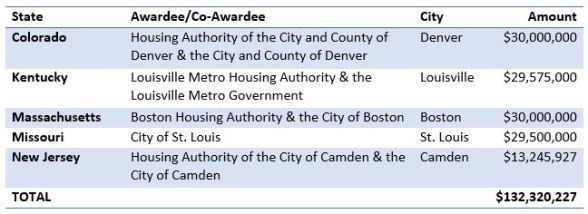
On December 12, HUD announced that five U.S. communities will receive a combined total of $132 million in FY 2016 Choice Neighborhoods Initiative (CNI) grant funds. The goal of the CNI is to aid struggling communities with severely distressed public housing or HUD-assisted housing by reinvesting in the community’s housing, residents, and neighborhoods.

These five communities will receive funding under the CNI’s Implementation Grant component, which supports communities that are ready to implement their neighborhood revitalization plan, or “Transformation Plan.” All five awardees are also past Choice Neighborhoods Planning Grant recipients.

The following communities will receive Implementation Grants:

cni-2016-awards

According to HUD’s press release, the awardees will replace 1,853 severely distressed public housing units with nearly 3,700 new mixed-income, mixed-use housing units, and leverage every $1 in Choice Neighborhood funding with an additional $5 in public and private funding for their project proposals. Together, the awardees and their partners are expected to leverage a combined total of $636 million through other public/private sources and indirectly stimulate another $3.3 billion in their local economies.

Read a summary of each grants here.


Early Lessons Learned in Affirmatively Furthering Fair Housing

This is a guest blog by Mark Shelburne, Novogradac & Company LLP.

As most readers are aware, in 2015 the U.S. Department of Housing and Urban Development (HUD) substantially revised its approach to affirmatively furthering fair housing (AFFH). One of the key aspects is submitting an Assessment of Fair Housing (AFH), using a “Tool” document as a template.

The first group of 22 cities and counties sent their AFHs to HUD for review October. Under the 2015 rule, thousands of other local governments, states, and housing authorities will do the same over the next several years.

Novogradac & Company LLP partnered with Civitas, LLC to help the city of Wilmington, N.C., and Wilmington Housing Authority on their AFH submission. Late in November, HUD staff reached out regarding a few additions and clarifications, which Novogradac, Civitas, and local officials were able to complete in the two days before Thanksgiving. The notice of acceptance came Dec. 2, making Wilmington’s plan one of the first to be completed in the nation. (Reports suggest HUD did not accept all of the AFHs submitted in the initial round.)

The best news for jurisdictions with upcoming AFFH deadlines is you are not going first. There is an opportunity to learn from those who’ve begun the process. The following is a summary list of the most important lessons learned from Novogradac’s experience in Wilmington.

  1. Collaborate with other local HUD funding recipients. This item is first both because of being an early decision and one of the most important. There is no reason to go it alone–partnering may result in some challenges, but the net is a benefit for all involved.
  1. Have widespread, diverse opportunities for public input. Try to include any fair housing organizations operating within your area. Also be aware of limited English proficiency and disability-access considerations.
  1. Start early and speak often. Applying the prior two lessons will take time, as does drafting the text. In fact, the best time to get started is as soon as you’re finished reading this post. Frequent communication (not just meetings but emails and calls), particularly around goals, is essential.
  1. Consider a consultant, but be realistic. Contracting for assistance can be particularly helpful for data analysis and providing a more objective view, but local staff will do a lot of work regardless.
  1. You know at least some of the concerns. In many cases what should happen in the community is not a mystery. You do not need to rigidly follow the steps in the Tool, it is okay to think of some goals first.
  1. Read accepted AFHs. Wilmington’s and New Orleans’ are good places to start.
  1. Be careful about dot density. Try different settings in the HUD-provided maps. For example, using the 75-per-person setting does not always show patterns of segregation.
  1. Address all protected classes. Usually the focus is on race, but all seven classes are covered. Most will vary even within a state, with disability as the most uniform. Be aware of possible implications of an ADA/Olmstead settlement underway.
  1. Don’t assume the reader knows your community. The review might not be limited to your local or state HUD office. For example, staff from across the HUD Region (Columbia, Greensboro, Jacksonville, and Nashville) were involved in Wilmington’s submission.
  1. Have specific, actionable goals. The next steps should strike a balance between making real progress and being actually achievable. You will need to have a goal for any issue either identified or apparent to the HUD reviewer.
  1. Address all issues identified. Some of the assessed factors may appear to be beyond the jurisdiction’s control. For example, many school districts are distinct governing entities from HUD funding recipients. Yet even in this instance, the goal could be to build new affordable rental properties in areas with high-performing schools.
  1. Change your mindset. True AFFH compliance is less about completing the Tool (although doing so is necessary) and more about a change of thinking. For too long, our nation has seen federal housing programs as being meant only for construction and rehabilitation; reducing segregation and expanding opportunities are equally important. This purpose should be part of program administrators’ every decision.

Final Thoughts

There is certainly a possibility the process may be different under Secretary Carson, who has expressed concerns about certain aspects of fair housing. However nothing has been announced, nor is likely to change early in the next Administration, so for now HUD recipients should continue with current approach.

Please feel free to reach out with any comments or questions.


SAVE THE DATE

Housing Rules Series! Affirmatively Furthering Fair Housing: How did we get here?

January 10, 2017 from 1:30 PM – 3:00 PM ET

If feels like there is a notice on affirmatively furthering fair housing every few days. In this rapidly changing environment, NAHRO staff will look back at the AFFH rule. Then an overview of the current notices and guidance specifically focusing on the Assessment of Fair Housing (AFH) tools will be discussed. This e-briefing will provide a regulatory context for a constructive and informed discussion on AFFH moving forward. Guest speaker, Mark Shelburne, Senior Manager at Novogradac & Company LLP, will share the important lessons learned from Novogradac’s experience in Wilmington, N.C.

New Mapping Tool Shows What HUD Investments Your Community Receives

On December 6, HUD launched the Community Assessment Reporting Tool (CART) – a new online and mobile-friendly tool that offers the public real-time information on HUD investments across a community. This interactive reference and mapping tool uses geospatial technology to show a variety of  property- and grant level detail by city, state, county, metropolitan area, or congressional district levels. According to HUD, CART cuts down the time that it typically takes to generate this information from several days to minutes.

CART includes information on many of HUD’s major programs, including:

  • Community Planning and Development Competitive and Formula Grants
  • Rental Assistance through HUD’s Multifamily programs, Housing Choice Vouchers and Public Housing properties
  • Housing Counseling
  • Signature programs – Promise Zones, Strong Cities Strong Communities and Rental Assistance Demonstration.
  • Census demographic information

CART also allows users to build custom community maps using thematic layers (i.e., voucher concentration, poverty rate) and property layers (i.e., location of public housing buildings, CDBG and HOME activities).Access CART online at: egis.hud.gov/cart

Technical Correction to HUD’s VAWA 2013 Implementation Final Rule

On December 6, HUD will issue a technical correction to the “Violence Against Women Reauthorization Act of 2013: Implementation in HUD Housing Programs” final rule. This correction updates the compliance date for completing an emergency transfer plan and providing emergency transfers, and associated recordkeeping and reporting requirements to June 14, 2017. After the rule’s publication last month, HUD discovered the compliance date was incorrectly listed in the preamble as May 15, 2017, while the regulatory text provided the correct date of June 14, 2017. The final rule’s effective date (separate from the emergency transfer compliance date) is still December 16, 2016. 

New HUD Rule Makes Changes to HOME Commitment Requirement

Today, HUD issued an interim final rule for the HOME Investment Partnerships (HOME) Program that makes changes to how the Department will determine participating jurisdictions’ (PJs) compliance with the statutory 24-month commitment requirement.

Starting with Fiscal Year (FY) 2015 HOME grants, HUD will begin determining compliance using a grant-specific accounting method. In order to prevent PJs from losing appropriated funds when they expend program income, this rule also establishes a new method of administering program income.

Beginning in 2013, HUD has provided frequent discussions and training on the transition from the cumulative method to grant-specific method of accounting for its formula grant programs. With the exception of the new requirements related to program income, this rule does not establish new and unfamiliar requirements for PJs. Thus, HUD has elected to omit the advanced public notice and comment process. This interim final rule becomes effective on January 3, 2017

HUD is still accepting public comments on the rule however, and requests comments on the best way to treat program income to avoid loss of appropriated HOME funds. Public comments are due by January 31, 2017.

NAHRO staff will provide with a section-by-section analysis of this rule in the forthcoming edition of the NAHRO Monitor (members only).

[Note: This article previously reported  erroneous effective and comment due dates that were included in HUD’s final rule. HUD has since issued a technical correction and this article has been updated to reflect the correct dates.] 

NAHRO Provides Recommendations to the HUD 2017 Transition Team

Today NAHRO provided members of President-elect Trump’s HUD transition team with the NAHRO Transition 2017 recommendations. All recommendations and positions in this document have been previously approved by our standing committees and the NAHRO Board of Governors. We also intend to make ourselves available to the new transition team and supply them with any and all information and assistance they may require from us to make the transition at HUD under the Trump Administration as smooth as possible.

The transition recommendations can be used as you reach out to your local HUD officials, your elected officials who will be seated in the new Congress, the media and your own state and local officials in a united effort to move a responsible and responsive housing agenda forward at HUD and on Capitol Hill. In addition to this document, the association will also be producing the NAHRO 2017 Regulatory and Legislative Agenda, which will be drafted over the coming weeks with input from NAHRO membership and leadership and will be available at the NAHRO 2017 Washington Conference.

NAHRO’s Transition 2017 recommendations for HUD may be viewed here.

Upcoming Climate Corps for Affordable Housing Webinar

NAHRO would like to share information on an upcoming Climate Corps for Affordable Housing Webinar provided by HUD, Environmental Defense Fund (EDF), and TDA next Monday, November 21st at 2 PM (EST).


 Climate Corps for Affordable Housing

On October 4, 2016, HUD announced a proposed reporting requirement that will require all Public Housing Authorities and owners of HUD-assisted multifamily housing to benchmark their portfolios’ utility usage.  The notices can be found at  https://www.gpo.gov/fdsys/pkg/FR-2016-10-04/pdf/2016-23979.pdf and https://www.gpo.gov/fdsys/pkg/FR-2016-10-04/pdf/2016-23978.pdf; the 60-day public comment period ends December 5, 2016.  Benchmarking will give affordable housing owners and operators a better understanding of the overall utility consumption and costs associated with their properties and enable them to more efficiently and effectively manage their portfolios.

To help owners with the greatest need for technical assistance in complying with the benchmarking requirement, HUD is partnering with the Environmental Defense Fund (EDF) and TDA Consulting to bring you the Climate Corps for Affordable Housing Summer Fellowship program.  The program will embed 12 fellows with affordable housing organizations across the country for the summer of 2017 and will be offered at no cost to host institutions, which will be chosen on the basis of need.  This free, full-time technical assistance will allow affordable housing organizations to get ahead of the curve on this upcoming HUD requirement.

Please join us for a webinar to further explain the details of this exciting new opportunity on MONDAY, NOVEMBER 21 @ 2 PM ET.

To register, please click here.