New CRS Report on Federal Spending Trends

The Congressional Research Service recently created a report titled “Federal Benefits and Services for People with Low Income: Overview of Spending Trends, FY2008-FY2015.” The report is the latest in a series that attempts to identify and discuss programs and services oriented toward low-income populations, while focusing on aggregate spending trends.

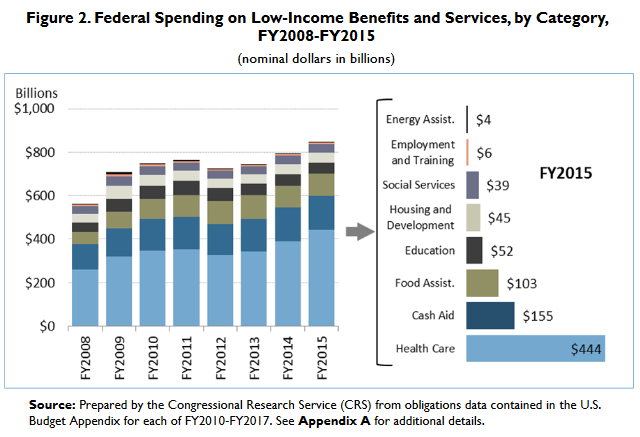
The report contains some interesting charts that show how spending on housing compares to other categories of federal spending. The chart below from page 6 of the report shows spending by category. Notice that health care spending dwarfs the other categories, while “housing and development” is in the middle.
Federal-Spending-Chart-FY2015-CRS-Report

Read the full report here.

HUD Offering $2 million in ROSS Grants to Help Students Navigate College and Continuing Education Financial Aid Assistance

On August 2, HUD announced $2 million in grants to “help low-income families and young people apply for federal aid for college and other post-secondary educational opportunities.” The program is being funded through the Resident Opportunities and Self Sufficiency (ROSS) Program. The program will allow up to six public housing agencies (PHAs) to support “Education Navigators.”

HUD’s ROSS for Education Program is known as Project SOAR (Students + Opportunities + Achievements = Results).  It will “support hundreds of young people between the ages of 15 – 20 to apply for [the] U.S. Department of Education’s Free Application for Federal Student Aid (FAFSA).” HUD is also working with the Department of Education to share data about FAFSA completion and is working with the White House’s Social and Behavioral Sciences Team to develop methods to increase completion rates of the FAFSA among students with housing assistance.

Read HUD’s full press release here.

Read HUD’s Notice of Funding Availability (NOFA) here.

Read more about how behavioral economics can be used to “nudge” applicants receiving housing assistance to seek Federal Student Aid here.

Administration Announces Steep Decline in Veteran Homelessness

Today–HUD, the U.S. Department of Veterans Affairs (VA), and the U.S. Interagency Council on Homelessness (USICH) announced that the number of veterans experiencing homelessness in the United States has declined significantly since 2010. According to HUD’s Point-in-Time (PIT) estimates, there has been a 47 percent decrease in the number of veterans experiencing homelessness since 2010 and a 17 percent decrease since 2015.

HUD believes that this decline is a function of partnerships between HUD and VA, USICH, and other partners at all levels of government (i.e., federal, state, and local) and the HUD-VASH program. The partnerships were a result of Opening Doors, the federal strategic plan to prevent and end homelessness.

Read HUD’s full press release here.

Read more about Opening Doors here.

View HUD’s PIT Estimates of Veteran Homelessness in the U.S. here.

TAC’s Section 8 Made Simple Guide

The Technical Assistance Collaborative has published a Housing Choice Voucher (HCV) Program guide titled “Section 8 Made Simple – Special Edition: Using the Housing Choice Voucher Program to End Chronic Homelessness.”

Thanks to the Center on Budget and Policy Priorities for bringing this to our attention.

MTW Expansion Committee Conference Call and Summary of Policies

As mentioned in a prior blog post, the Moving to Work (MTW) Expansion Committee Conference Call is occurring now [Edit: The call ended at 4 pm]. HUD has also posted a summary of the policy proposals it has received to be potentially studied in MTW cohorts. Here are the numbers to call in:

  • United States –  (800) 230-1766;
  • Outside the United States – (612) 288-0329; and
  • Persons with hearing impairments – (800) 977-8339 and providing the FRS operator with the conference call toll-free number: (800) 230-1766.

The call is until 4 pm today. The next call will be at the following time:

  • July 28, 2016 – Cost-Effectiveness and Incentives to Increase Self-Sufficiency for Families with Children (1 pm to 4 pm).

Read the summary of policy proposals here.

UPCS-V Update and Timeline

Earlier today, HUD REAC had a conference call with PHAs that volunteered to be a part of the UPCS-V Demonstration. In the conference call, HUD shared additional information on the Demonstration including a timeline moving forward. The Demonstration has 173 agencies from 41 states, Puerto Rico, and the U.S. Virgin Islands (31% of vouchers are represented in the Demonstration). HUD took NAHRO’s suggestion in its comment letter and has accepted small and very small agencies, but is still looking for additional agencies to apply.

If your agency is still interested in applying, please provide the following information to UPCSV@hud.gov:

  • Name of PHA;
  • PHA Address;
  • Name of Point of Contact (POC);
  • Phone Number of POC; and
  • Email Address of POC.

Here is the tentative timeline for the demonstration moving forward.

Currently

  • Prepare for PHAs starting August 1st;
  • Release the software;
  • Update the decision trees; and
  • Protocol Document release [should be in the next week or two].

August

  • OED to shadow HQS inspections [for first wave of 13 or 14 chosen PHAs; PHAs that are chosen for this wave should already be informed];
  • Start training PHAs on UPCS-V August 29th to September 31st;
  • PIH Listening Sessions for PHAs only, scheduled at various locations around the country; and
  • Public outreach presentation on UPCS-V.

September – December

  • Train PHAs [HUD will train PHA inspectors who will start performing inspections at this time];
  • Completion of online training tool;
  • PIH Listening Sessions; and
  • Other presentations on UPCS-V.

January – Summer 2017

  • Continue training PHAs.

Additional questions about the demonstration can be mailed to OED@hud.gov.

As noted in the timeline, a revised version of the UPCS-V protocol will be published in the next week or two at the REAC OED website. The slides from today’s call will also be made available on the OED website.

NAHRO is following the Demonstration very closely and will continue to bring you the latest updates.


PAHRC Releases “Housing is a Foundation” 2016 Report

Today, July 20, PAHRC released its yearly research report for 2016 titled “Housing is a Foundation.” This year’s report focuses on the lack of available housing assistance, the people who receive housing assistance, and the beneficial impacts of housing assistance. The report supplies data to “foster a better understanding of the need for housing assistance and how this assistance helps meet the needs of low-income families and their communities.”

Here’s a great graphic on how helpful rental assistance is on all facets of a household.

https://www.housingcenter.com/sites/default/files/styles/panopoly_image_full/public/general/Summary.png?itok=lOA8Moub

The full report can be read here.

MTW Research Advisory Committee – Conference Calls

The Moving to Work (MTW) Research Advisory Committee will be holding two public conference calls. The MTW Research Advisory Committee will advise HUD on how to move forward with the MTW expansion, especially with respect to specific policies to test in the expansion. The calls are open to the public, but members of the public must register to provide comment.

The calls are at the following dates and times [edit: the calls are until 4 pm; previously this post stated they were until 3 pm]:

July 26, 2016 – Increasing Housing Choice for Low-Income Families (1 pm to 4 pm); and

July 28, 2016 – Cost-Effectiveness and Incentives to Increase Self-Sufficiency for Families with Children (1 pm to 4 pm).

Use the following numbers to call-in:

  • United States –  (800) 230-1766;
  • Outside the United States – (612) 288-0329; and
  • Persons with hearing impairments – (800) 977-8339 and providing the FRS operator with the conference call toll-free number: (800) 230-1766.

To register, please click here.

Additional information on the call agendas can be found here.

Our prior blog post on these calls can be found here.

Voucher Mobility Debate at the Furman Center

The Furman Center has published a discussion on their website about voucher mobility. The discussion centers around HUD’s proposed Small Area Fair Market Rents rule, which would require certain metropolitan areas to use zip code level fair market rents. There are four written pieces, each with a unique viewpoint:

Here’s a quote from Rachel Fee’s essay:

HUD’s proposal is made without a Section 8 budget increase, so housing “opportunity” for some low-income families will come at the expense of others.  Families who choose to stay in their current homes in high poverty areas or those who are unable to move, will literally pay the price of higher rents for families using their voucher in more expensive neighborhoods.

While NAHRO is still in the process of writing its comment letter on the proposed rule, NAHRO’s initial concerns about the Small Area FMR proposed rule include concerns about tenant welfare, limiting the choice of tenants, and administrative burdens. NAHRO also believes that additional research should be done before implementing HUD’s rule and that additional funding is required to properly implement it.

HUD Awards $75 Million in FSS Grants

Today, HUD announced that it was awarding $75 million in grants through the Family Self-Sufficieny (FSS) program. The grants allow for public housing residents, Housing Choice Voucher (HCV) program participants, and recipients of Project-Based Rental Assistance (PBRA) to advance their education or receive job-training skills. The grants allow public housing agencies (PHAs) to work with social service agencies, community colleges, businesses, and other local partners to help individuals participating in the program.

HUD’s press release on the awards can be found here.

A list of the grant awards can be found here.