HOME Impact Story in Vancouver, Washington

During National Community Development Week, NAHRO celebrates the hard work of communities across the country by sharing Community Development Block Grant (CDBG) and HOME Investment Partnerships Program (HOME) impact stories, highlighting the importance of these federal affordable housing and community development programs at the local level.

Project name Isabella Court I IMG_3578_Isabella
Location Vancouver, WA
District WA-03
Project Year 2015
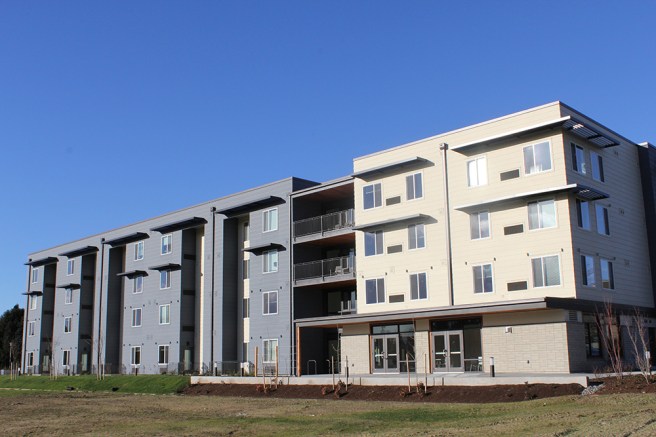
Project Description Spearheaded by REACH, one of the largest and most successful Community Development Corporations in Oregon, Isabella Court offers affordable, senior living in Vancouver, Washington. Isabella includes 46 one-bedroom and 3 two-bedroom apartments and is built to the Evergreen Sustainable Development Standard (ESDS), with its focus on energy efficiency and promotion of sustainable living. The Isabella offers vibrant living in the Fourth Plain Corridor, with nearby restaurants, shopping, movie theater, and parks.
Use of HOME Funds New construction and development costs for multifamily rental housing.
Target Population Apartments are reserved for households 62 years of age and over earning 60% or less of the area median income.
HOME Funds $2,518,734 were provided by the Washington State Department of Commerce, the City of Vancouver and Clark County Community Services.
Other Funds 10 Project-Based Section 8 vouchers valued at $331,200; LIHTC; Tax-exempt bonds; State Housing Trust Fund. Total project cost: $12,476,777.
Project Impact The investment of these HOME funds and other leveraged dollars brought one of the first rent-restricted senior developments to the City of Vancouver in almost ten years and supplied the area economy with construction jobs with a living wage. The affordable housing provided much needed apartments to a City with one of the highest percentage rent increases in the nation between 2015 and 2016. Other impacts of this project include municipal economic development, job skills training, apprenticeship and neighborhood revitalization for one of the poorest Census Tracts in Clark County.
Contact Ben Sturz – bsturtz@reachcdc.org www.reachcdc.org

National Community Development Week 2017 — April 17-22: Celebrating the Important Work of CDBG and HOME

NAHRO, along with fellow members of the Community Development Block Grant (CDBG) Coalition, will be celebrating National Community Development Week, April 17-22, 2017. Over the course of this week, communities across the country will celebrate the work of the CDBG Program and the HOME Investment Partnerships (HOME) Program.

The CDBG program provides grants to over 1,200 state and local governments and funds activities such as housing rehabilitation, business assistance, senior services, and infrastructure – to name a few. These activities are primarily targeted to low-income persons and households. Every $1.00 of CDBG leverages another $3.65 in other funding; bringing additional resources to communities that support jobs, businesses and, most importantly, the people who live in these communities.

HOME provides grants to over 600 State and local governments to create safe, decent and affordable housing, both rental and homeowner. HOME is a vital federal housing program that allows communities to leverage $4.20 of public and private dollars for every HOME dollar invested.

CDBG and HOME have been proposed for elimination in the President’s FY 2018 HUD budget and National Community Development Week provides the opportunity for Congressional Members and the community to see first-hand the results of these programs by touring projects, meeting with state and local staff and interacting directly with beneficiaries served by the programs.

NAHRO is urging members a to participate in National Community Development Week by supporting local project tours, issuing proclamations, engaging and educating Congressional Members on the programs, and reaching out to the media to promote the impact of CDBG and HOME. Here’s what you can can do:

Learn

Advocate

  • Contact and engage with your members of Congress to schedule meetings and plan a site visit of a local projects to show how these programs have helped your community. Remember –  Congress is in recess through April 23 and lawmakers will be back in their districts
  • Send letters to your legislators using NAHRO’s pre-drafted Advocacy Action Center letter telling Congress to take action today to finalize FY 2017 spending and pass a full-year Transportation, Housing and Urban Development spending bill.
  • Join over 2,000 local, state and national organizations and sign on to the CDBG support letter seeking $3.3 billion for CDBG in FY 2018. This letter will be sent to Appropriations Committee leaders in May.

Spread the Word

  • Share your impact story by writing and submitting a Letter to the Editor or op-ed to your local newspaper. Make sure to mention your members of Congress so it gets picked up in their daily clips.
  • Join @NAHROnational on Twitter and elevate awareness of the need for – and the impact of – CDBG and HOME through tweets. Make sure to use the following hashtags: #CDBG #CDBGImpact #Fight4CDBG #HOME #HOMEImpact, and to tag your House and Senate representatives.
  • Follow and share the NAHRO Blog where we will post success stories of CDBG and HOME submitted by NAHRO members throughout week.

Connect with NAHRO

  • If your impact story was published in your local newspaper or you meet with your member of Congress, let us know! Please email Jenny Hsu at jhsu@nahro.org with a description of your advocacy efforts so that we can highlight your efforts with Congress once they are back in session.

CDBG Coalition Members: NAHRO, U.S. Conference of Mayors, National Association of Counties, National League of Cities, National Community Development Association, Council of State Community Development Agencies, National Association for County Community and Economic Development, National Association of Development Organizations, American Planning Association, Local Initiatives Support Corporation, Habitat for Humanity International, Feeding America, YWCA USA, Enterprise Community Partners, Rebuilding Together, National Recreation and Park Association, National Association of Regional Councils, National Urban League, International Economic Development Council, Heartland Alliance, The Trust for Public Land, and National Development Council

2017 Grade-Level Reading Week in Denver, CO

As part of NAHRO’s partnership with the Campaign for Grade-Level Reading (GLR), we encourage NAHRO members to learn about and engage with GLR on opportunities to improve the educational outcomes of the children living in your affordable housing programs. Below is information on the 2017 Grade-Level Reading Week being held in Denver, Colo. This is an excellent chance to interact with local communities and leaders on educational opportunities.

The Campaign for Grade-Level Reading is coming home to Denver in June 2017. In many respects, Denver, Colo., is the birthplace of the GLR Campaign. In June 2012, 14 communities were recognized with the coveted title of All-America City for their focus on grade-level reading. And 124 communities signed on as Charter Members of the GLR Community Network.

Since then, The GLR Network has grown to include over 300 communities in 42 states, the District of Columbia, Puerto Rico and the U.S. Virgin Islands. These local campaigns are supported by 2,300 local organizations and 250+ state and local funders, including 130 United Ways.

From June 13-14, local, state, and national funders that support early literacy will gather for the 2017 Funder Huddle. Attendees will have an opportunity to meet other funders in the grade-level reading community, share challenges and successes, learn from and with each other, and collectively drive toward bigger, stronger and better results.

From June 14-16, hundreds of civic and community leaders, public officials and educators from across the country will come together for the 2017 All-America City Awards, America’s oldest and most prestigious community recognition. Each year, the All-America City Awards are given to communities that exemplify outstanding civic accomplishments. This year, the National Civic League and the Campaign for Grade-Level Reading will recognize communities that have made measurable progress for low-income children on the key drivers of early reading success. REGISTER today!

Regulatory Freeze Memo Issued

On January 20, the Trump Administration issued a “Regulatory Freeze Pending Review” memo that applies to all Federal agencies, including the U.S. Department of Housing and Urban Development (HUD). This memo is similar to memos issued by previous administrations as they come into office, and NAHRO had expected this regulatory freeze.

Generally, the regulatory freeze requires agencies to withdraw any regulations that have not yet been published in the Federal Register and to extend the effective date by 60 days of any regulations that have not become effective as of January 20, 2017. The Director of the Office of Management and Budget (OMB) can issue exceptions to the regulatory freeze in emergency situations and to address urgent health, safety, financial, or national security issues.

The regulatory review not only applies to regulations but also any “guidance document.” A “guidance document” is any substantive action or an agency statement that states a policy on a statutory, regulatory, or technical issue that is normally published in the Federal Register.

NAHRO will continue to monitor the effects of the regulatory freeze and has reached out to HUD staff on how this regulatory freeze will affect specific regulations. As more information becomes, available NAHRO will share it with our members through The NAHRO Blog and the Monitor.

For any specific questions or concerns, please contact Georgi Banna, NAHRO’s Director of Policy and Program Development, at gbanna@nahro.org. As always for the most up-to-date information of the affordable housing and community development regulations and legislation, follow The NAHRO Blog and check the NAHRO website.

Five Communities Awarded $132 Million in Choice Neighborhoods Grants

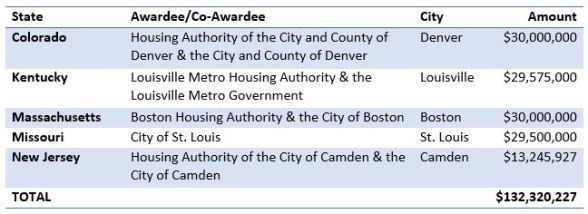
On December 12, HUD announced that five U.S. communities will receive a combined total of $132 million in FY 2016 Choice Neighborhoods Initiative (CNI) grant funds. The goal of the CNI is to aid struggling communities with severely distressed public housing or HUD-assisted housing by reinvesting in the community’s housing, residents, and neighborhoods.

These five communities will receive funding under the CNI’s Implementation Grant component, which supports communities that are ready to implement their neighborhood revitalization plan, or “Transformation Plan.” All five awardees are also past Choice Neighborhoods Planning Grant recipients.

The following communities will receive Implementation Grants:

cni-2016-awards

According to HUD’s press release, the awardees will replace 1,853 severely distressed public housing units with nearly 3,700 new mixed-income, mixed-use housing units, and leverage every $1 in Choice Neighborhood funding with an additional $5 in public and private funding for their project proposals. Together, the awardees and their partners are expected to leverage a combined total of $636 million through other public/private sources and indirectly stimulate another $3.3 billion in their local economies.

Read a summary of each grants here.


NAHRO Provides Recommendations to the HUD 2017 Transition Team

Today NAHRO provided members of President-elect Trump’s HUD transition team with the NAHRO Transition 2017 recommendations. All recommendations and positions in this document have been previously approved by our standing committees and the NAHRO Board of Governors. We also intend to make ourselves available to the new transition team and supply them with any and all information and assistance they may require from us to make the transition at HUD under the Trump Administration as smooth as possible.

The transition recommendations can be used as you reach out to your local HUD officials, your elected officials who will be seated in the new Congress, the media and your own state and local officials in a united effort to move a responsible and responsive housing agenda forward at HUD and on Capitol Hill. In addition to this document, the association will also be producing the NAHRO 2017 Regulatory and Legislative Agenda, which will be drafted over the coming weeks with input from NAHRO membership and leadership and will be available at the NAHRO 2017 Washington Conference.

NAHRO’s Transition 2017 recommendations for HUD may be viewed here.

NAHRO Presents at HUD on the Lead Safe Housing Proposed Rule

On October 6, NAHRO participated in a HUD organized convening on the proposed Lead Safe Housing Rule. NAHRO’s Director of Policy and Program Development, Georgi Banna, along with the National Center for Healthy Housing’s Chief Scientist, Dr. David E. Jacobs and the Green and Healthy Homes Initiative’s Executive Director, Ruth Ann Norton were on a panel moderated by HUD-PIH’s Principal Deputy Assistant Secretary Lourdes Castro Ramirez that discussed the need to combat lead poisoning in children and the role of housing in that battle.ghhi-lead-2016-10-06_16-49-58_000

A video of the Lead Safe Housing Rule Convening has been posted on HUD’s YouTube Channel. Clicking Georgi Banna will begin at NAHRO’s statement.

Comments on HUD’s proposed Lead Safe Housing Rule are due to HUD on Monday, October 31, 2016. NAHRO submitted its comments this week. More information on the HUD’s Lead Safe Housing Rule and NAHRO thoughts and comments on it can be found in the current edition of the NAHRO Monitor.

HUD Awards $500 Million in Disaster Recovery Funds; Pledges Expedited Assistance for Southern States

Last week, HUD Secretary Julian Castro awarded $500 million in Community Development Block Grant Disaster Recovery (CDBG-DR) funds to Louisiana, Texas and West Virginia to help recover from severe flooding earlier this year. These recovery funds will help the most impacted counties that experienced the greatest level of damage to their housing stock. CDBG-DR grants can provide support for housing redevelopment, business assistance, and infrastructure repair.

According to HUD’s press release, “[i]n the hardest-hit counties of Louisiana (6 counties), Texas (3 counties), and West Virginia (2 counties), more than 102,000 households experienced some level of damage to their homes including more than 41,000 families who saw the most serious level of damage or destruction and unmet needs.” The following allocations of funds are based on each state’s proportional share of serious unmet housing needs:

Grantee
Amount
State of Louisiana
$437,800,000
State of Texas
$45,200,000
State of West Virginia
$17,000,000
TOTAL
$500,000,000

Also last week, Secretary Castro announced that HUD will expedite assistance to the States of North Carolina, Florida, and Georgia to address the impacts of Hurricane Matthew. The Department will help by: assisting the affected states and local governments in re-allocating existing federal resources toward disaster relief; granting immediate foreclosure relief; making mortgage insurance available; making insurance available for both mortgages and home rehabilitation; offering Section 108 loan guarantee assistance; and providing information to FEMA and the State on housing providers that may have available units in the impacted counties.

GAO Study: CDBG Communities Lack Alternative Sources of Income Data for Determining Project Eligibility

On September 6, the Government Accountability Office (GAO) published a report examining HUD’s policies related to communities that disagree with their Community Development Block Grant (CDBG) eligibility determinations based on 5-year American Community Survey (ACS) data.The findings of the report are based on the GAO’s analyses of ACS data and HUD’s policy guidance to grantees, as well as interviews with CDBG administrators, stakeholders and community development groups, including NAHRO.

In order for a project to qualify for CDBG funding under the objective of providing benefit to low- and moderate-income (LMI) persons on an area basis, HUD instructs communities to use ACS data to show that a majority of the proposed service area consists of LMI residents. Some communities believe the ACS produces inaccurate results due to its smaller sample size and larger error rates. When a community disagrees with an eligibility determination, local income surveys may be used instead.  However, the GAO finds a number of challenges small communities face when conducting local income surveys, including: resource constraints, administrative burdens, and difficulty obtaining a sufficient number of survey responses. Furthermore, alternative ways to demonstrate eligibility are limited because other sources of income data are not as reliable and comprehensive compared to the ACS.

The GAO report does not make any specific recommendations to Congress on the sources of data issue, but it does point out that the Census Bureau is currently exploring ways to use external data, such as data from the Social Security Administration and IRS, to supplement the ACS. These recommendations are expected by March 2017.

Learn more about this GAO report in the September 15, 2016 edition of the NAHRO Monitor.

HUD Seeks Comments on CoC Formula, Proposes Formula Alternatives

On July 25, the “Continuum of Care Program: Solicitation of Comment on Continuum of Care Formula” notice will be published by HUD in the Federal Register. The purpose of the notice to solicit comments on the current Continuum of Care (CoC) formula and a number of updated CoC Preliminary Pro Rata Need (PPRN formula) options. Comments will be due 60 days after the notice is issued – September 23, 2106, based on the anticipated Federal Register date of July 25.

The current PPRN formula was published by HUD as the interim rule on July 31, 2012, and is a combination of Emergency Solutions Grants (ESG) program grant funds and Community Development Block Grant (CBDG) funds awarding formulas. This notice proposes four alternative formulas that use various factors and factor weights.

HUD has made available two tools to explore potential updates to the PPRN formula. The first tool is the CoC PPRN Proposed Formula Impacts by CoC resource where users can learn more about the CoC-level PPRN funding impact of implementing each of the four proposed formulas in the Notice, as compared to the FY 15 PPRN amounts by CoC. The second tool, CoC PPRN Alternate Formula Testing Tool, tests the impact of potential factors for an alternate CoC PPRN formula.

Additional information will be available on NAHRO’s Community Development Resource Center and on HUD’s notice website.