
Our friends at the National Housing Conference (NHC) and the Public Housing Authorities Director’s Association (PHADA) have written a blog post with a series of beautiful maps on historical Small Area Fair Market Rent (SAFMR) volatility on NHC’s Open House Blog. Here’s a map from the blog post on the Washington-Arlington-Alexandria HUD Metro Fair Market Rent (FMR) area.

I recommend looking at the blog post to read their take on SAFMRs and volatility and to see the other maps.
Here are a couple of points that I would like to note to further this conversation.
The methodology for calculating Fair Market Rents (and SAFMRs) is changing
In calculating the final FY 2016 FMRs HUD switched from a “historical-based annualized change in gross rent trend factor [to] a forward-looking forecast . . . [that] uses a model that forecasts national rent and utility [Consumer Price Index] indices based on economic assumptions used in the formulation of the President’s Budget.”[1] Since the methodology has changed, we need a time horizon of a few years to see if the volatility remains as bad a problem as before the methodological change.
Additionally, Peter Kahn, the Director of HUD PD&R‘s Economic Market Analysis Division, has stated the following:
We are looking at ways throughout the proposed ’17 FMR process of addressing that . . . variability in general. When the proposed ’17 FMRs are out, the . . . you can read that preamble and see that we are trying to take steps to address that variability. (See the YouTube clip where he said that here.)
Will HUD be successful in addressing this volatility? I don’t know, but it’s good that they’re aware of the problem and are taking steps to address the issue.
The passage of the Housing Opportunity Through Modernization Act of 2016 (HOTMA) may give PHAs a tool in managing volatility of payment standards based on both FMRs and SAFMRs
HOTMA has a provision that allows PHAs to hold harmless households that live in areas that receive lower FMRs. Section 107(b) of HOTMA states that “no public housing agency shall be required as a result of a reduction in the fair market rental to reduce the payment standard applied to a family continuing to reside in a unit for which the family was receiving assistance . . . at the time the fair market rental was reduced.” It is NAHRO’s understanding that this provision will apply to payment standards based on FMRs and SAFMRs.
The chart below shows how if a provision allowing for payment standards to be held harmless was in place between 2010 and 2016, then volatility may have been reduced in some instances. The blue line shows the actual Washington-Arlington-Alexandria FMR for 2 Bedroom units. The orange line shows what a payment standard based on that FMR would have been, had it been held harmless.
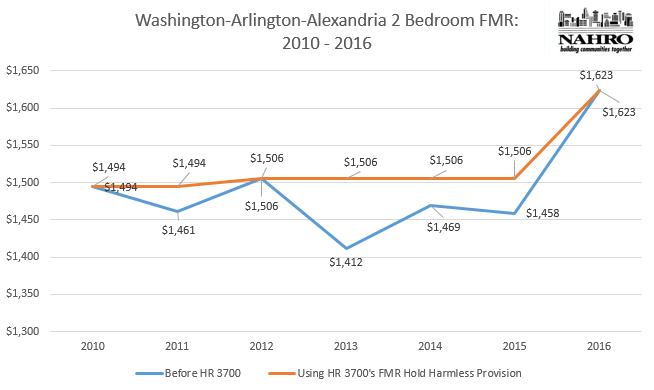
The HOTMA provision has the ability to reduce volatility in certain instances, though holding FMR payment standards harmless may have budget implications. Another point to remember is that when the payment standard starts being held harmless matters. In the chart above, if the payment standard starts being held harmless in 2013, then the volatility that results from increases in the FMR will still occur.
Although the chart above shows a payment standard based on a FMR being held harmless, the same principle would apply to payment standards based on SAFMRs.
[1] – 80 Fed. Reg. 77,124 (December 11, 2015).


 The NAHRO Blog: Legislative & Policy Updates from Washington, DC