Upcoming Climate Corps for Affordable Housing Webinar

NAHRO would like to share information on an upcoming Climate Corps for Affordable Housing Webinar provided by HUD, Environmental Defense Fund (EDF), and TDA next Monday, November 21st at 2 PM (EST).


 Climate Corps for Affordable Housing

On October 4, 2016, HUD announced a proposed reporting requirement that will require all Public Housing Authorities and owners of HUD-assisted multifamily housing to benchmark their portfolios’ utility usage.  The notices can be found at  https://www.gpo.gov/fdsys/pkg/FR-2016-10-04/pdf/2016-23979.pdf and https://www.gpo.gov/fdsys/pkg/FR-2016-10-04/pdf/2016-23978.pdf; the 60-day public comment period ends December 5, 2016.  Benchmarking will give affordable housing owners and operators a better understanding of the overall utility consumption and costs associated with their properties and enable them to more efficiently and effectively manage their portfolios.

To help owners with the greatest need for technical assistance in complying with the benchmarking requirement, HUD is partnering with the Environmental Defense Fund (EDF) and TDA Consulting to bring you the Climate Corps for Affordable Housing Summer Fellowship program.  The program will embed 12 fellows with affordable housing organizations across the country for the summer of 2017 and will be offered at no cost to host institutions, which will be chosen on the basis of need.  This free, full-time technical assistance will allow affordable housing organizations to get ahead of the curve on this upcoming HUD requirement.

Please join us for a webinar to further explain the details of this exciting new opportunity on MONDAY, NOVEMBER 21 @ 2 PM ET.

To register, please click here.

Report: Homelessness in the U.S. Continues to Decline

Earlier this week, HUD published Part 1 of the 2016 Annual Homeless Assessment (AHAR) Report, providing Congress with local estimates of sheltered and unsheltered persons experiencing homelessness on a single night in January 2016. According to the report, on a single night in 2016, there were 549,928 persons experiencing homelessness – a 14 percent decrease from 2010 and a 3 percent decrease over the past year. This decline was especially prevalent among families with children, Veterans, and individuals with long-term disabling conditions. Despite the downward trend of homelessness nationally, 13 states and the District of Columbia still saw an increase in their share of homelessness between 2015 and 2016.

The AHAR is typically released in two parts: Part 1 provides Point-in-Time (PIT) estimates that offer a “snapshot” of homelessness as reported by Continuums of Care (CoCs) across the U.S.; Part 2 offers in-depth detail on the characteristics of the homeless. The PIT methodology is regarded as a reliable estimate of the general size of the homeless population; however, it is important to note that it does not count every single homeless person, nor does it measure the number of people who are at risk of homelessness.

****

paperphoto

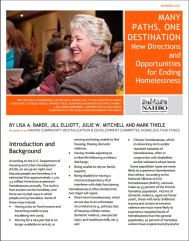
NAHRO members have long been on the front lines of preventing and ending homelessness. Read this recent NAHRO white paper to learn about public housing authority (PHA) collaborations and new directions and opportunities for ending homelessness.Case studies include: effectively ending veteran homelessness in Houston, Texas; implementing medical respite to save lives and reduce costs in Fargo, North Dakota.; and using a model for working with the chronically homeless in encampment settings by the City of West Sacramento, Yolo County, California.

HUD Final Rule Provides Expanded Housing Protections for Survivors of Violence

Today, HUD published a final rule in the Federal Register that provides expanded housing protections for survivors of violence and fully codifies the provisions of the Violence Against Women Reauthorization Act of 2013 (VAWA 2013) into HUD’s regulations. At its core, VAWA 2013 prohibits housing providers from denying or terminating housing assistance on the basis that an applicant or tenant is a survivor of violence.

The rule’s regulations become effective on December 16, 2016, and compliance with the rule with respect to completing an emergency transfer plan and providing emergency transfers, and associated recordkeeping and reporting requirements, is required no later than June 14, 2017.

Read more about the rule’s provisions in our blog post, published last month. A more in-depth analysis of the rule is also available in the NAHRO Monitor (members only).

[Note: After the final rule’s publication, HUD discovered an incorrect compliance date in the rule’s preamble, with respect to completing an emergency transfer plan and providing emergency transfers, and associated recordkeeping and reporting requirements. The compliance date was incorrectly listed as May 15, 2017, while the regulatory text provided the correct date of June 14, 2017. This blog post has been updated to reflect the correct compliance date of June 14, 2017]

HUD Releases Small Area FMR Final Rule

HUD will release the Small Area Fair Market Rents in Housing Choice Voucher Program Values for Selection Criteria and Metropolitan Areas Subject to Small Area Fair Market Rents Final Rule in the Federal Register tomorrow (November 16). HUD will also release a Notice in the Federal Register that would set the selection values for Small Area FMRs (SAFMRs). Subsequent SAFRMs will be specified through the Federal Register notice providing the public the opportunity to comment as new SAFMR designations are made. More information on HUD’s proposed rule (released June 2), can be found here (members only), and NAHRO’s comments can be found here (members only). NAHRO will hold a webinar on the final rule on Monday, December 19. Save the date and stay tuned for additional information.

In additional to other changes, the final rule includes additional criteria by which SAFMRs will be set. The final rule adds the vacancy rate of an area as a criterion and excludes metropolitan areas with a certain ACS vacancy rate from being designated a SAFMR area. The final rule also adds a threshold for the voucher concentration ratio to better target communities where voucher concentration is most severe.

As a result of the additional criteria, 7 Metropolitan Statistical Areas (MSAs) have been exempted from complying with the SAFMR final rule that were included in the proposed rule. These MSAs are:

  • Nassau County-Suffolk County
  • New York, NY
  • Oakland-Hayward-Berkeley, CA
  • Oxnard-Thousand Oaks-Ventura, CA
  • San Jose-Sunnyvale-Santa Clara, CA
  • Tacoma-Lakewood, WA
  • Virginia Beach-Norfolk-Newport News, VA

NAHRO will provide a detailed analysis of the final rule in the coming days. The final rule will go into effect 60 days after its publication date. 

Senior Housing Focus: Aging in Place Webinar


NAHRO would like to share information on an upcoming webinar conducted by Community Catalyst on aging in place for low-income and chronically ill seniors. Below is the invitation from Community Catalyst for their webinar on Thursday, December 1, 2016, at 1pm to 2:30pm eastern time.


Aging in Place: Integrating Health and Housing for Low-Income and Chronically Ill Seniors

Thursday, December 1, 2016 1:00 pm – 2:30 pm EDT

RSVP Here

This is the third webinar in a series Community Catalyst is hosting to engage with national, regional, state and local partners who are working or want to start working in the health and housing space.

This call will provide an overview of the issue from what is being discussed and worked on from the federal, state and local levels, featuring leaders in these areas.

Speakers will discuss the growing research and recognition that the aging population requires more effective integration of housing and health care systems and highlight impact that affordable housing has on older adults’ ability to live at home and in the community. There will be ample time for questions and answers between participants and speakers, allowing for dialogue and learning for those working in both the health and housing areas.

This webinar will feature:

In response to the growing national and local discourse about the connections between housing and health outcomes, we at Community Catalyst see a clear interest in identifying the role health policy advocates can play in protecting and expanding access to quality, affordable and appropriate housing for vulnerable populations. In addition to the demonstrable connections between housing and health outcomes, housing is a fundamental human right that is under threat in many communities.

Please RSVP here to participate on December 1st.

We hope you will join us in this opportunity to connect stakeholders working on initiatives related to aging in place for low-income and chronically ill seniors with those from other sectors to address housing issues.

Carol Regan, Senior Advisor

Center for Consumer Engagement in Health Innovation

This Community Catalyst Learning Community webinar is part of an ongoing effort to help advocates from across the country share best practices, explore new ideas and learn from each other’s experiences. The Learning Community connects advocates, giving them a needed forum to effectively collaborate with and learn from their peers.

HUD to Hold COCC Listening Session in Los Angeles

NAHRO encourages all PHAs, especially those on the West Coast, to attend the HUD COCC (Central Office Cost Center) listening session on December 7, 2016 in Los Angeles, CA. Previous COCC listening sessions have been held in Alabama, Michigan and the District of Columbia. NAHRO has participated in a HUD COCC listening session and HUD shared substantive information in addition to listening to the concerns and questions of PHAs. These listening session are not part of the formal rulemaking process and is an opportunity to have a discussion with HUD on the COCC and the fee system.

PHAs interested in attending the COCC listening session in Los Angeles on December 7, 2016 will need to register at the following website: http://www.hud.gov/emarc/index.cfm?fuseaction=emar.registerEvent&eventId=2944&update=N.

Below is the Los Angeles COCC Listening Session information and agenda that was received from HUD.


In consideration of those PHAs that are located on or closer to the West Coast, HUD has decided to offer an additional COCC Listening Session in Los Angeles, CA on Wednesday, December 7, 2016.  Registration information for the Los Angeles, CA session is provided below.   

Background: In response to an OIG audit report, HUD is considering changes to the amount and types of fees a PHA’s Central Office Cost Center (COCC) can charge and the eligible uses of these funds by the COCC.  These changes could significantly impact the more than 600 PHAs that operate under asset management using the COCC model.  To more fully understand the impact of such changes when developing possible new rules, procedures, and guidance on the COCC, HUD has chosen to hold listening sessions in several cities, including Los Angeles, CA.

We welcome your PHA’s participation.

Detailed information on the COCC listening session and registration information is provided below.  Note: The listening session is in person only; there is no audio or video broadcasting of the sessions.

D.J. Lavoy,

Deputy Assistant Secretary

PIH-Real Estate Assessment Center


Who Should Attend? The target audience for this listening session is Executive Directors, Chief Financial Officers, and Public Housing Directors of PHAs that operate under asset management using a COCC.  PHAs also are encouraged to share this information with their fee accountants and auditors.  HUD will be sending a separate email to invite fee accountants, auditors, and financial consultants to the listening session.

Listening Session Registration. Registration is limited to no more than two (2) participants from the same PHA or organization.  To register for the Los Angeles session, please click on the link below.

http://www.hud.gov/emarc/index.cfm?fuseaction=emar.registerEvent&eventId=2944&update=N

The event will be held at HUD’s Los Angeles, CA Field Office.  Take the elevator directly to the 4th floor to Room 4054.

Los Angeles Federal Building

300 North Los Angeles Street, Suite 4054

Los Angeles, CA 90012

Note: Attendees will be asked to go through a metal detector and place their personal items through an x-ray machine.  With this in mind, please give yourself an extra 15 to 20 minutes to go through security and consider what you bring with you.

COCC Listening Session Agenda. A draft agenda for the COCC listening session is provided below.

COCC Listening Session – Draft Agenda
# Topic Time
1 Onsite Registration 8:30 – 9:00
2 Welcome and Background 9:00 – 9:30
3 Reasonableness of Fees and Fee Type 9:30 – 10:15
4 Re-federalization of Fees 10:15 – 10:45
5 Break 10:45 – 11:00
6 Eligible Uses of Fee Income 11:00 – 12:00
7 Lunch 12:00 – 1:00
8 Accounting and Reporting 1:00 – 2:15
9 Break 2:15 – 2:30
10 Transition Items 2:30 – 3:30
11 Next Steps / Closing 3:45 – 4:00

Lodging/Parking Information. For attendees who may need overnight accommodations or parking, this information is provided at the link below.  This hotel list is provided for your convenience.  HUD does not endorse or recommend any hotel.

https://drive.google.com/file/d/0B1BC9D4S6JWMcmEwYWhOYjd6eGM/view?usp=sharing

HUD Publishes Notice on the Modernization of the Housing Opportunities for Persons With AIDS Program

Last week, HUD published new guidance (notice CPD-16-17) for Housing Opportunities for Persons With AIDS (HOPWA) grantees explaining the changes to the HOPWA program  that resulted from the passing and signing of the Housing Opportunity Through Modernization Act (HOTMA) on July 29, 2016. The passage of HOTMA was a huge victory for NAHRO and its members because it provided housing authorities with the effective tools and mechanisms to improve the operation of their programs. The new law also provided long-awaited amendments to the HOPWA statue that modernizes the program’s allocation formula, and addresses administrative provisions and adds program definitions. HUD’s new notice describes how the HOTMA provisions will effect HOPWA formula allocations for FY 2017 and beyond. The notice also details the program changes that became effective on July 29, 2016 versus the program changes that must be implemented by HUD through future rulemaking.

Learn more about the modernization of the HOPWA program in next edition of the NAHRO Monitor – available November 15, 2016 (members only).

HUD Extends AFH Submission Deadline for Small Local Governments

On October 24, HUD published a notice in the Federal Register announcing the extension of the initial Assessment of Fair Housing (AFH) submission deadlines for small consolidated plan program participants that received a Community Development Block Grant (CDBG) of $500,000 or less in Fiscal Year (FY) 2015 or in a subsequent FY; or in the case of a HOME consortium, whose members collectively received a CDBG grant of $500,000 or less.

Previously, HUD established the first AFH due date for small consolidated plan program participants to be 270 days (approximately 9 months) before the program year for which a new 3-5 year Consolidated Plan is due, starting on or after January 1, 2018. HUD is now extending the initial due date to 270 days before the program year which a new 3-5 year Consolidated Plan is due, starting on or after January 1, 2019 – the same date that qualified public housing agencies (QPHAs – PHAs with a combined unit total of 550 or less) are required to submit their AFHs.

Learn more about HUD’s Affirmatively Furthering Fair Housing (AFFH) Final Rule and subsequent AFH requirements for states, local governments, and PHAs by accessing NAHRO’s AFFH Resource Page (members only).

NAHRO Presents at HUD on the Lead Safe Housing Proposed Rule

On October 6, NAHRO participated in a HUD organized convening on the proposed Lead Safe Housing Rule. NAHRO’s Director of Policy and Program Development, Georgi Banna, along with the National Center for Healthy Housing’s Chief Scientist, Dr. David E. Jacobs and the Green and Healthy Homes Initiative’s Executive Director, Ruth Ann Norton were on a panel moderated by HUD-PIH’s Principal Deputy Assistant Secretary Lourdes Castro Ramirez that discussed the need to combat lead poisoning in children and the role of housing in that battle.ghhi-lead-2016-10-06_16-49-58_000

A video of the Lead Safe Housing Rule Convening has been posted on HUD’s YouTube Channel. Clicking Georgi Banna will begin at NAHRO’s statement.

Comments on HUD’s proposed Lead Safe Housing Rule are due to HUD on Monday, October 31, 2016. NAHRO submitted its comments this week. More information on the HUD’s Lead Safe Housing Rule and NAHRO thoughts and comments on it can be found in the current edition of the NAHRO Monitor.

HUD Family Options Study: HCV Most Effective and Rapid Re-Housing Least Costly

On October 25, HUD’s Office of Policy Development and Research (PD&R) released a report titled Family Options Study: Long-Term Impacts of Housing and Services Interventions for Homeless Families, which seeks to identify the most efficient and cost-effective way to house and serve homeless families with children.capture

The report presents the long-term (37 months) outcomes of HUD’s Family Options Study, which tracked how homeless families in emergency shelters across 12 U.S. communities responded to various homelessness interventions. Between September 2010 and January 2012, over 2,000 families were enrolled and randomly assigned to participate in one of four homelessness interventions: housing subsidy, community-based rapid re-housing, project-based transitional housing, and usual care (defined as any housing or services that a family accesses in the absence of immediate referral to the other interventions).

The study found long-term housing subsidies, typically Housing Choice Vouchers, had the greatest impact on reducing family homelessness and improving non-housing family outcomes (i.e., increased adult well-being, child well-being, food-security, and less economic stress). While not as effective as housing vouchers, rapid re-housing programs were significantly less expensive, with an average per-family monthly cost of approximately $800, compared to voucher at $1,172/month, transitional housing at $2,700/month and emergency shelter programs at $4,800/month.

Read more about HUD’s study and findings here.