RAD Roundup – RAD Supplemental Guidance

There has been a lot of activity around the new RAD guidance documents over the past few days. This post is meant to compile a lot of that information in one place.

New RAD Guidance Documents:

Additional HUD Documentation of new RAD Guidance Documents:

Additional non-HUD Posts:


HUD Publishes New RAD Guidance

Tomorrow, HUD will publish new Rental Assistance Demonstration (RAD) guidance in the form of two new Federal Register notices. The Department has also published a new RAD Public and Indian Housing (PIH) Notice. The three new guidance documents are the following:

  1. Rental Assistance Demonstration: Implementation of Certain Fiscal Year (FY) 2018 Appropriations Act Provisions (link is to a pre-publication copy);
    1. [7/3/18 Edit – The final, published document can be found here];
  2. Rental Assistance Demonstration: Supplemental Guidance on Final Notice (link is to a pre-publication copy);
    1. [7/3/18 Edit – The final, published document can be found here]; and
  3. PIH-2018-11Rental Assistance Demonstration (RAD) – Supplemental Guidance.

[7/2/18 11:55 am edit – At the same time this post was published, HUD sent a RADBlast! email with additional information.

  • Modified FY 16 RAD Rents can be found here.
  • HUD will host a webinar on July 9, 2018 at 2 pm ET. Registration can be found here.
  • Finally, a version of the RAD notice revised version 3 as amended with the Supplemental Notice can be found here.]

The first notice announces several things:

  1. HUD will use rent levels based on the FY 18 RAD rent base year for Commitments to enter into a HAP contract (CHAPs), portfolio awards, and multi-phase awards issued on or after January 1, 2019. Those rent levels will be published once the final public housing operating subsidy obligation is made for FY 18.
  2. For awards before Jan. 1, 2019, HUD will modify the FY 16 RAD rent base year by replacing the PHA’s FY 16 Capital Fund Formula Grant  with the PHA’s FY 18 Capital Fund Formula Grant (i.e., in calculating RAD rents before Jan. 1, 2019, HUD will use FY 18 Capital Grant allocations, but FY 16 Operating Fund allocations and tenant rents);
  3. The Department can award RAD authority to certain projects where PHAs have submitted Letters of Interest (LOIs) to reserve their position on the RAD waiting list if they submit a complete RAD application within 60 days of publication of the notice;
  4. For all multi-phase awards issued after March 22, 2018, PHAs will have until September 30, 2024 to submit an application for the final phase of the project covered by the multi-phase award; and
  5. HUD may approve a replacement CHAP without new application materials, when a PHA voluntarily withdraws a project and requests new RAD authority for the same project within one month thereafter.

The second notice summarizes certain aspects of the PIH notice. It expands Rent Bundling such that PHAs may bundle between RAD project-based vouchers and non-RAD project-based vouchers. It allows PHAs to establish a project-specific utility allowances for Covered Projects. It provides alternative developer fee limits when a PHA adopts a waiting list preference for households exiting homelessness. It establishes that HUD will disapprove a proposed conversion where a PHA is disposing units at a proposed project and HUD determines that the use of disposition and RAD undermines the unit replacement requirements of RAD. It creates a streamlined conversion option for PHAs that have a very small public housing portfolio of 50 units or less that will not involve any rehabilitation, new construction, or relocation.

NAHRO members will receive additional coverage on these notices and the RAD program.

HUD Publishes New RAD and Section 18 Blend Document

Earlier today, HUD’s Office of Recapitalization sent a RADBlast! email announcing the publication of a Frequently-Asked-Questions (FAQ) document about using HUD’s new demolition and disposition notice–PIH 2018-04 (HA)–in conjunction with the Rental Assistance Demonstration (RAD) program.

Specifically, the document answers questions around the provision in the demolition and disposition notice that allows PHAs to convert at least 75 percent of public housing units in a project under RAD–which meet the requirements of the RAD Final Implementation Notice REV-3, H-2017-3–and to convert through disposition up to 25 percent of public housing units within the project to Section 8 project-based voucher assistance.

For those contemplating completing a RAD transaction, this provision is another tool to help finance the deal.

The RAD-Section 18 Blend document can be found at the RAD Resource Desk or here.

HUD Posts “Keys to A Successful RAD Conversion” Videos

On Thursday, May 17 and Friday, May 18, HUD held a training on the Rental Assistance Demonstration (RAD) program titled “Keys to A Successful RAD Conversion.” The two day long sessions were held in the Brooke-Mondale Auditorium at HUD’s Headquarters. The training was targeted at PHAs that had not yet contemplated, or had not yet started, a RAD transaction and was meant to provide information about the RAD process. The Department had previously promised to post videos of each of the sessions, which they recently did. The session videos can be found below.

Click below to see each session.

Continue reading

Share Your HUD Strong Families Initiative Events!

HUD Strong Families

HUD’s Strong Families Initiative builds upon HUD’s longstanding Father’s Day efforts to involve fathers in the lives of their children. This year HUD is expanding its focus to include mothers, children and parents of all kinds!

Join HUD Strong Families by hosting a resource event in your community anytime during the months of May or June! Your HUD Strong Families event can feature fun and useful activities from moon bounces and barbeques to reading booths, STEM workshops, digital literacy trainings, health clinics, and more!

Check out HUD’s latest Brief:  HUD Strong Families: Parenthood Edition!

Visit the Strong Families website to learn more:  www.hud.gov/strongfamilies.

Or directly register:  go.usa.gov/xndru

Questions?  Email HUD at:  Strongfamilies@hud.gov

This Tuesday!! NAHRO e-Briefing – RAD: Program Updates and PHA Experiences

RAD: Program Updates and PHA Experiences
A NAHRO Professional Development e-Briefing
Tuesday, February 13, 2018
1:30 – 3:00 pm EST

Register Now Button

The Rental Assistance Demonstration (RAD) continues to be a critically important tool for housing authorities looking to pursue innovation while renovating and preserving their local affordable housing stock. As we begin 2018, join the NAHRO Policy Team for an in-depth review of the current status of RAD. Participants will also hear from PHAs that have gone through the RAD conversion process. These RAD agencies will discuss why RAD worked for them, explain how they chose between Project Based Vouchers (PBV) or Project Based Rental Assistance (PBRA), and share lessons learned and best practices. Whether your agency is a RAD veteran or exploring whether RAD is a viable option for the future, don’t miss this opportunity to have your questions addressed by industry experts during this interactive online training.

Only $95 for NAHRO members!

Registration closes Monday, February 12 at 11:59 ET pm. 

Register Now Button

Reminder: Whether you’re watching alone or with an audience of 100, only one registration per connected device is required, making NAHRO Professional Development’s e-Briefings an outstanding value! Can’t attend the session at the scheduled time? Register anyway, and we will email you a link to the archived recording as soon as it’s ready to be stream.

Why the 4% LIHTC Matters: Housing Authority of the City of Austin

North Loop Apartments
North Loop Apartments & Gaston Place Apartments. Photo: HACA

The Low-Income Housing Tax Credit (LIHTC) is one of the most effective tools for creating new and critically needed affordable housing, and accounts for the vast majority of all affordable rental housing created in the United States. This is one in a series of articles that show how public housing authorities (PHAs) and community development agencies have successfully used federal tax credits and tax-exempt bonds to build and/or preserve public housing and affordable housing, and to increase the sustainability of their communities.

Housing Authority of the City of Austin: Portfolio Modernization

The Housing Authority of the City of Austin (HACA) is fully converting its public housing portfolio to RAD, and for many properties, has used 4 percent LIHTC and Private Activity Bonds (PABs) to improve its public housing stock through HUD’s Rental Assistance Demonstration Program (RAD).

“Our ability to use 4 percent Low Income Housing Tax Credits and Private Activity Bonds has been crucial to meeting Austin’s affordable housing challenge,” said HACA President and CEO Michael Gerber. “We are fully converting our public housing portfolio to RAD, and PABs layered with 4 percent credits have provided us with the necessary financing to dramatically rehabilitate our properties – including new kitchens, bathrooms, flooring, and accessibility features.  There is intense competition in Texas for 9 percent tax credits, and winning them is difficult.  Without PABs and 4 percent credits, our RAD program would be dead in the water.”

“In just the past three years, HACA has issued $150 million in Private Activity Bonds, coupled with 4 percent credits, to develop 1,600 high-quality apartment units,” Gerber explained.” These developments would not have happened without the PAB  / 4 percent tax credit program. One thousand people a week are moving to Austin, and recent studies show that the city needs another 55,000 affordable housing units on the ground today.  Losing PAB capacity effectively kills the 4 percent tax credit.  And, without these financing tools, low-income people – seniors, persons with disabilities, veterans, and far too many children – will lose the opportunity for safe, decent housing.”

For more information about this project or to share your organization’s 4 percent LIHTC success story, please contact nahro@nahro.org.

Why the 4% LIHTC Matters: Housing Commission of Anne Arundel County

Freetown Village

The Low-Income Housing Tax Credit (LIHTC) is one of the most effective tools for creating new and critically needed affordable housing, and accounts for the vast majority of all affordable rental housing created in the United States. This is one in a series of articles that show how public housing authorities (PHAs) and community development agencies have successfully used federal tax credits and tax-exempt bonds to build and/or preserve public housing and affordable housing, and to increase the sustainability of their communities.

Housing Commission of Anne Arundel County: Freetown Village

Freetown Village is an existing community built in 1977 on 9.6 acres in Pasadena, Maryland. It is currently owned and operated as public housing by the Housing Commission of Anne Arundel County (HCAAC).  The property includes 154 family apartments, ranging in size from one-bedroom to four-bedroom apartments. The current unit mix is 24 one-bedroom units, 48 two-bedroom units, 60 three-bedroom units, and 22 four-bedroom units, contained in 15 two-story townhome-style residential buildings, and two three-story garden-style buildings.

Freetown Village needs modernization and upgrades. The Rental Assistance Demonstration (RAD) Program provides an opportunity to access private capital in order to address the property’s physical needs and secure a more stable funding source for rental assistance long-term. HCAAC will use funding from four key resources of the Maryland Department of Housing and Community Development (DHCD): Tax-Exempt Bonds, 4% Low Income Housing Tax Credits, a soft loan from Rental Housing Works loan, and a construction and permanent loan using DHCD’s Risk Share loan product totaling more than $41.5 million. This project is contingent on the use of tax-exempt bonds and issuance of 4% Low income Housing Tax Credits, which have an anticipated commitment date of early 2018.

Existing units will be upgraded with:

  • New kitchen cabinets and counters
  • New kitchen appliances (refrigerators, ranges, range goods)
  • New bathroom vanities
  • New flooring
  • New entry doors
  • R-49 attic insulation
  • Install LED lighting replacement
  • Replace bathtubs with roll-in showers for Americans with Disabilities Act (ADA) units; other ADA upgrades.

In addition system and common area upgrades will include:

  • New hot water heaters
  • HVAC upgrades
  • Upgraded landscaping features
  • Seal/stripe parking spaces
  • Added insulation
  • LED lighting replacement
  • ADA sidewalk improvements
  • New playground
  • All new flooring in common rooms.

The proposal would also add 36 new homes to Freetown Village, including 24 2BR units (approximately 720 square feet) and 12 3BR units ( approximately 980 square feet). Anne Arundel County’s Workforce Housing requirements mandate 20 of the units would be reserved for households at or below 60 percent of Area Median Income. The other 16 units could be occupied by households up to 120 percent of Area Median Income.

For more information about this project or to share your organization’s 4 percent LIHTC success story, please contact nahro@nahro.org.

Why the 4% LIHTC Matters: Knoxville Community Development Corporation

2009-NorthRidge-Crossing-1024x576
KNOXVILLE’S COMMUNITY DEVELOPMENT CORPORATION (KCDC) RECENTLY ANNOUNCED A $33.1 REHABILITATION INITIATIVE AT THREE AFFORDABLE HOUSING PROPERTIES: LONSDALE HOMES, NORTH RIDGE CROSSING (PICTURED) AND THE VISTA AT SUMMIT HILL. THE IMPROVEMENTS WILL IMPROVE ENERGY EFFICIENCY AND QUALITY OF LIFE FOR RESIDENTS.

The Low-Income Housing Tax Credit (LIHTC) is one of the most effective tools for creating new and critically needed affordable housing, and accounts for the vast majority of all affordable rental housing created in the United States. This is one in a series of articles that show how public housing authorities (PHAs) and community development agencies have successfully used federal tax credits and tax-exempt bonds to build and/or preserve public housing and affordable housing, and to increase the sustainability of their communities.

Knoxville Community Development Corporation: Lonsdale Homes, North Ridge Crossing and The Vista at Summit Hill Properties

Knoxville’s Community Development Corporation (KCDC) recently approved a $33.1 million rehabilitation initiative at three affordable housing properties. In total, 705 units at Lonsdale Homes, North Ridge Crossing and The Vista at Summit Hill will undergo significant improvements with an emphasis on energy efficiency and quality of life for residents. The plans include better insulation, LED lighting, energy-efficient appliances, plumbing repairs, roof replacement and new windows, flooring, cabinets and countertops. The improvements will be funded with a combination of low-income housing tax credits and multifamily housing bonds. “This initiative will yield significant benefits for the three properties and the residents we serve,” KCDC Executive Director and CEO Ben Bentley said. “The physical condition of these properties will be greatly enhanced and that, in turn, leads to lower operational and maintenance costs.”

“These improvements further our mission of providing quality affordable housing for our residents,” Sean Gilbert, KCDC’s Senior Vice President of Housing, added. “KCDC has been able to dramatically impact the quality of life for 705 Knoxville families by utilizing the LIHTC 4% credit/tax-exempt bonds.  If not for these important financing tools, low-income families would be forced to reside in aging units with deteriorating structures and without modern amenities and improved energy efficiency.  Our families will be able to focus on job growth and their children’s education without the distraction of obsolete housing structures.”

The plans are part of KCDC’s transition of its public housing stock to the rental assistance demonstration (RAD) program, which was created by the U.S. Department of Housing and Urban Development (HUD) in 2012 to help agencies continue their housing mission without dependence on federal funds. The program allows housing agencies to leverage public and private debt and equity to reinvest in their properties.

For more information about this project or to share your organization’s 4 percent LIHTC success story, please contact nahro@nahro.org.

Why the 4% LIHTC Matters: Walla Walla Housing Authority

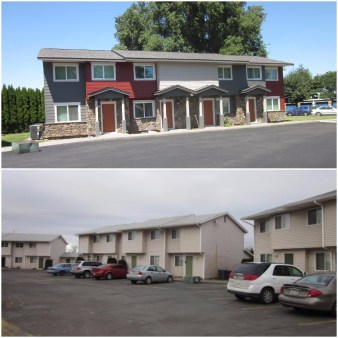
emerald_before_after

Before (bottom) and after (top) pictures of Emerald Family Properties buildings. Photo credits: Walla Walla Housing Authority

The Low-Income Housing Tax Credit (LIHTC) is one of the most effective tools for creating new and critically needed affordable housing, and accounts for the vast majority of all affordable rental housing created in the United States. This is one in a series of articles that show how public housing authorities (PHAs) and community development agencies have successfully used federal tax credits and tax-exempt bonds to build and/or preserve public housing and affordable housing, and to increase the sustainability of their communities.

Walla Walla Housing Authority: Emerald Family Properties

Walla Walla (Wash.) County has the largest affordable housing gap in the state of Washington, and so the pressure is high to keep existing public and affordable housing. Recently, the Walla Walla Housing Authority (WWHA) used a combination of 4 percent LIHTCs and tax-exempt bonds to revitalize and preserve the Emerald Family Properties, an 84-unit family development with two- to five-bedroom units in nine neighborhoods. The financing package allowed the housing authority to upgrade both the interiors and the exteriors of the units, and to increase energy efficiency in a way that would lower the utility costs for the residents. Emerald Family Properties has project-based vouchers attached to its units, and thus is able to serve very low-income families as well as those of moderate income.

“This project never would have pointed in the 9 percent LIHTC credit round, so the 4 percent LIHTC and tax-exempt bonds are essential financing tools that we use to address our community’s housing needs,” said WWHA Executive Director Renée Rooker. “Over the past five years, we have developed 245 units serving elderly individuals, veterans, persons with disabilities, and families by utilizing 4 percent LIHTCs and tax-exempt bonds. Besides Emerald Family Properties, we will have completed 80 more units in the next couple of weeks. None of this could have transpired without these financing tools.”

For more information about this project or to share your organization’s 4 percent LIHTC success story, please contact nahro@nahro.org.