New CRS Report on Federal Spending Trends

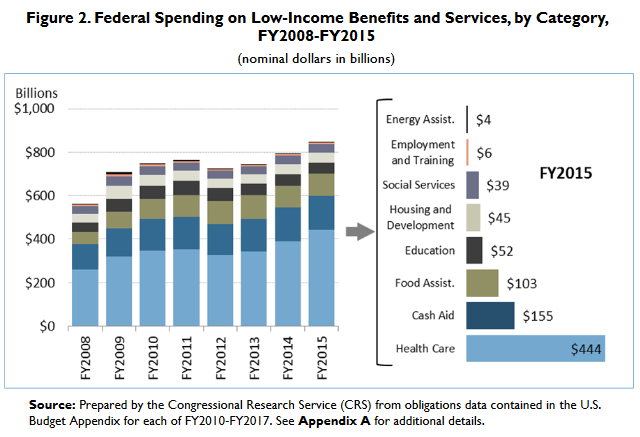
The Congressional Research Service recently created a report titled “Federal Benefits and Services for People with Low Income: Overview of Spending Trends, FY2008-FY2015.” The report is the latest in a series that attempts to identify and discuss programs and services oriented toward low-income populations, while focusing on aggregate spending trends.

The report contains some interesting charts that show how spending on housing compares to other categories of federal spending. The chart below from page 6 of the report shows spending by category. Notice that health care spending dwarfs the other categories, while “housing and development” is in the middle.

Federal-Spending-Chart-FY2015-CRS-Report

Read the full report here.

HUD Offering $2 million in ROSS Grants to Help Students Navigate College and Continuing Education Financial Aid Assistance

On August 2, HUD announced $2 million in grants to “help low-income families and young people apply for federal aid for college and other post-secondary educational opportunities.” The program is being funded through the Resident Opportunities and Self Sufficiency (ROSS) Program. The program will allow up to six public housing agencies (PHAs) to support “Education Navigators.”

HUD’s ROSS for Education Program is known as Project SOAR (Students + Opportunities + Achievements = Results).  It will “support hundreds of young people between the ages of 15 – 20 to apply for [the] U.S. Department of Education’s Free Application for Federal Student Aid (FAFSA).” HUD is also working with the Department of Education to share data about FAFSA completion and is working with the White House’s Social and Behavioral Sciences Team to develop methods to increase completion rates of the FAFSA among students with housing assistance.

Read HUD’s full press release here.

Read HUD’s Notice of Funding Availability (NOFA) here.

Read more about how behavioral economics can be used to “nudge” applicants receiving housing assistance to seek Federal Student Aid here.

HUD Holds MTW Expansion Teleconferences

HUD held its first two MTW Research Advisory Committee meetings on Tuesday, June 26 and Thursday, June 28. As stipulated by the FY 2016 Omnibus, the MTW Research Advisory Committee is tasked to advise HUD on how to move forward with the MTW expansion, especially with respect to specific policies to test in the expansion. The committee discussed potential policy proposals for each of the three statutory MTW objectives: cost effectiveness, self-sufficiency, and housing choice. On Tuesday, the committee discussed potential housing choice policies to implement through the expansion, and on Thursday, the committee discussed cost effectiveness and self-sufficiency. Thirty minutes per call were allotted to public comment. NAHRO staff commented on both calls, and transcripts of those comments can be found here and here (members only).

The committee will reconvene in person in Washington, DC sometime in mid-to-late August or early September. NAHRO staff plan to attend the in-person meeting.

Additional background information on the MTW Expansion can be found here (members only). NAHRO’s MTW policy proposals and research evaluation recommendations can be found here (members only).

Better Know a HUD Official

HUD’s Office of Policy Development and Research (PD&R) has published a message from Richard Green, Senior Advisor on Housing Finance in Edge, their online magazine. He makes five points, but there are two that are particularly interesting (and are related to the Federal Government) and are reproduced below:

The federal government relies too much on obsolete technology.

. . . Within HUD, for example, the FHA program relies on systems that are driven by coding in COBOL, a mainframe (!) language developed in 1959 (!!). Because almost no one uses COBOL anymore, our university computer science departments don’t train students in its use. As COBOL programmers retire, it will become impossible to find people to maintain the system.

On a more personal level, I was stunned to learn that my HUD PC had a 32-bit operating system in a world where 64-bit system have been around for PCs for 13 years. As a practical matter, 32 bit systems are limited in the amount of data they can analyze, whereas 64 bit systems are nearly unlimited. Many doing HUD work rely on large data sets (for example the Public Use Microsamples of the Census and the American Community Survey). The current standard for operating systems makes it relatively easy to use these datasets; the old standard requires compromises.

Few people know who the third most powerful person is in the Federal Government.

My guess is that the name Shaun Donovan is not well known outside the Beltway. But pretty much nothing gets done without the approval of the director of the Office of Management and Budget.

Assuming the most powerful person in the Federal Government  is the President, and third most powerful person is OMB Director, then who’s the second most powerful person? The Speaker of the House? The Senate Majority Leader? The Vice-President?

Read the full message here.


MTW Expansion Committee Conference Call and Summary of Policies

As mentioned in a prior blog post, the Moving to Work (MTW) Expansion Committee Conference Call is occurring now [Edit: The call ended at 4 pm]. HUD has also posted a summary of the policy proposals it has received to be potentially studied in MTW cohorts. Here are the numbers to call in:

  • United States –  (800) 230-1766;
  • Outside the United States – (612) 288-0329; and
  • Persons with hearing impairments – (800) 977-8339 and providing the FRS operator with the conference call toll-free number: (800) 230-1766.

The call is until 4 pm today. The next call will be at the following time:

  • July 28, 2016 – Cost-Effectiveness and Incentives to Increase Self-Sufficiency for Families with Children (1 pm to 4 pm).

Read the summary of policy proposals here.

Housing as a Basic Patient Need

The importance of housing is starting to permeate other professions, including medicine, as this post in the The New York Times Health and Wellness blog illustrates. Here’s a great quote:

Research also shows that providing housing for low-income and homeless people can substantially reduce medical costs. A housing initiative in Oregon, for example, decreased Medicaid spending by 55 percent for the newly housed; a study of a similar program in Los Angeles found that every $1 spent on housing led to $6 saved on medical costs.

Read the entire post here.

PAHRC Releases “Housing is a Foundation” 2016 Report

Today, July 20, PAHRC released its yearly research report for 2016 titled “Housing is a Foundation.” This year’s report focuses on the lack of available housing assistance, the people who receive housing assistance, and the beneficial impacts of housing assistance. The report supplies data to “foster a better understanding of the need for housing assistance and how this assistance helps meet the needs of low-income families and their communities.”

Here’s a great graphic on how helpful rental assistance is on all facets of a household.

https://www.housingcenter.com/sites/default/files/styles/panopoly_image_full/public/general/Summary.png?itok=lOA8Moub

The full report can be read here.

NAHRO Publishes New RAD Toolkit

Last week, NAHRO published the “RAD Toolkit,” a new online resource that serves as a primer for PHAs interested in HUD’s Rental Assistance Demonstration (RAD) program. This educative tool will provide PHAs with a background on RAD, a step-by-step outline of the conversion process and compliance, as well as links to additional resources important to understanding how to close a RAD transaction.

The RAD Toolkit was developed by the NAHRO Community Revitalization and Development (CR&D) Committee Redevelopment Task Force.

NAHRO members can access the toolkit here: www.nahro.org/RAD.

RADTOOLKIT2

MTW Research Advisory Committee – Conference Calls

The Moving to Work (MTW) Research Advisory Committee will be holding two public conference calls. The MTW Research Advisory Committee will advise HUD on how to move forward with the MTW expansion, especially with respect to specific policies to test in the expansion. The calls are open to the public, but members of the public must register to provide comment.

The calls are at the following dates and times [edit: the calls are until 4 pm; previously this post stated they were until 3 pm]:

July 26, 2016 – Increasing Housing Choice for Low-Income Families (1 pm to 4 pm); and

July 28, 2016 – Cost-Effectiveness and Incentives to Increase Self-Sufficiency for Families with Children (1 pm to 4 pm).

Use the following numbers to call-in:

  • United States –  (800) 230-1766;
  • Outside the United States – (612) 288-0329; and
  • Persons with hearing impairments – (800) 977-8339 and providing the FRS operator with the conference call toll-free number: (800) 230-1766.

To register, please click here.

Additional information on the call agendas can be found here.

Our prior blog post on these calls can be found here.

HUD Awards $75 Million in FSS Grants

Today, HUD announced that it was awarding $75 million in grants through the Family Self-Sufficieny (FSS) program. The grants allow for public housing residents, Housing Choice Voucher (HCV) program participants, and recipients of Project-Based Rental Assistance (PBRA) to advance their education or receive job-training skills. The grants allow public housing agencies (PHAs) to work with social service agencies, community colleges, businesses, and other local partners to help individuals participating in the program.

HUD’s press release on the awards can be found here.

A list of the grant awards can be found here.