HUD Releases Data-Sharing Road Map for PHAs and School Districts

In an effort to improve the educational outcomes of students living in public housing agencies and local redevelopment agencies, HUD has release a “Data-Sharing Road Map.” This Road Map will provide PHAs practical guidance, such as starting the data-sharing conversation and negotiating the data-sharing agreement, to establish partnerships with their local school districts. The Data-Sharing Road Map is based on the experience of PHAs that have successfully developed data-sharing agreements with their local school district.

NAHRO continues to partner with the Campaign for Grade-Level Reading and HUD on promoting and improving the education outcomes of children living in HUD-assisted properties.

HUD Posts 2017 Operating Fund Forms

On January 12, HUD posted 2017 electronic Operating Fund Forms 52723 and 52722 to the Financial Management Division (FMD) website. This is ahead of their target posting date of January 17. PHAs must submit their completed forms by February 7, 2017 to their local Field Office.

HUD to Publish Lead-Free Final Rule and additional AFH Tools

Tomorrow, January 13, 2017, HUD will publish in the Federal Register the lead-free final rule and additional Assessment of Fair Housing (AFH) tools. The final rule titled “Requirements for Notification, Evaluation and Reduction of Lead-Based Paint Hazards in Federally Owned Residential Property and Housing Receiving Federal Assistance; Response to Elevated Blood Lead Levels” adopts a revised definition of “elevated blood lead level” (EBLL) in children under the age of 6 to track the Centers for Disease Control and Prevention (CDC) guidance. The rule will become effective 30 days after publication and compliance will be required by 6 months after publication. NAHRO will provide additional coverage of the final rule in the next few days.

The Department also released two additional AFH tools:

  1. A Revised Local Government Tool: This tool is meant for use by CDBG, HOME, ESG or HOPWA recipients. One of the major changes to the tool is an insert for use by PHAs with 1,250 of fewer units that choose to collaborate with their local governments. NAHRO is pleased that HUD increased number of PHAs that can use this insert, making collaboration easier.
  2. A Final PHA Tool: The notice states that this tool has been approved, but “the Notice does not trigger the obligation of PHAs to conduct and submit an AFH . . . as HUD has not yet provided PHAs with the data they will need.” Again, one of the major changes from the proposed tool includes increasing the threshold for the Qualified PHA insert to 1,250 units.

NAHRO will continue to look through these tools and will provide additional coverage to our members in the coming days.

The Lead-Free final rule can be found here.

The Local Government AFH Tool can be found here.

The PHA AFH Tool can be found here.

Reminder!! Dr. Carson Confirmation Hearing for HUD Today!

The United States Senate Committee on Banking, Housing, and Urban Affairs  will hold a confirmation hearing for HUD Secretary-Designate Carson at 10 am ET on Thursday, January 12, 2017. The hearing will be held at the Dirksen Senate Office Building in Room 538.

The confirmation hearing will be webcast live on the Senate Committee on Banking, Housing, and Urban Affairs hearing website. Dr. Carson’s written testimony is also posted, here, on the Senate Banking Committee website.

John Bohm, NAHRO Acting CEO, is attending the hearing and additional coverage of the confirmation hearing will be available for members in the January 15 Monitor.

HUD Secretary-Designate Carson to Have Confirmation Hearing on 1/12/17

The United States Senate Committee on Banking, Housing, and Urban Affairs  will hold a confirmation hearing for HUD Secretary-Designate Carson at 10 am ET on Thursday, January 12, 2017. The hearing will be held at the Dirksen Senate Office Building in Room 538.

The confirmation hearing will be webcast live on the Senate Committee on Banking, Housing, and Urban Affairs hearing website.

NAHRO will cover this hearing and other HUD-related transition events in the coming weeks.


Book-Rich Environment Initiative Launched

On January 5th; HUD, Dept. of Education, and President Obama’s My Brother’s Keeper Task Force along with the Campaign for Grade-Level Reading (GLR), the National Book Foundation (NBF) and the Urban Libraries Council (ULC) launched the Book-Rich Environment Initiative at Washington, D.C.’s Southwest Public Library. HUD Secretary Julian Castro, Dept. of Education Secretary John King, and My Brother’s Keeper Task Force Chair Broderick Johnson along with Adrianne Todman, Executive Director of the District of Columbia Housing Authority spoke about the importance of education as the key to opening the door to future opportunities.2017-01-05_10-50-17_052

The Book-Rich Environment Initiative has three major components – Book Distribution, Partnership Building, and Library Engagement. Book Distribution will launch in Spring 2017 with local events that will introduce children and families to their local library, summer learning and literacy, and preparing to go back to school and success in the next grade level. Partnership building will focus on creating strong local partnerships between HUD-assisted housing providers; such as PHAs; with their local library, local and national non-profits and foundation, and the children and family served by these organizations. Library engagement between PHAs, the children and families living in HUD-assisted properties, and the local library is essential to keeping children engaged in reading. Engagement strategies include mobile libraries in public housing buildings, summer learning opportunities and registering children and families for library cards.

NAHRO attended the Book-Rich Environment Initiative launch and continues to partner with the Campaign for Grade-Level Reading and HUD on promoting and improving the education outcomes of children living in HUD-assisted properties.

More information on the Book-Rich Environment Initiative can be found, here, in HUD’s press release.


HUD OIG Publishes Semiannual Report to Congress

HUD’s Office of Inspector General (OIG) has published it’s Semiannual Report to Congress for the second half of fiscal year 2016. These reports are “intended to keep the Secretary and the Congress fully informed of significant findings, progress the Agency has made and recommendations for improvement.”

The report can be found here.

HUD Issues Final Rule Requiring Broadband Infrastructure in New Construction and Substantial Rehabilitation

Tomorrow, HUD will publish a final rule that requires the installation of broadband infrastructure at the time of new construction or substantial rehabilitation for multifamily rental housing that is funded or supported by HUD. Since the installation of broadband infrastructure may not be feasible for all new construction or substantial rehabilitation, the rule allows limited exceptions to the installation requirements.

The following programs will be covered by this final rule:

  1. Choice Neighborhoods Implementation Grant program;
  2. Community Development Block Grant (CDBG) program, including the CDBG Disaster Recovery program;
  3. Continuum of Care program;
  4. HOME Investment Partnerships program;
  5. Housing Opportunities for Persons With AIDS program;
  6. Housing Trust Fund program;
  7. Project-Based Voucher program;
  8. Public Housing Capital Fund program;
  9. Section 8 project-based housing assistance payments programs, including, but not limited to, the Section 8 New Construction, Substantial Rehabilitation, Loan Management Set Aside, and Property Disposition programs; and
  10. Section 202 and Section 811 Supportive Housing for the Elderly and Persons with Disabilities programs.

The rule will not apply to multifamily rental housing that only has a mortgage insured by HUD’s Federal Housing Administration or with a loan guaranteed under a HUD loan guarantee program.

The final rule does not change any of the substantive requirements that were in the proposed rule (members only), but adds clarifications on the threshold for substantial rehabilitation and on the point in the planning process for new construction or substantial rehabilitation at which a project must be to not be subject to the rule’s requirements. This final rule will become effective 30 days after the rule’s publication in the Federal Register.

This new rule supports the Obama Administration’s efforts to narrow the Digital Divide in the low-income communities served by HUD. Earlier this month, HUD also issued a final rule that will “modernize” the consolidated planning process for Community Planning and Development (CPD) formula grantees by adding the concepts of broadband access and vulnerability to natural hazard risks to the Consolidated Plan’s housing market analysis.

HUD Forms that Provide Expanded Housing Protections for Survivors of Violence Now Available

As NAHRO previously reported, HUD recently finalized a rule that will provide expanded housing protections for survivors of violence and fully codifies the provisions of the Violence Against Women Reauthorization Act (VAWA) of 2013 into HUD regulations.

HUD has made available the relevant forms necessary under the new rule:

  • Notice of Occupancy Rights under VAWA  (HUD-5380) that certain housing providers must give to tenants and applicants to ensure they are aware of their rights under VAWA and these implementing regulations;
  • New Certification form  (HUD-5382) for documenting incidents of domestic violence, dating violence, sexual assault, and stalking that must be used by housing providers;
  • Model emergency transfer plan (HUD-5381) that may be used by housing providers to develop their own emergency transfer plans; and
  • Model emergency transfer request form (HUD-5383) that housing providers could provide to tenants requesting an emergency transfer under these regulations.

HUD is currently translating these forms into 8 main language.

The final rule become effective on December 16, 2016 and housing providers must now include the Notice of Occupancy Rights and the new certification form with future denials or admissions of assistance notices and future eviction or termination of assistance notices.

Additionally, housing providers have until December 16, 2017 to provide existing tenants with the Notice of Occupancy Rights and the new certification form (via the annual recertification or lease renewal process, or through other means). Compliance with the final rule’s emergency transfer provisions is required no later than June 14, 2017.

Read more about HUD’s implementation of VAWA 2013 in the October 31, 2016 edition of the NAHRO Monitor (members only).

Five Communities Awarded $132 Million in Choice Neighborhoods Grants

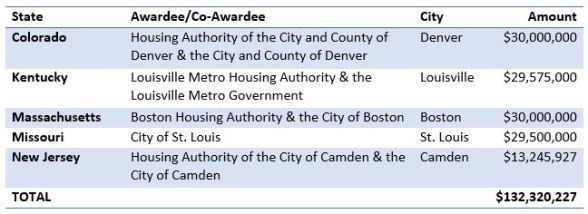
On December 12, HUD announced that five U.S. communities will receive a combined total of $132 million in FY 2016 Choice Neighborhoods Initiative (CNI) grant funds. The goal of the CNI is to aid struggling communities with severely distressed public housing or HUD-assisted housing by reinvesting in the community’s housing, residents, and neighborhoods.

These five communities will receive funding under the CNI’s Implementation Grant component, which supports communities that are ready to implement their neighborhood revitalization plan, or “Transformation Plan.” All five awardees are also past Choice Neighborhoods Planning Grant recipients.

The following communities will receive Implementation Grants:

cni-2016-awards

According to HUD’s press release, the awardees will replace 1,853 severely distressed public housing units with nearly 3,700 new mixed-income, mixed-use housing units, and leverage every $1 in Choice Neighborhood funding with an additional $5 in public and private funding for their project proposals. Together, the awardees and their partners are expected to leverage a combined total of $636 million through other public/private sources and indirectly stimulate another $3.3 billion in their local economies.

Read a summary of each grants here.