As previously mentioned on this blog, IMS-PIC will be down starting tomorrow (Friday, 3/13/2020) until the Monday after next (Monday, 3/23/2020). During this period, housing agencies are asked not to use the system so that a security-related patch may be applied. The Department is encouraging PHAs with programs with fiscal years that end prior to Dec. 31 to complete submission of their SEMAP certification prior to the system entering the shutdown phase. When the system resumes operation, the Department will publish step-by-step instructions for PHAs and Field Offices to address potential problems.
Tomorrow, HUD will publish a notice in the Federal Register announcing the creation of a HUD guidance portal. In the process of complying with a presidential executive order, the Department conducted a review of all of its guidance and ensured that those documents that remain in effect were linked to a single website that could be searched. The single searchable database containing all of HUD’s guidance can be found at:http://www.hud.gov/guidance.
The National Association of Housing and Redevelopment Officials applauds HUD for creating this searchable index and looks forward to further refinements.
The pre-publication copy of the notice announcing this portal can be found here.
The Department has released a new Infectious Disease Toolkit for Continuums of Care (CoCs). The toolkits provide “structure and specific examples for planning and responding to influenza, coronavirus, and other infectious diseases.” The toolkit is composed of three documents for CoC leadership, homeless service providers, and other partners to use in responding to infectious diseases. The documents include the following:
Additionally, one of our members wanted to share these coronavirus anti-stigma resources. They mostly apply to the local King County / Seattle area, but others may also find them useful.
Earlier today, HUD sent an email with links to fact sheets from the Centers for Disease Control and Prevention (CDC) about COVID-19 (popularly known as the coronavirus). The Department encourages PHAs to make the fact sheets available to their program participants. The fact sheets are listed below:
Tomorrow HUD will publish in the Federal Register “Economic Growth, Regulatory Relief, and Consumer Protection Act: Initial Guidance on Property Inspections and Environmental Reviews.” The act referred to in the notice is commonly call by its Senate bill number, S. 2155 and S. 2155 will be used in this post to refer to the act. NAHRO worked very closely with Congress to ensure S. 2155 provided statutory and regulatory relief to small PHAs across the country. Additionally, NAHRO also submitted comments to help guide HUD in the implementation of the provisions, many of which HUD incorporated into this notice. NAHRO is thrilled to see the critical provisions of S. 2155 being implemented!
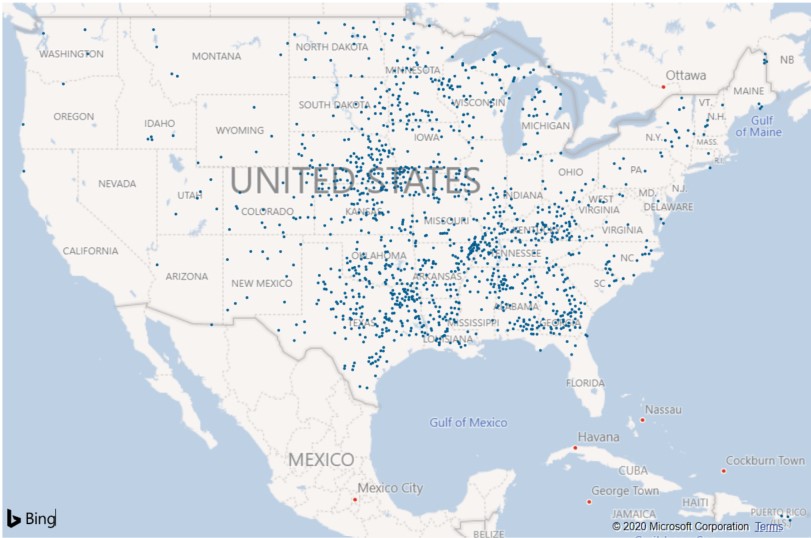
The notice also resolves a key sticking point in the implementation of S. 2155 – what is a small rural PHA? HUD defines “small rural PHA” as a PHA that operates 550 or fewer combined Public Housing and Housing Choice Voucher units and predominantly operates in a rural area. The notice takes NAHRO’s suggestions to exclude Project-Based Rental Assistance (PBRA) units in determining unit count. The notice also draws heavily on NAHRO’s comments on how to define “predominantly operates,” taking two out of three of NAHRO’s suggestions on the definition. “Predominantly operates in a rural area” is defined as having a primary administrative building with a physical address in a rural area OR more than 50 percent of its combined Public Housing units and voucher units under Section 8(o) are in a rural area. Rural area is defined by a Consumer Financial Protection Bureau regulation. Currently there are 1,519 PHAs that qualify as a “small rural PHA” under this definitions and HUD has published a list of small rural PHAs (scroll to bottom on HUD link page).
Map of Small Rural PHAs
The notice also implements potions of the property inspection and environmental review provisions of S. 2155.
Small rural PHAs that operate the Housing Choice Voucher programs can now inspect their tenant-based and project-based vouchers units every three (3) years. This new inspection schedule will begin for the small rural PHA after its next currently schedule inspection. Small rural PHAs must continue to conduct any lead safety inspection that are required under the Lead-Based Paint Poisoning Prevention Act.
Small rural PHAs will now be exempt from Environmental Reviews with respect to development or modernization projects that cost no more than $100,000. This exemption applies to any section 9(d) Capital Fund, section 9(e) Operating Fund, or section 8(o)(13) Project Based Voucher (PBV) eligible work activity by a small rural PHA at a project site with a project cost of $100,000 or less. For project with a cost of more the $100,000, the small rural PHA must complete the appropriate Environmental Review but HUD will use the rulemaking process to proposed streamlined Environmental Reviews.
NAHRO will continue to work with HUD to ensure full implementation of S. 2155, Economic Growth, Regulatory Relief, and Consumer Protection Act.
As previously mentioned on this blog, the Vera Institute of Justice (Vera) is seeking applications for technical assistance from PHAs that would like to plan and implement reentry programs or change their policies toward people with conviction histories. Applications are due in one week on Friday, February 28, 2020.
The goals of the initiative include the following: increase housing for people with conviction histories while increasing public safety; improve the safety of public housing through the use of reentry strategies; and promote collaboration between PHAs, law enforcement, and other criminal justice stakeholders.
Housing authorities of all sizes (including those with housing choice vouchers) are encouraged to apply. Applicants must submit a letter of intent, an application narrative, and letters of support. Award announcements will be made in April.
The notice states that FHA complaints involving requests for reasonable accommodations for assistance animals are on the rise. One of the purposes of this guidance is to help housing providers distinguish between a person with a non-obvious disability who has a legitimate need for an assistance animal and a person without a disability who wants to have a pet (or otherwise circumvent a rule applicable to a pet).
The guidance does several things. First, it provides a framework for identifying service animals. Second, it provides a framework to analyze reasonable accommodation requests under the Fair Housing Act for assistance animals other than service animals (There are two types of assistance animals–“service animals” and “support animals”; the latter are trained or untrained animals that do work, perform tasks, provide assistance, or emotional support for individuals with disabilities that do not fall under the service animals category). Third, the guidance provides criteria for assessing whether to grant a requested accommodation. Fourth, the guidance provides information on which types of animals (i.e., species of animals) are acceptable in which situations. Fifth, the guidance provides additional considerations that must be taken into account.
Additionally, there is a second section of the notice which provides a section on documenting an individual’s need for assistance animals in housing and provides a series of frequently-asked questions and accompanying answers.
The United States Supreme Court permitted the Department of Homeland Security (DHS) to make effective the administration’s public charge rule. The rule had been blocked from taking effect by a federal judge in New York. The Supreme Court allows it to be implemented in most of the country—except Illinois where it is still blocked. The rule states that any individual seeking a green card to become a lawful permanent resident (and individuals within the United States who hold non-immigrant visas and wish to extend their stay in the same non-immigrant classification or change their status to a different non-immigrant classification) is inadmissible if they are likely to become a public charge.
The rule defines a “public charge” based on the receipt of financial support from the general public through government funding, including federal rental assistance. The individual would need to receive one or more designated public benefits, including but not limited to federal rental assistance, for more than 12 months in the aggregate within any 36-month period to meet the threshold.
The Department of Homeland Security is not imposing any requirements on benefit-granting agencies through this final rule or a requirement that these agencies specifically verify information individuals submit to U.S. Citizenship and Immigration Services (USCIS). This rule does not change any of the Public Housing, HCV, or PBRA program requirements. The Department of Homeland Security plans to enter into information-sharing agreements with specific agencies (e.g., the Department of Housing and Urban Development) to obtain verification of the information supplied by applicants. Any information sharing will depend on the ability of the relevant agencies to share such information with DHS.
The Vera Institute of Justice (Vera) is offering a webinar that promises to inform potential applicants about the goals of the Opening Doors to Public Housing Initiative. The Opening Doors to Public Housing Initiative seeks to provide technical assistance to PHAs that wish to plan and implement reentry programs or change their admissions policies for people with conviction histories. Additionally, the webinar will provide an overview of the application requirements, allow time for questions from interested applicants, and present applicants from past Opening Doors sites who will share their experiences implementing reentry programs and changing their housing policies.
Housing authorities and their justice system partners are strongly encouraged to participate in the webinar, though it is open to all.
Opening Doors to Public Housing (Friday, January 17, 2020 at 1 pm ET)
Presenters include the following:
Andre Bethea, Policy Advisor, Corrections, Bureau of Justice Assistance, Office of Justice Programs, U.S. Department of Justice;
Laura Gregory, Resident Services Manager, Oklahoma City Housing Authority; and
Julio Sanchez, Senior Probation & Parole Officer, Delaware Correctional Reentry Commission (DCRC) In-reach Coordinator, Georgetown Probation & Parole.
The Vera Institute of Justice (Vera) is soliciting applications from PHAs that would like to plan and implement reentry programs or change their policies toward people with conviction histories. Applications are due February 28, 2020.
The goals of the initiative are the following (quoted from Vera):
increase housing access for people with conviction histories and increase public safety in communities that people return to on release from jails and prisons;
improve the safety of public housing and surrounding communities through the use of reentry housing strategies; and
promote collaboration among public housing authorities, law enforcement agencies, and other criminal justice stakeholders to effectively reduce crime and improve reentry outcomes for people leaving prisons and jails.
Vera encourages PHAs of all sizes–including those with Housing Choice Voucher (HCV) programs–to apply. Applicants must submit a letter of intent, an application narrative, and letters of support. While PHAs will first be informed, Vera will make a public announcement in April.


 The NAHRO Blog: Legislative & Policy Updates from Washington, DC