
Book-Rich Environment Initiative Launched

On January 5th; HUD, Dept. of Education, and President Obama’s My Brother’s Keeper Task Force along with the Campaign for Grade-Level Reading (GLR), the National Book Foundation (NBF) and the Urban Libraries Council (ULC) launched the Book-Rich Environment Initiative at Washington, D.C.’s Southwest Public Library. HUD Secretary Julian Castro, Dept. of Education Secretary John King, and My Brother’s Keeper Task Force Chair Broderick Johnson along with Adrianne Todman, Executive Director of the District of Columbia Housing Authority spoke about the importance of education as the key to opening the door to future opportunities.2017-01-05_10-50-17_052

The Book-Rich Environment Initiative has three major components – Book Distribution, Partnership Building, and Library Engagement. Book Distribution will launch in Spring 2017 with local events that will introduce children and families to their local library, summer learning and literacy, and preparing to go back to school and success in the next grade level. Partnership building will focus on creating strong local partnerships between HUD-assisted housing providers; such as PHAs; with their local library, local and national non-profits and foundation, and the children and family served by these organizations. Library engagement between PHAs, the children and families living in HUD-assisted properties, and the local library is essential to keeping children engaged in reading. Engagement strategies include mobile libraries in public housing buildings, summer learning opportunities and registering children and families for library cards.

NAHRO attended the Book-Rich Environment Initiative launch and continues to partner with the Campaign for Grade-Level Reading and HUD on promoting and improving the education outcomes of children living in HUD-assisted properties.

More information on the Book-Rich Environment Initiative can be found, here, in HUD’s press release.
HUD Publishes FY 2017 Section 8 Annual Adjustment Factors

Today, December 20, 2016, HUD published in the Federal Register a notice titled “Section 8 Housing Assistance Program–Annual Adjustment Factors, Fiscal Year 2017.” The notice announces the FY 2017 Annual Adjustment Factors (AAFs) for adjustment of contract rents on the anniversary of certain assistance contracts. The Housing Choice Voucher program does not use AAFs, and a separate notice is published announcing the renewal funding inflation factors (RFIFs) for that program. There are three categories of Section 8 programs that use the AAFs.

Category 1: The Section 8 New Construction, Substantial Rehabilitation, and Moderate Rehabilitation programs.

Category 2: The Section 8 Loan Management (LM) and Property Disposition (PD) programs.

Category 3: The Section 8 Project-Based Certificate (PBC) program.

Each Section 8 program uses AAFs differently, and the specific application of the AAFs is determined by the law, the HAP contract, and the program regulations and requirements.

The full notice can be found here.

HUD Issues New Certification Requirements for Housing Counselors

On December 14, HUD issued a final rule titled “Housing Counseling Certification” that codifies statutory requirements that housing counseling required under or provided in connection with all HUD programs will be provided by HUD-Certified Housing Counselors. In order to become certified, housing counselors must pass a standardized written examination and work for a HUD-approved housing counseling agency (HCA). The goal of these new requirements is to improve the knowledge and effectiveness of housing counselors that serve HUD-assisted renters, prospective homebuyers, or existing homeowners.

The final compliance date for the certification requirement is three years after the date the certification examination becomes available. HUD will publish a separate Federal Register notice to announce the start of the testing and certification process. However, some of the provisions of the final rule will become effective on January 13, 2017, including:

  • Requirement for agencies that provide homeownership counseling,
  • Requirement related to distribution of home inspection materials,
  • Provision for agencies found to have misused housing counseling program grant funds, and
  • Prohibition against distribution of funds to organizations convicted of violating election laws.

Access HUD’s resource page on the final rule here.

It is important to note that this new rule now covers not only participants in HUD’s Housing Counseling Program but also participants in other HUD programs including HOME Investment Partnerships, Community Development Block Grant, Public and Indian Housing, and FHA Single Family. Covered stakeholders will have three years from the date the certification examination becomes available to comply with the housing counselor certification requirement. A resource sheet for other HUD programs covered under this final rule is available here.

Additional coverage of the final rule will be available in the forthcoming edition of the NAHRO Monitor (members only).

Technical Correction to HUD’s VAWA 2013 Implementation Final Rule

On December 6, HUD will issue a technical correction to the “Violence Against Women Reauthorization Act of 2013: Implementation in HUD Housing Programs” final rule. This correction updates the compliance date for completing an emergency transfer plan and providing emergency transfers, and associated recordkeeping and reporting requirements to June 14, 2017. After the rule’s publication last month, HUD discovered the compliance date was incorrectly listed in the preamble as May 15, 2017, while the regulatory text provided the correct date of June 14, 2017. The final rule’s effective date (separate from the emergency transfer compliance date) is still December 16, 2016. 

New HUD Rule Makes Changes to HOME Commitment Requirement

Today, HUD issued an interim final rule for the HOME Investment Partnerships (HOME) Program that makes changes to how the Department will determine participating jurisdictions’ (PJs) compliance with the statutory 24-month commitment requirement.

Starting with Fiscal Year (FY) 2015 HOME grants, HUD will begin determining compliance using a grant-specific accounting method. In order to prevent PJs from losing appropriated funds when they expend program income, this rule also establishes a new method of administering program income.

Beginning in 2013, HUD has provided frequent discussions and training on the transition from the cumulative method to grant-specific method of accounting for its formula grant programs. With the exception of the new requirements related to program income, this rule does not establish new and unfamiliar requirements for PJs. Thus, HUD has elected to omit the advanced public notice and comment process. This interim final rule becomes effective on January 3, 2017

HUD is still accepting public comments on the rule however, and requests comments on the best way to treat program income to avoid loss of appropriated HOME funds. Public comments are due by January 31, 2017.

NAHRO staff will provide with a section-by-section analysis of this rule in the forthcoming edition of the NAHRO Monitor (members only).

[Note: This article previously reported  erroneous effective and comment due dates that were included in HUD’s final rule. HUD has since issued a technical correction and this article has been updated to reflect the correct dates.] 

HUD Releases Final Smoke-Free Rule

Earlier today, Wednesday, November 30, HUD released a press release for its final rule on smoke-free public housing. Secretary Castro announced the final rule in Boston, Massachusetts at a gathering that included NAHRO National President Stephen Merritt.

The smoke-free final rule will require PHAs to implement smoke-free policies over the next 18 months. The final rule “prohibits lit tobacco products (cigarettes, cigars, or pipes) in all living units, indoor common areas, administrative offices and all outdoor areas within 25 feet of housing and administrative office buildings.”

The rule makes two changes from the proposed rule. First, waterpipes (i.e., “hookahs”) are included in the list of products that may not be used in restricted areas. Second, HUD has changed the term “lit tobacco products” to “prohibited tobacco products.”

HUD’s full press release can be found here.

The text of the final rule can be found here.

NAHRO Provides Recommendations to the HUD 2017 Transition Team

Today NAHRO provided members of President-elect Trump’s HUD transition team with the NAHRO Transition 2017 recommendations. All recommendations and positions in this document have been previously approved by our standing committees and the NAHRO Board of Governors. We also intend to make ourselves available to the new transition team and supply them with any and all information and assistance they may require from us to make the transition at HUD under the Trump Administration as smooth as possible.

The transition recommendations can be used as you reach out to your local HUD officials, your elected officials who will be seated in the new Congress, the media and your own state and local officials in a united effort to move a responsible and responsive housing agenda forward at HUD and on Capitol Hill. In addition to this document, the association will also be producing the NAHRO 2017 Regulatory and Legislative Agenda, which will be drafted over the coming weeks with input from NAHRO membership and leadership and will be available at the NAHRO 2017 Washington Conference.

NAHRO’s Transition 2017 recommendations for HUD may be viewed here.

Report: Homelessness in the U.S. Continues to Decline

Earlier this week, HUD published Part 1 of the 2016 Annual Homeless Assessment (AHAR) Report, providing Congress with local estimates of sheltered and unsheltered persons experiencing homelessness on a single night in January 2016. According to the report, on a single night in 2016, there were 549,928 persons experiencing homelessness – a 14 percent decrease from 2010 and a 3 percent decrease over the past year. This decline was especially prevalent among families with children, Veterans, and individuals with long-term disabling conditions. Despite the downward trend of homelessness nationally, 13 states and the District of Columbia still saw an increase in their share of homelessness between 2015 and 2016.

The AHAR is typically released in two parts: Part 1 provides Point-in-Time (PIT) estimates that offer a “snapshot” of homelessness as reported by Continuums of Care (CoCs) across the U.S.; Part 2 offers in-depth detail on the characteristics of the homeless. The PIT methodology is regarded as a reliable estimate of the general size of the homeless population; however, it is important to note that it does not count every single homeless person, nor does it measure the number of people who are at risk of homelessness.

****

paperphoto

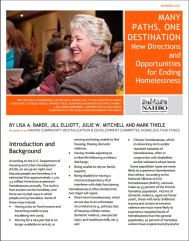
NAHRO members have long been on the front lines of preventing and ending homelessness. Read this recent NAHRO white paper to learn about public housing authority (PHA) collaborations and new directions and opportunities for ending homelessness.Case studies include: effectively ending veteran homelessness in Houston, Texas; implementing medical respite to save lives and reduce costs in Fargo, North Dakota.; and using a model for working with the chronically homeless in encampment settings by the City of West Sacramento, Yolo County, California.

HUD Final Rule Provides Expanded Housing Protections for Survivors of Violence

Today, HUD published a final rule in the Federal Register that provides expanded housing protections for survivors of violence and fully codifies the provisions of the Violence Against Women Reauthorization Act of 2013 (VAWA 2013) into HUD’s regulations. At its core, VAWA 2013 prohibits housing providers from denying or terminating housing assistance on the basis that an applicant or tenant is a survivor of violence.

The rule’s regulations become effective on December 16, 2016, and compliance with the rule with respect to completing an emergency transfer plan and providing emergency transfers, and associated recordkeeping and reporting requirements, is required no later than June 14, 2017.

Read more about the rule’s provisions in our blog post, published last month. A more in-depth analysis of the rule is also available in the NAHRO Monitor (members only).

[Note: After the final rule’s publication, HUD discovered an incorrect compliance date in the rule’s preamble, with respect to completing an emergency transfer plan and providing emergency transfers, and associated recordkeeping and reporting requirements. The compliance date was incorrectly listed as May 15, 2017, while the regulatory text provided the correct date of June 14, 2017. This blog post has been updated to reflect the correct compliance date of June 14, 2017]

HUD Releases Small Area FMR Final Rule

HUD will release the Small Area Fair Market Rents in Housing Choice Voucher Program Values for Selection Criteria and Metropolitan Areas Subject to Small Area Fair Market Rents Final Rule in the Federal Register tomorrow (November 16). HUD will also release a Notice in the Federal Register that would set the selection values for Small Area FMRs (SAFMRs). Subsequent SAFRMs will be specified through the Federal Register notice providing the public the opportunity to comment as new SAFMR designations are made. More information on HUD’s proposed rule (released June 2), can be found here (members only), and NAHRO’s comments can be found here (members only). NAHRO will hold a webinar on the final rule on Monday, December 19. Save the date and stay tuned for additional information.

In additional to other changes, the final rule includes additional criteria by which SAFMRs will be set. The final rule adds the vacancy rate of an area as a criterion and excludes metropolitan areas with a certain ACS vacancy rate from being designated a SAFMR area. The final rule also adds a threshold for the voucher concentration ratio to better target communities where voucher concentration is most severe.

As a result of the additional criteria, 7 Metropolitan Statistical Areas (MSAs) have been exempted from complying with the SAFMR final rule that were included in the proposed rule. These MSAs are:

  • Nassau County-Suffolk County
  • New York, NY
  • Oakland-Hayward-Berkeley, CA
  • Oxnard-Thousand Oaks-Ventura, CA
  • San Jose-Sunnyvale-Santa Clara, CA
  • Tacoma-Lakewood, WA
  • Virginia Beach-Norfolk-Newport News, VA

NAHRO will provide a detailed analysis of the final rule in the coming days. The final rule will go into effect 60 days after its publication date.