Why the 4% LIHTC Matters: Housing Commission of Anne Arundel County

Freetown Village

The Low-Income Housing Tax Credit (LIHTC) is one of the most effective tools for creating new and critically needed affordable housing, and accounts for the vast majority of all affordable rental housing created in the United States. This is one in a series of articles that show how public housing authorities (PHAs) and community development agencies have successfully used federal tax credits and tax-exempt bonds to build and/or preserve public housing and affordable housing, and to increase the sustainability of their communities.

Housing Commission of Anne Arundel County: Freetown Village

Freetown Village is an existing community built in 1977 on 9.6 acres in Pasadena, Maryland. It is currently owned and operated as public housing by the Housing Commission of Anne Arundel County (HCAAC).  The property includes 154 family apartments, ranging in size from one-bedroom to four-bedroom apartments. The current unit mix is 24 one-bedroom units, 48 two-bedroom units, 60 three-bedroom units, and 22 four-bedroom units, contained in 15 two-story townhome-style residential buildings, and two three-story garden-style buildings.

Freetown Village needs modernization and upgrades. The Rental Assistance Demonstration (RAD) Program provides an opportunity to access private capital in order to address the property’s physical needs and secure a more stable funding source for rental assistance long-term. HCAAC will use funding from four key resources of the Maryland Department of Housing and Community Development (DHCD): Tax-Exempt Bonds, 4% Low Income Housing Tax Credits, a soft loan from Rental Housing Works loan, and a construction and permanent loan using DHCD’s Risk Share loan product totaling more than $41.5 million. This project is contingent on the use of tax-exempt bonds and issuance of 4% Low income Housing Tax Credits, which have an anticipated commitment date of early 2018.

Existing units will be upgraded with:

  • New kitchen cabinets and counters
  • New kitchen appliances (refrigerators, ranges, range goods)
  • New bathroom vanities
  • New flooring
  • New entry doors
  • R-49 attic insulation
  • Install LED lighting replacement
  • Replace bathtubs with roll-in showers for Americans with Disabilities Act (ADA) units; other ADA upgrades.

In addition system and common area upgrades will include:

  • New hot water heaters
  • HVAC upgrades
  • Upgraded landscaping features
  • Seal/stripe parking spaces
  • Added insulation
  • LED lighting replacement
  • ADA sidewalk improvements
  • New playground
  • All new flooring in common rooms.

The proposal would also add 36 new homes to Freetown Village, including 24 2BR units (approximately 720 square feet) and 12 3BR units ( approximately 980 square feet). Anne Arundel County’s Workforce Housing requirements mandate 20 of the units would be reserved for households at or below 60 percent of Area Median Income. The other 16 units could be occupied by households up to 120 percent of Area Median Income.

For more information about this project or to share your organization’s 4 percent LIHTC success story, please contact nahro@nahro.org.

Why the 4% LIHTC Matters: Knoxville Community Development Corporation

2009-NorthRidge-Crossing-1024x576
KNOXVILLE’S COMMUNITY DEVELOPMENT CORPORATION (KCDC) RECENTLY ANNOUNCED A $33.1 REHABILITATION INITIATIVE AT THREE AFFORDABLE HOUSING PROPERTIES: LONSDALE HOMES, NORTH RIDGE CROSSING (PICTURED) AND THE VISTA AT SUMMIT HILL. THE IMPROVEMENTS WILL IMPROVE ENERGY EFFICIENCY AND QUALITY OF LIFE FOR RESIDENTS.

The Low-Income Housing Tax Credit (LIHTC) is one of the most effective tools for creating new and critically needed affordable housing, and accounts for the vast majority of all affordable rental housing created in the United States. This is one in a series of articles that show how public housing authorities (PHAs) and community development agencies have successfully used federal tax credits and tax-exempt bonds to build and/or preserve public housing and affordable housing, and to increase the sustainability of their communities.

Knoxville Community Development Corporation: Lonsdale Homes, North Ridge Crossing and The Vista at Summit Hill Properties

Knoxville’s Community Development Corporation (KCDC) recently approved a $33.1 million rehabilitation initiative at three affordable housing properties. In total, 705 units at Lonsdale Homes, North Ridge Crossing and The Vista at Summit Hill will undergo significant improvements with an emphasis on energy efficiency and quality of life for residents. The plans include better insulation, LED lighting, energy-efficient appliances, plumbing repairs, roof replacement and new windows, flooring, cabinets and countertops. The improvements will be funded with a combination of low-income housing tax credits and multifamily housing bonds. “This initiative will yield significant benefits for the three properties and the residents we serve,” KCDC Executive Director and CEO Ben Bentley said. “The physical condition of these properties will be greatly enhanced and that, in turn, leads to lower operational and maintenance costs.”

“These improvements further our mission of providing quality affordable housing for our residents,” Sean Gilbert, KCDC’s Senior Vice President of Housing, added. “KCDC has been able to dramatically impact the quality of life for 705 Knoxville families by utilizing the LIHTC 4% credit/tax-exempt bonds.  If not for these important financing tools, low-income families would be forced to reside in aging units with deteriorating structures and without modern amenities and improved energy efficiency.  Our families will be able to focus on job growth and their children’s education without the distraction of obsolete housing structures.”

The plans are part of KCDC’s transition of its public housing stock to the rental assistance demonstration (RAD) program, which was created by the U.S. Department of Housing and Urban Development (HUD) in 2012 to help agencies continue their housing mission without dependence on federal funds. The program allows housing agencies to leverage public and private debt and equity to reinvest in their properties.

For more information about this project or to share your organization’s 4 percent LIHTC success story, please contact nahro@nahro.org.
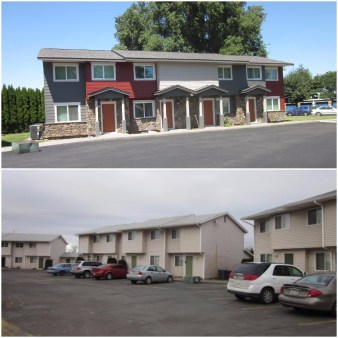
Why the 4% LIHTC Matters: Walla Walla Housing Authority

emerald_before_after

Before (bottom) and after (top) pictures of Emerald Family Properties buildings. Photo credits: Walla Walla Housing Authority

The Low-Income Housing Tax Credit (LIHTC) is one of the most effective tools for creating new and critically needed affordable housing, and accounts for the vast majority of all affordable rental housing created in the United States. This is one in a series of articles that show how public housing authorities (PHAs) and community development agencies have successfully used federal tax credits and tax-exempt bonds to build and/or preserve public housing and affordable housing, and to increase the sustainability of their communities.

Walla Walla Housing Authority: Emerald Family Properties

Walla Walla (Wash.) County has the largest affordable housing gap in the state of Washington, and so the pressure is high to keep existing public and affordable housing. Recently, the Walla Walla Housing Authority (WWHA) used a combination of 4 percent LIHTCs and tax-exempt bonds to revitalize and preserve the Emerald Family Properties, an 84-unit family development with two- to five-bedroom units in nine neighborhoods. The financing package allowed the housing authority to upgrade both the interiors and the exteriors of the units, and to increase energy efficiency in a way that would lower the utility costs for the residents. Emerald Family Properties has project-based vouchers attached to its units, and thus is able to serve very low-income families as well as those of moderate income.

“This project never would have pointed in the 9 percent LIHTC credit round, so the 4 percent LIHTC and tax-exempt bonds are essential financing tools that we use to address our community’s housing needs,” said WWHA Executive Director Renée Rooker. “Over the past five years, we have developed 245 units serving elderly individuals, veterans, persons with disabilities, and families by utilizing 4 percent LIHTCs and tax-exempt bonds. Besides Emerald Family Properties, we will have completed 80 more units in the next couple of weeks. None of this could have transpired without these financing tools.”

For more information about this project or to share your organization’s 4 percent LIHTC success story, please contact nahro@nahro.org.