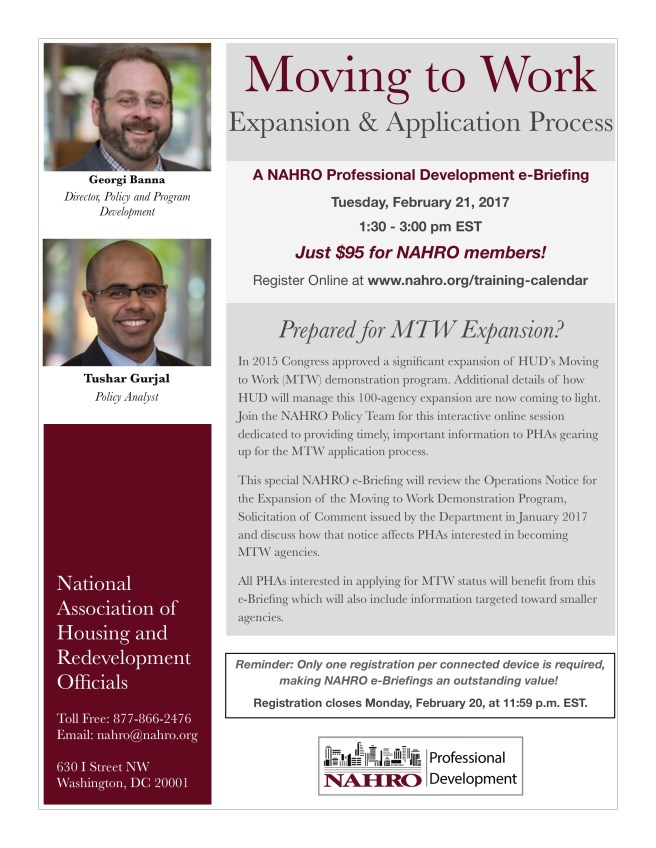
MTW Expansion e-Briefing on Tuesday February 21!

 Tomorrow NAHRO will present This Just in from Washington. It’s a new era in Washington; a new Congress and a new Administration will have major impacts on housing and community development programs. Join NAHRO’s Congressional Relations team for an interactive session that will help you navigate the new Congress and its relationship with the new Administration. John Bohm and Tess Hembree will give you an update on FY2017 appropriations, preview FY2018, outline potential legislative action on HCD programs, and discuss ways in which you can be the most effective advocate in this rapidly changing political climate.
Registration information for this e-Briefing is available through the NAHRO Professional Development calendar.
In 2016, the Department of Housing and Urban Development (HUD) was very busy setting forth new rules and regulations and providing updated notices and guidances on many of the HUD administered affordable housing programs. The year has also been marked by many legislative victories and a few challenges.
 NAHRO has drafted and compiled this Regulatory and Legislative Year in Review – 2016 to provide a primer of the topics on the forefront of the affordable housing industry. It can also provide you, your public housing agencies (PHAs) and local redevelopment agencies (LRAs) and your stakeholders with current information on many of the programs used and administered by HUD and the affordable housing community.
The full Regulatory and Legislative Year in Review – 2016, along with the individual topic one-pagers, is available on the NAHRO website. For the most up-to-date versions and information visit the NAHRO website and the NAHRO blog.
NAHRO Policy and Congressional teams are also conducting two e-Briefings through NAHRO Professional Development. The first is This Just in from Washington on January 31, 2017, where NAHRO’s Congressional team will give you an update on FY2017 appropriations, preview FY2018, outline potential legislative action on HCD programs, and discuss ways in which you can be the most effective advocate in this rapidly changing political climate. The second is part of the Housing Rules! Series, Moving Forward: A Review of 2016 Regulation and Legislation on February 7, 2017, where NAHRO’s Policy team will discuss many areas that HUD and Congress addressed during 2016 and NAHRO reviewed in detail in NAHRO’s Regulatory and Legislative Year in Review – 2016, which will provide a solid regulatory and legislative foundation as we work with the new Administration and new Congress to keep our affordable housing agenda moving forward. Registration information for both of these e-Briefings is available through the NAHRO Professional Development calendar.
Tomorrow, January 18, 2017, HUD will publish in the Federal Register a notice implementing certain Section 8 provisions of the Housing Opportunity Through Modernization Act of 2016 (HOTMA) titled “Housing Opportunity Through Modernization Act of 2016: Implementation of Various Section 8 Voucher Provisions.” These provisions include the following:
HUD is also soliciting information regarding the implementation of many of the provisions. NAHRO is still reading through the notice, but will provide more detailed coverage in the coming days to our members.
The provisions in the notice will take effect 90 days after tomorrow’s publication. [1/18/17 Edit – April 18, 2017.]
The comment deadline for the provisions will occur 60 days after tomorrow’s publication. [1/18/17 Edit – March 20, 2017.]
The pre-publication notice can be found here.
[1/18/17 Edit – The published notice can be found here.]
The United States Senate Committee on Banking, Housing, and Urban Affairs will hold a confirmation hearing for HUD Secretary-Designate Carson at 10 am ET on Thursday, January 12, 2017. The hearing will be held at the Dirksen Senate Office Building in Room 538.
The confirmation hearing will be webcast live on the Senate Committee on Banking, Housing, and Urban Affairs hearing website. Dr. Carson’s written testimony is also posted, here, on the Senate Banking Committee website.
John Bohm, NAHRO Acting CEO, is attending the hearing and additional coverage of the confirmation hearing will be available for members in the January 15 Monitor.
Last week, HUD published new guidance (notice CPD-16-17) for Housing Opportunities for Persons With AIDS (HOPWA) grantees explaining the changes to the HOPWA program that resulted from the passing and signing of the Housing Opportunity Through Modernization Act (HOTMA) on July 29, 2016. The passage of HOTMA was a huge victory for NAHRO and its members because it provided housing authorities with the effective tools and mechanisms to improve the operation of their programs. The new law also provided long-awaited amendments to the HOPWA statue that modernizes the program’s allocation formula, and addresses administrative provisions and adds program definitions. HUD’s new notice describes how the HOTMA provisions will effect HOPWA formula allocations for FY 2017 and beyond. The notice also details the program changes that became effective on July 29, 2016 versus the program changes that must be implemented by HUD through future rulemaking.
Learn more about the modernization of the HOPWA program in next edition of the NAHRO Monitor – available November 15, 2016 (members only).
On September 26, Principal Deputy Assistant Secretary Lourdes Castro Ramirez sent an e-mail to PHA executive directors identifying the self-implementing provisions of the Housing Opportunity Through Modernization Act of 2016 (HOTMA). All the other Housing Choice Voucher or Public Housing provisions will require HUD promulgated notices or regulations.
Five HOTMA Self-Implementing Provisions
Summer may officially be over, but it still feels very much like July here in DC (mostly because it’s about 197 degrees today); Congress returned to Capitol Hill on Monday, picking up where they left their negotiations over the upcoming fiscal year.
It’s a foregone conclusion at this point that a continuing resolution will be necessary to avoid a government shutdown on the first day of the new fiscal year, October 1. Prior to Congress’ early departure for the August recess in July, some lawmakers floated the idea of a six month CR that would delay final FY 2017 spending decisions until after the new Congress and the President swear into office (and right around the time the debt ceiling is set to expire).
This idea seems to have varying amounts of (seemingly dwindling) traction on Capitol Hill. However, the main driver behind the push is the House Freedom Caucus, which still feels burned by the work on appropriations, the budget, and taxes that was done very quickly at the end of calendar year 2015 without their input or support. Ideally, the House Freedom Caucus would like to entirely eliminate the Lame Duck session of Congress immediately following the election and adjourn the 114th Congress for the final time when lawmakers leave Washington for the election recess in October. Understanding that this is extremely unlikely to happen, they’ve targeted the CR as one of the main drivers of action during the Lame Duck session and are aiming to avoid quick spending decisions in December.
Senate Majority Leader Mitch McConnell (R-Ky.), who in the past had seemed somewhat open to a longer-term CR, signaled this week that he would like to move a CR that would expire on December 9 to the Senate floor as early as next week. Recognizing that a CR that expires in March was unlikely to gain enough Democratic support in the Senate to pass and, even if it did pass, would be vetoed by the President, Majority Leader McConnell made the decision to move quickly on a shorter-term bill to allow ample time for the House to work out their issues and approve a CR. Rumors are circulating of issues and Senators who could raise an objection to a CR blocking it from moving forward, though it doesn’t appear any actual plan to object has been substantiated. So, at this point, I am planning to watch for a vote on a two(ish) month CR in the Senate next week, but I will not be surprised when an issue like Zika delays it.
Whether or not the House Freedom Caucus will cause major problems for Speaker Paul Ryan (R-Wisc.) in his attempt to pass what is (eventually) sent over by the Senate is still unclear. The position of the caucus has not changed, but appears that progress was made today in a closed-door meeting with the House Republican Conference. A shutdown during an election year is highly unlikely, especially considering that House Democrats would probably support a straight CR, but I wouldn’t rule out considerable drama and suspense leading up to the end of the fiscal year. Remember last year, even though there wasn’t much of a threat of a shutdown, House Freedom Caucus members still managed to oust Speaker John Boehner (R-Ohio) from both his Speaker position and Congress (though the jury is still out on the actual reason why he resigned).
Another complicating factor that makes a longer-term CR even more unlikely is the score the Congressional Budget Office (CBO) recently assigned to a theoretical year-long CR for FY 2017: $1.08 trillion, which is $10 billion higher than the allowable cap set by the 2015 budget deal. This is caused by several factors, mainly spending cuts (CHIMPS) from FY 2016 that do not automatically continue into FY 2017. If a long-term CR is approved, appropriators will have to either find ways to offset the additional spending, cut specific programs, or allow across the board spending cuts in order to avoid triggering the automatic sequestration that is still in place until FY 2020. The longer the CR, the more difficult offsetting that spending becomes.
To make matters more complicated, only the non-defense discretionary accounts are over the cap, not defense, so drafting any CR that would violate the FY 2017 cap would transform a simple date change in the existing appropriations law to either a much more complicated task or a huge political fight over cutting defense spending. And in election years when Congress can delay controversial decisions, the delay typically wins out.
I’m optimistic that I’ll be able to provide a very short update next week that the Senate has approved a CR that expires on December 9 , but we’ll keep you updated if anything changes throughout the week.
Have a great weekend!!
-Tess
Our friends at the National Housing Conference (NHC) and the Public Housing Authorities Director’s Association (PHADA) have written a blog post with a series of beautiful maps on historical Small Area Fair Market Rent (SAFMR) volatility on NHC’s Open House Blog. Here’s a map from the blog post on the Washington-Arlington-Alexandria HUD Metro Fair Market Rent (FMR) area.

I recommend looking at the blog post to read their take on SAFMRs and volatility and to see the other maps.
Here are a couple of points that I would like to note to further this conversation.
The methodology for calculating Fair Market Rents (and SAFMRs) is changing
In calculating the final FY 2016 FMRs HUD switched from a “historical-based annualized change in gross rent trend factor [to] a forward-looking forecast . . . [that] uses a model that forecasts national rent and utility [Consumer Price Index] indices based on economic assumptions used in the formulation of the President’s Budget.”[1] Since the methodology has changed, we need a time horizon of a few years to see if the volatility remains as bad a problem as before the methodological change.
Additionally, Peter Kahn, the Director of HUD PD&R‘s Economic Market Analysis Division, has stated the following:
We are looking at ways throughout the proposed ’17 FMR process of addressing that . . . variability in general. When the proposed ’17 FMRs are out, the . . . you can read that preamble and see that we are trying to take steps to address that variability. (See the YouTube clip where he said that here.)
Will HUD be successful in addressing this volatility? I don’t know, but it’s good that they’re aware of the problem and are taking steps to address the issue.
The passage of the Housing Opportunity Through Modernization Act of 2016 (HOTMA) may give PHAs a tool in managing volatility of payment standards based on both FMRs and SAFMRs
HOTMA has a provision that allows PHAs to hold harmless households that live in areas that receive lower FMRs. Section 107(b) of HOTMA states that “no public housing agency shall be required as a result of a reduction in the fair market rental to reduce the payment standard applied to a family continuing to reside in a unit for which the family was receiving assistance . . . at the time the fair market rental was reduced.” It is NAHRO’s understanding that this provision will apply to payment standards based on FMRs and SAFMRs.
The chart below shows how if a provision allowing for payment standards to be held harmless was in place between 2010 and 2016, then volatility may have been reduced in some instances. The blue line shows the actual Washington-Arlington-Alexandria FMR for 2 Bedroom units. The orange line shows what a payment standard based on that FMR would have been, had it been held harmless.
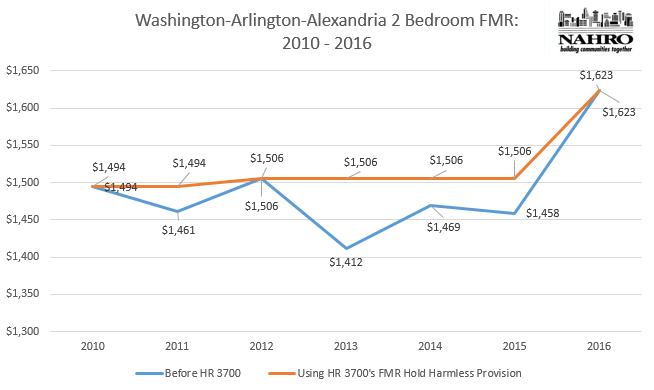
The HOTMA provision has the ability to reduce volatility in certain instances, though holding FMR payment standards harmless may have budget implications. Another point to remember is that when the payment standard starts being held harmless matters. In the chart above, if the payment standard starts being held harmless in 2013, then the volatility that results from increases in the FMR will still occur.
Although the chart above shows a payment standard based on a FMR being held harmless, the same principle would apply to payment standards based on SAFMRs.
[1] – 80 Fed. Reg. 77,124 (December 11, 2015).
 The NAHRO Blog: Legislative & Policy Updates from Washington, DC