Report: Homelessness in the U.S. Continues to Decline

Earlier this week, HUD published Part 1 of the 2016 Annual Homeless Assessment (AHAR) Report, providing Congress with local estimates of sheltered and unsheltered persons experiencing homelessness on a single night in January 2016. According to the report, on a single night in 2016, there were 549,928 persons experiencing homelessness – a 14 percent decrease from 2010 and a 3 percent decrease over the past year. This decline was especially prevalent among families with children, Veterans, and individuals with long-term disabling conditions. Despite the downward trend of homelessness nationally, 13 states and the District of Columbia still saw an increase in their share of homelessness between 2015 and 2016.

The AHAR is typically released in two parts: Part 1 provides Point-in-Time (PIT) estimates that offer a “snapshot” of homelessness as reported by Continuums of Care (CoCs) across the U.S.; Part 2 offers in-depth detail on the characteristics of the homeless. The PIT methodology is regarded as a reliable estimate of the general size of the homeless population; however, it is important to note that it does not count every single homeless person, nor does it measure the number of people who are at risk of homelessness.

****
paperphoto

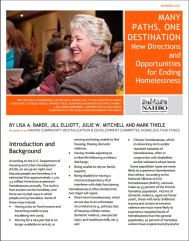
NAHRO members have long been on the front lines of preventing and ending homelessness. Read this recent NAHRO white paper to learn about public housing authority (PHA) collaborations and new directions and opportunities for ending homelessness.Case studies include: effectively ending veteran homelessness in Houston, Texas; implementing medical respite to save lives and reduce costs in Fargo, North Dakota.; and using a model for working with the chronically homeless in encampment settings by the City of West Sacramento, Yolo County, California.

HUD Family Options Study: HCV Most Effective and Rapid Re-Housing Least Costly

On October 25, HUD’s Office of Policy Development and Research (PD&R) released a report titled Family Options Study: Long-Term Impacts of Housing and Services Interventions for Homeless Families, which seeks to identify the most efficient and cost-effective way to house and serve homeless families with children.capture

The report presents the long-term (37 months) outcomes of HUD’s Family Options Study, which tracked how homeless families in emergency shelters across 12 U.S. communities responded to various homelessness interventions. Between September 2010 and January 2012, over 2,000 families were enrolled and randomly assigned to participate in one of four homelessness interventions: housing subsidy, community-based rapid re-housing, project-based transitional housing, and usual care (defined as any housing or services that a family accesses in the absence of immediate referral to the other interventions).

The study found long-term housing subsidies, typically Housing Choice Vouchers, had the greatest impact on reducing family homelessness and improving non-housing family outcomes (i.e., increased adult well-being, child well-being, food-security, and less economic stress). While not as effective as housing vouchers, rapid re-housing programs were significantly less expensive, with an average per-family monthly cost of approximately $800, compared to voucher at $1,172/month, transitional housing at $2,700/month and emergency shelter programs at $4,800/month.

Read more about HUD’s study and findings here.


HUD Finalizes Rule to Expand Housing Protections for Survivors of Violence

On October 24, HUD announced the impending publication of a final rule that will expand the housing protections for victims of  domestic violence, dating violence, sexual assault, and stalking (hereinafter known as “victim”) regardless of sex, gender identity, sexual orientation, or age. The final rule will fully codify the provisions of the Violence Against Women Reauthorization Act of 2013 (VAWA 2013) into HUD’s regulations.

At its core, VAWA 2013 prohibits housing providers from denying or terminating housing assistance on the basis that an applicant or tenant is a victim. HUD’s final rule expands the universe of HUD rental assistance programs subject to the VAWA 2013 statute beyond Public Housing and Section 8 programs to also include:

  • Housing Trust Fund (HTF) – a program originally not listed under VAWA 2013;
  • HOME Investment Partnerships (HOME) program;
  • Housing Opportunities for Persons With AIDS (HOPWA) program;
  • HUD’s McKinney-Vento Homeless programs;
  • Section 811 Supportive Housing for Persons with Disabilities;
  • Section 202 Supportive Housing for the Elderly;
  • Section 221(d)(3) Below Market Interest Rate (BMIR) Program
  • Section 236 Rental Program

These programs, along with properties assisted through the USDA Rural Housing programs and the Low-Income Housing Tax Credit program, are collectively referred to as “covered housing programs.”

Overall, HUD’s final rule:

  • Codifies the core protections under VAWA 2013 across HUD’s covered programs by ensuring survivors are not denied assistance as an applicant, or evicted or have assistance terminated due to the individual’s victim status, or for being affiliated with a victim.
  • Provides a model emergency transfer plan for housing providers and explains how housing providers must address their tenants’ requests for emergency transfers.
  • Offers protections against the adverse effects of abuse that can often have negative economic and criminal consequences on a survivor. For example, a perpetrator may take out credit cards in a survivor’s name, ruining their credit history. Covered housing providers may  not deny tenancy or occupancy rights based solely on adverse factors that are a direct result of being a survivor.
  • Makes clear that under most circumstances, a survivor need only to self-certify in order to exercise their rights under VAWA, there by “ensuring third party documentation does not cause a barrier in a survivor expressing their rights and receiving the protections needed to keep themselves safe.”

HUD’s final rule is currently pending publication in the Federal Register. Once published, the rule’s regulations will become effective after 30 days.

An in-depth analysis of the final rule can be found in the October 30, 2016 edition of the NAHRO Monitor (members only).


HUD to Release Long-Term Outcomes of Family Options Study

On October 25, HUD will release the long-term outcomes of the Family Options Study. The study was a “multi-site random assignment experiment designed to study the impact of various housing and services interventions for homeless families.” Homeless families across the nation in twelve communities were assigned one of four possible interventions:

  1. subsidy only;
  2. project-based transitional housing;
  3. community-based rapid re-housing; or
  4. usual care.

Families were tracked for a minimum of 37 months and metrics on housing stability, family preservation, adult well-being, and self-sufficiency were collected.

HUD will be announcing the long term results of the interventions on October 25. The event can be attended in person at the Brooke-Mondale Auditorium at HUD Headquarters or via webcast.

Register for the event here.

HUD Makes $33 Million Available for the Youth Homelessness Demonstration Program

Yesterday, HUD published the Youth Homelessness Demonstration Program (YHDP) Notice of Funding Availability (NOFA), opening up a competition to award $33 million to up to 10 communities (including 4 rural) across the nation. Awardees of the competition will use the federal resources to design and implement a coordinated community approach to ending youth homelessness.

YHDP applications must be submitted by a community’s  Continuum of Care (CoC) Collaborative Applicant and must be co-developed with a wide spectrum of community partners, including a youth advisory board (required), a state or local child welfare agency (required), youth homelessness housing and service providers, local school districts, workforce development organizations, law enforcement, judges, corrections and more.

YHDP applications are due by Wednesday, November 30, 2016. Additional information on the demonstration program can be found on HUD Exchange.

HUD-VASH Second Round Funding Announced

Yesterday, HUD and the United States Department of Veterans Affairs (VA) announced a second round of HUD-VASH funding. HUD-VASH combines vouchers from HUD with case management and clinical services provided by VA. Since 2008, more than 79,000 vouchers have been awarded. This round of funding provides 108 vouchers and $871,056 worth of funding.

A list of PHAs that have been awarded HUD-VASH vouchers can be found at HUD’s press release here.

HUD Publishes Integrity Bulletins for CPD Formula Grantees

The HUD Offices of the Inspector General (OIG) and Community Planning and Development (CPD) have developed Integrity Bulletins that cover topics representing issues that CPD formula grantees often struggle with: procurement and contracting; sub-recipient oversight; conflicts of interest; internal controls; documentation and reporting; and financial management.

The four Integrity Bulletins available include:

HUD Updates Resource Locator App

HUD recently updated their Resource Locator app. The app, which is available for both Android and Apple products as well as a web-based version, maps HUD field offices, affordable housing property management companies, and public housing authority representatives to answer housing availability inquiries and general housing questions. The app includes information about commonly requested housing-related resources from HUD field and regional offices throughout the country; location data and contact information for HUD Field and Regional Offices, PHAs, Multifamily Housing, LIHTC apartments, USDA Rural Housing, Homeless client referral contacts; and provides maps linked via Facebook, Twitter, Google+, email, and text messages. The app uses GIS and Browser Location Detection to show local resources and users can export search results to Excel and generate a custom PDF resource guide. The HUD Resource Locator mobile app is available via Apple iTunes, Google Play Marketplace and through the web browser.

Moving On from Supportive Housing Toolkit

Corporation for Supportive Housing (CSH) has developed a new Moving On Toolkit for supportive housing providers, Continuums of Care, PHAs, state and local government agencies and other organizations that would like to plan, develop, sustain and evaluate Moving On initiatives within their communities. Moving On initiatives provide rental subsidy and transition assistance to tenants who are able and want to move out of supportive housing and into a new apartment. The toolkit outlines the various phases and steps in the Moving On process and offers numerous links and helpful resources, including descriptions of previous or existing Moving On projects and practical tools or templates developed by implementing organizations. According to CSH, the fundamental goal of Moving On is to promote the highest levels of independence and choice for tenants. HUD has previously provided public support for Moving On but current initiatives only exist on a small scale through scattered pilots.

Administration Announces Steep Decline in Veteran Homelessness

Today–HUD, the U.S. Department of Veterans Affairs (VA), and the U.S. Interagency Council on Homelessness (USICH) announced that the number of veterans experiencing homelessness in the United States has declined significantly since 2010. According to HUD’s Point-in-Time (PIT) estimates, there has been a 47 percent decrease in the number of veterans experiencing homelessness since 2010 and a 17 percent decrease since 2015.

HUD believes that this decline is a function of partnerships between HUD and VA, USICH, and other partners at all levels of government (i.e., federal, state, and local) and the HUD-VASH program. The partnerships were a result of Opening Doors, the federal strategic plan to prevent and end homelessness.

Read HUD’s full press release here.

Read more about Opening Doors here.

View HUD’s PIT Estimates of Veteran Homelessness in the U.S. here.