September is Attendance Awareness Month

As schools get into full swing this month, September is Attendance Awareness Month. For schools to work as centers of learning, it is important for students to be in class. Attendance Works focuses on the importance of student attendance and tracking student attendance data. PHAs and community development organizations can be an important partner with families and schools to insure increased school attendance and therefore improved educational outcomes for the children living in affordable housing..

As part of Attendance Awareness Month, Attendance Works is hosting a webinar on using attendance data.

Thursday, September 8, 2016: Ensuring an Equal Opportunity to Learn: Leveraging Chronic Absence Data for Strategic Action, 11-12:30 pm (PT) / 2-3:30 pm (ET). Register now.

In June 2016, the U.S. Office for Civil Rights released its first national count of students who were chronically absent. The data showed a staggering 6.5 million students were chronically absent, which means that they missed so much school that their ability to read well and gain fundamental skills and knowledge for college and career was hampered. In the 500 most heavily impacted districts, over 30% of students were chronically absent.

Join experts Hedy Chang, Executive Director of Attendance Works and Dr. Robert Balfanz, Director of the Everyone Graduates Center at Johns Hopkins University as they release a major national study analyzing the data and more importantly, showing how leaders at the local, state and national levels can take strategic action to monitor and address chronic absence in order to ensure an equal opportunity to learn and succeed.

 The webinar will provide suggestions and tips on to become engaged in attendance awareness month activities such as displaying an attendance poster at housing sites, establishing or expanding programmatic interventions such as a mentoring program, etc.

More information on Attendance Awareness Month and Attendance Works can be found at: http://awareness.attendanceworks.org/.
Assessment of Fair Housing Tool for Local Governments with Proposed Changes Now Available

As NAHRO previously reported, on August 23, HUD published a 30-day Notice in the Federal Register seeking additional public feedback on the proposed changes to HUD’s Affirmatively Furthering Fair Housing (AFFH) Local Government Assessment Tool (Local Government Tool). The Local Government Tool is the standardized tool that communities receiving HUD Community Planning and Development (CPD) formula grant dollars must use to conduct and submit their Assessments of Fair Housing (AFH).

The 30-day Notice proposes a number of additions to the Local Government Tool that would, ideally, help simplify the AFH process for Qualified Public Housing Authorities (QPHAs), defined as PHAs not designed as “troubled” with a combined unit total of 550 or less, and for local governments receiving small CPD formula grants. The tool would include two new sections for streamlined assessments for QPHAs and small local governments, called “inserts.”  QPHAs and local governments seeking to fulfill their Fair Housing requirements through these streamlined “inserts” must be involved in a joint or regional collaboration with a local government as the lead entity.

The proposed Local Government Tool with the new “inserts” is now available for public viewing on  HUD Exchange. The deadline to respond to the 30-day Notice and comment on the Local Government Tool is September 22, 2016.

HUD Announces Changes to the AFFH Assessment Tools for Small PHAs and Local Governments

On August 23, HUD will publish a 30-day notice in the Federal Register seeking public feedback on the Local Government Assessment Tool, the instrument with which communities receiving HUD Community Planning and Development (CPD) formula grant dollars must use to conduct and submit their Assessment of Fair Housing (AFH) analysis, as required by the Affirmatively Furthering Fair Housing (AFFH) Final Rule.

Due to limited staff and resources, NAHRO has long-requested for HUD to streamline the AFFH assessment tools for small program participants. The 30-day Notice announces two substantial changes that would, ideally, help simplify the AFH process for Qualified Public Housing Authorities (QPHAs), defined as PHAs not designed as “troubled” with a combined unit total of 550 or less, and for local governments receiving small CPD formula grants:

  • HUD seeks to revise the existing Local Government Assessment Tool to include two new streamlined assessments for small program participants, called “inserts.” The first insert would be for use by QPHAs and the second insert would be for use by local governments that received a CBDG grant of $500,000 or less in the most recent fiscal year prior to the AFH due date. QPHAs and local governments seeking to fulfill their AFFH requirements through these streamlined inserts must be involved in a joint or regional collaboration with a local government as the lead entity.
  • HUD seeks to issue a fourth assessment tool for Qualified PHAs. Prior to this notice, HUD had committed to issuing only three AFFH assessment tools (Local Government, State and Insular Areas, and PHA-only). The new QPHA Assessment Tool would be for use by a QPHA or by multiple QPHAs jointly collaborating to submit an AFH. HUD assumes that many QPHAs will want to take advantage of this option, particularly those unable to enter into a joint or regional collaboration with another partner. HUD intends to issue a separate public notice and comment process for this new tool.

The 30-day notice also addresses the public comments received in response to the 60-day information collection notice that was published on March 23, 2016 (see NAHRO’s comments here). NAHRO’s next issue of The Monitor (members only) will have additional details about the contents of the 30-day notice.

GAO Publishes Report on HUD Management

On August 19, the United States Government Accountability Office (GAO) made publicly available a report it wrote for congressional requesters. The report found that HUD has “not consistently incorporated requirements and key practices  identified by GAO to help ensure effective management into its operations.”

The report identified five management functions and discusses how completely HUD implemented prior GAO recommendations. Selected excerpts can be found below:

Performance planning and reporting – “HUD met most of the requirements in the GPRA Modernization Act of 2010 for its strategic plan and annual performance plan and report . . . [b]ut HUD’s strategic plan does not clearly link HUD’s goals and objectives with federal priority goals.”

Information technology management – “HUD has not demonstrated that it has the capacity to effectively plan for and manage IT projects.”

Human capital management – “HUD has made progress in developing new human capital plans and mostly followed key principle and practices for strategic workforce planning, succession planning, and training planning.”

Financial management – “HUD did not follow seven of eight key practices for financial management.”

Acquisition management – “HUD partially followed key practices for acquisition relating to organizational alignment and human capital.”

The report recommends that HUD take the following eight actions:

  1. Link HUD’s goals and objectives with federal priority goals;
  2. Describe why HUD’s goals were not met and HUD’s plans for achieving them;
  3. Establish procedures and time frames to reach out to Congress and stakeholders to ensure that the strategic plan meets statutory requirements;
  4. Establish a process and schedule to review and update HUD’s human capital strategic plan; strategic workforce plan; and succession plan;
  5. Establish a process and schedule to update policies and procedures to help ensure that policies and procedures for key management functions remain current and complete;
  6. Formalize lines of communication between the Chief Information Officer and the agency head;
  7. Designate entities within program offices for fraud risk management activities; and
  8. Develop written policies for conducting program evaluations.

Thanks to PHADA for bringing this report to our attention.

The full report can be found here. The PDF can be found here.

The highlights page can be found here.

Interactive Tool Shows the Challenges in Affordable Housing Development

The Urban Institute and National Housing Conference have published an interactive and educative tool, “The Cost of Affordable Housing: Does It Pencil Out,” that demonstrates the huge gap between what it costs to build and maintain affordable housing and the affordable rent that low-income families can pay, making it difficult to finance affordable housing without additional subsidy. Aimed at policymakers and those new to the affordable housing world, users can play with the tool by changing specific variables on development costs and see how a development’s funding gap can be closed. The tool spotlights the importance of federal programs that support affordable housing, such as the Low-Income Housing Tax Credit (LIHTC) – which is the largest source of capital supporting the affordable housing inventory in the United States.

The formidable gap in financing affordable housing development is why it is important for the public to call on Congress to pass Sen. Maria Cantwell’s (D-Wash.) and Sen. Orrin Hatch’s (R-Utah) Affordable Housing Improvement Act of 2016. This legislation would expand the overall LIHTC allocation authority by 50 percent and make permanent the 4 percent Housing Credit rate. For more information on this legislation, visit NAHRO’s Community Development Resource Center (log-in required) to access a one-pager on the bills.

HUD Publishes Integrity Bulletins for CPD Formula Grantees

The HUD Offices of the Inspector General (OIG) and Community Planning and Development (CPD) have developed Integrity Bulletins that cover topics representing issues that CPD formula grantees often struggle with: procurement and contracting; sub-recipient oversight; conflicts of interest; internal controls; documentation and reporting; and financial management.

The four Integrity Bulletins available include:

HUD Publishes Housing Trust Fund Income Limits and Guidance on Environmental Provisions

In May 2016, HUD announced the first-ever National Housing Trust Fund (HTF) allocations to states, amounting to nearly $174 million in available funds for FY 2016. HUD recently published the HTF Income Limits for FY 2016, which are calculated using the following methodologies:

  • The formula that HUD uses for calculating the income limits for the Section 8 program, in accordance with Section 3(b)(2) of the U.S. Housing Act of 1937, as amended. These limits are based on HUD estimates of median family income, with adjustments based on family size.
  • The Federal Poverty Line as determined by the U.S. Department of Health and Human services, published annually in the Federal Register.

In years in which the total amount available for allocations is below $1 billion (as is the case for FY 2016), the income limit reports will only display the limit for extremely low income families or families with incomes at or below the poverty line (whichever is greater) and will not include the very low income limit. The HTF FY 2016  Rent Limits are also available online, both limits became effective on July 1, 2016.

Additionally, HUD has made available new guidance entitled, “Requirements for Housing Trust Fund Environmental Provisions.” This notice describes the Environmental Provisions for new construction and rehabilitation that are required for HTF projects under the Property Standards at 24 CFR § 93.301(f)(1) and (2).

HUD Updates Resource Locator App

HUD recently updated their Resource Locator app. The app, which is available for both Android and Apple products as well as a web-based version, maps HUD field offices, affordable housing property management companies, and public housing authority representatives to answer housing availability inquiries and general housing questions. The app includes information about commonly requested housing-related resources from HUD field and regional offices throughout the country; location data and contact information for HUD Field and Regional Offices, PHAs, Multifamily Housing, LIHTC apartments, USDA Rural Housing, Homeless client referral contacts; and provides maps linked via Facebook, Twitter, Google+, email, and text messages. The app uses GIS and Browser Location Detection to show local resources and users can export search results to Excel and generate a custom PDF resource guide. The HUD Resource Locator mobile app is available via Apple iTunes, Google Play Marketplace and through the web browser.

New CRS Report on Federal Spending Trends

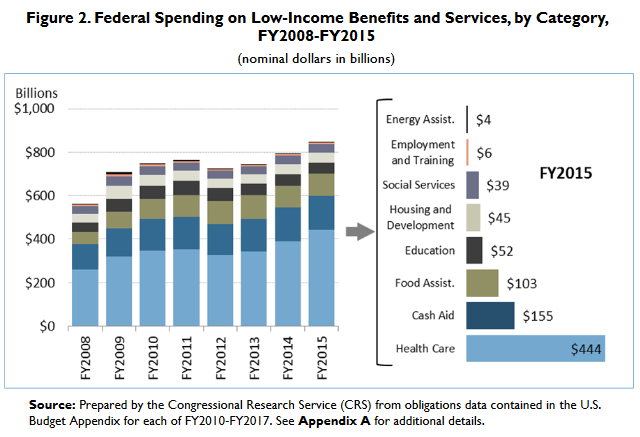
The Congressional Research Service recently created a report titled “Federal Benefits and Services for People with Low Income: Overview of Spending Trends, FY2008-FY2015.” The report is the latest in a series that attempts to identify and discuss programs and services oriented toward low-income populations, while focusing on aggregate spending trends.

The report contains some interesting charts that show how spending on housing compares to other categories of federal spending. The chart below from page 6 of the report shows spending by category. Notice that health care spending dwarfs the other categories, while “housing and development” is in the middle.

Federal-Spending-Chart-FY2015-CRS-Report

Read the full report here.

Moving On from Supportive Housing Toolkit

Corporation for Supportive Housing (CSH) has developed a new Moving On Toolkit for supportive housing providers, Continuums of Care, PHAs, state and local government agencies and other organizations that would like to plan, develop, sustain and evaluate Moving On initiatives within their communities. Moving On initiatives provide rental subsidy and transition assistance to tenants who are able and want to move out of supportive housing and into a new apartment. The toolkit outlines the various phases and steps in the Moving On process and offers numerous links and helpful resources, including descriptions of previous or existing Moving On projects and practical tools or templates developed by implementing organizations. According to CSH, the fundamental goal of Moving On is to promote the highest levels of independence and choice for tenants. HUD has previously provided public support for Moving On but current initiatives only exist on a small scale through scattered pilots.