HUD Awards $1.95 Billion for Local Homeless Programs

Yesterday, HUD announced $1.95 billion in FY 2016 Continuum of Care (CoC) grants to provide support to over 7,600 local homeless housing and service programs across the United States, Puerto Rico, Guam, and the U.S. Virgin Islands. View a complete list of the state and local homeless projects awarded here.

This year, HUD continued to strongly urge CoCs to compete for funding by making challenging decisions that involved shifting funds from existing projects to new projects considered to be more effective, such as investments in permanent supportive housing and rapid re-housing.

For this competition, local CoCs reallocated a combined $103 million in renewal funding from lower performing projects in order to apply for new housing projects. Together with funding for permanent housing “bonus” projects, HUD is awarding at total of $139 million for new projects.

Additional information on HUD’s FY 2016 CoC awards  will be included in the forthcoming edition of the NAHRO Monitor (members only)


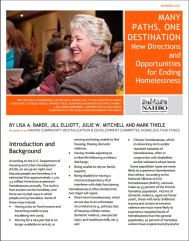
ICYMI: NAHRO members have long been on the front lines of preventing and ending homelessness. A recent NAHRO white paper demonstrates how public housing authority (PHA) are collaborating with communities and perusing new directions and opportunities for ending homelessness. Case studies include: ending veteran homelessness in Houston, Texas; implementing medical respite to save lives and reduce costs in Fargo, North Dakota.; and using a model for working with the chronically homeless in encampment settings by the City of West Sacramento, Yolo County, California.

HUD Issues Final Rule Requiring Broadband Infrastructure in New Construction and Substantial Rehabilitation

Tomorrow, HUD will publish a final rule that requires the installation of broadband infrastructure at the time of new construction or substantial rehabilitation for multifamily rental housing that is funded or supported by HUD. Since the installation of broadband infrastructure may not be feasible for all new construction or substantial rehabilitation, the rule allows limited exceptions to the installation requirements.

The following programs will be covered by this final rule:

  1. Choice Neighborhoods Implementation Grant program;
  2. Community Development Block Grant (CDBG) program, including the CDBG Disaster Recovery program;
  3. Continuum of Care program;
  4. HOME Investment Partnerships program;
  5. Housing Opportunities for Persons With AIDS program;
  6. Housing Trust Fund program;
  7. Project-Based Voucher program;
  8. Public Housing Capital Fund program;
  9. Section 8 project-based housing assistance payments programs, including, but not limited to, the Section 8 New Construction, Substantial Rehabilitation, Loan Management Set Aside, and Property Disposition programs; and
  10. Section 202 and Section 811 Supportive Housing for the Elderly and Persons with Disabilities programs.

The rule will not apply to multifamily rental housing that only has a mortgage insured by HUD’s Federal Housing Administration or with a loan guaranteed under a HUD loan guarantee program.

The final rule does not change any of the substantive requirements that were in the proposed rule (members only), but adds clarifications on the threshold for substantial rehabilitation and on the point in the planning process for new construction or substantial rehabilitation at which a project must be to not be subject to the rule’s requirements. This final rule will become effective 30 days after the rule’s publication in the Federal Register.

This new rule supports the Obama Administration’s efforts to narrow the Digital Divide in the low-income communities served by HUD. Earlier this month, HUD also issued a final rule that will “modernize” the consolidated planning process for Community Planning and Development (CPD) formula grantees by adding the concepts of broadband access and vulnerability to natural hazard risks to the Consolidated Plan’s housing market analysis.

HUD Adds New Requirements to Consolidated Planning

Today, the HUD Office of Community Planning and Development (CPD) published a final rule that will “modernize” the consolidated planning process (24 CFR 91) for CPD formula grantees. The rule adds the concepts of broadband access and vulnerability to natural hazard risks to the Consolidated Plan’s existing housing market analysis. According to HUD, this rule seeks to “promote a balanced planning process that more fully considers the housing, environment, and economic needs of communities.”

Under the new rule, States and local governments must analyze the broadband needs (i.e., broadband wiring and connection to broadband service in the household unit, or the need for additional broadband Internet service providers to increase competition) of housing occupied by low- and moderate-income (LMI) households, including housing in rural areas. The rule also requires States and local governments to assess the vulnerability of housing units occupied by LMI households to increased natural hazard risks, particularly risks associated with climate change.

HUD does not expect the new regulations to result in significant additional expenses and administrative burden to jurisdictions since the requirements are similar to existing planning requirements, and the data necessary is readily available on the internet. HUD plans to input data for both broadband and resilience assessment requirements within the Consolidated Plan pre-populated data tables for use by jurisdictions, though jurisdictions can opt to use other data of their choice. HUD will provide grantees with this data early in Fiscal Year 2018.

Compliance with the requirements of the final rule will apply to Consolidated Plans submitted on or after January 1, 2018. Additional coverage of this final rule will available in the forthcoming edition the NAHRO Monitor (members only).

Five Communities Awarded $132 Million in Choice Neighborhoods Grants

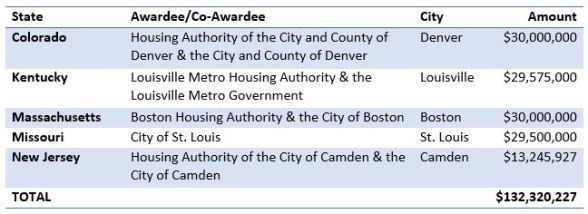
On December 12, HUD announced that five U.S. communities will receive a combined total of $132 million in FY 2016 Choice Neighborhoods Initiative (CNI) grant funds. The goal of the CNI is to aid struggling communities with severely distressed public housing or HUD-assisted housing by reinvesting in the community’s housing, residents, and neighborhoods.

These five communities will receive funding under the CNI’s Implementation Grant component, which supports communities that are ready to implement their neighborhood revitalization plan, or “Transformation Plan.” All five awardees are also past Choice Neighborhoods Planning Grant recipients.

The following communities will receive Implementation Grants:

cni-2016-awards

According to HUD’s press release, the awardees will replace 1,853 severely distressed public housing units with nearly 3,700 new mixed-income, mixed-use housing units, and leverage every $1 in Choice Neighborhood funding with an additional $5 in public and private funding for their project proposals. Together, the awardees and their partners are expected to leverage a combined total of $636 million through other public/private sources and indirectly stimulate another $3.3 billion in their local economies.

Read a summary of each grants here.


Early Lessons Learned in Affirmatively Furthering Fair Housing

This is a guest blog by Mark Shelburne, Novogradac & Company LLP.

As most readers are aware, in 2015 the U.S. Department of Housing and Urban Development (HUD) substantially revised its approach to affirmatively furthering fair housing (AFFH). One of the key aspects is submitting an Assessment of Fair Housing (AFH), using a “Tool” document as a template.

The first group of 22 cities and counties sent their AFHs to HUD for review October. Under the 2015 rule, thousands of other local governments, states, and housing authorities will do the same over the next several years.

Novogradac & Company LLP partnered with Civitas, LLC to help the city of Wilmington, N.C., and Wilmington Housing Authority on their AFH submission. Late in November, HUD staff reached out regarding a few additions and clarifications, which Novogradac, Civitas, and local officials were able to complete in the two days before Thanksgiving. The notice of acceptance came Dec. 2, making Wilmington’s plan one of the first to be completed in the nation. (Reports suggest HUD did not accept all of the AFHs submitted in the initial round.)

The best news for jurisdictions with upcoming AFFH deadlines is you are not going first. There is an opportunity to learn from those who’ve begun the process. The following is a summary list of the most important lessons learned from Novogradac’s experience in Wilmington.

  1. Collaborate with other local HUD funding recipients. This item is first both because of being an early decision and one of the most important. There is no reason to go it alone–partnering may result in some challenges, but the net is a benefit for all involved.
  1. Have widespread, diverse opportunities for public input. Try to include any fair housing organizations operating within your area. Also be aware of limited English proficiency and disability-access considerations.
  1. Start early and speak often. Applying the prior two lessons will take time, as does drafting the text. In fact, the best time to get started is as soon as you’re finished reading this post. Frequent communication (not just meetings but emails and calls), particularly around goals, is essential.
  1. Consider a consultant, but be realistic. Contracting for assistance can be particularly helpful for data analysis and providing a more objective view, but local staff will do a lot of work regardless.
  1. You know at least some of the concerns. In many cases what should happen in the community is not a mystery. You do not need to rigidly follow the steps in the Tool, it is okay to think of some goals first.
  1. Read accepted AFHs. Wilmington’s and New Orleans’ are good places to start.
  1. Be careful about dot density. Try different settings in the HUD-provided maps. For example, using the 75-per-person setting does not always show patterns of segregation.
  1. Address all protected classes. Usually the focus is on race, but all seven classes are covered. Most will vary even within a state, with disability as the most uniform. Be aware of possible implications of an ADA/Olmstead settlement underway.
  1. Don’t assume the reader knows your community. The review might not be limited to your local or state HUD office. For example, staff from across the HUD Region (Columbia, Greensboro, Jacksonville, and Nashville) were involved in Wilmington’s submission.
  1. Have specific, actionable goals. The next steps should strike a balance between making real progress and being actually achievable. You will need to have a goal for any issue either identified or apparent to the HUD reviewer.
  1. Address all issues identified. Some of the assessed factors may appear to be beyond the jurisdiction’s control. For example, many school districts are distinct governing entities from HUD funding recipients. Yet even in this instance, the goal could be to build new affordable rental properties in areas with high-performing schools.
  1. Change your mindset. True AFFH compliance is less about completing the Tool (although doing so is necessary) and more about a change of thinking. For too long, our nation has seen federal housing programs as being meant only for construction and rehabilitation; reducing segregation and expanding opportunities are equally important. This purpose should be part of program administrators’ every decision.

Final Thoughts

There is certainly a possibility the process may be different under Secretary Carson, who has expressed concerns about certain aspects of fair housing. However nothing has been announced, nor is likely to change early in the next Administration, so for now HUD recipients should continue with current approach.

Please feel free to reach out with any comments or questions.


SAVE THE DATE

Housing Rules Series! Affirmatively Furthering Fair Housing: How did we get here?

January 10, 2017 from 1:30 PM – 3:00 PM ET

If feels like there is a notice on affirmatively furthering fair housing every few days. In this rapidly changing environment, NAHRO staff will look back at the AFFH rule. Then an overview of the current notices and guidance specifically focusing on the Assessment of Fair Housing (AFH) tools will be discussed. This e-briefing will provide a regulatory context for a constructive and informed discussion on AFFH moving forward. Guest speaker, Mark Shelburne, Senior Manager at Novogradac & Company LLP, will share the important lessons learned from Novogradac’s experience in Wilmington, N.C.

New Mapping Tool Shows What HUD Investments Your Community Receives

On December 6, HUD launched the Community Assessment Reporting Tool (CART) – a new online and mobile-friendly tool that offers the public real-time information on HUD investments across a community. This interactive reference and mapping tool uses geospatial technology to show a variety of  property- and grant level detail by city, state, county, metropolitan area, or congressional district levels. According to HUD, CART cuts down the time that it typically takes to generate this information from several days to minutes.

CART includes information on many of HUD’s major programs, including:

  • Community Planning and Development Competitive and Formula Grants
  • Rental Assistance through HUD’s Multifamily programs, Housing Choice Vouchers and Public Housing properties
  • Housing Counseling
  • Signature programs – Promise Zones, Strong Cities Strong Communities and Rental Assistance Demonstration.
  • Census demographic information

CART also allows users to build custom community maps using thematic layers (i.e., voucher concentration, poverty rate) and property layers (i.e., location of public housing buildings, CDBG and HOME activities).Access CART online at: egis.hud.gov/cart

Technical Correction to HUD’s VAWA 2013 Implementation Final Rule

On December 6, HUD will issue a technical correction to the “Violence Against Women Reauthorization Act of 2013: Implementation in HUD Housing Programs” final rule. This correction updates the compliance date for completing an emergency transfer plan and providing emergency transfers, and associated recordkeeping and reporting requirements to June 14, 2017. After the rule’s publication last month, HUD discovered the compliance date was incorrectly listed in the preamble as May 15, 2017, while the regulatory text provided the correct date of June 14, 2017. The final rule’s effective date (separate from the emergency transfer compliance date) is still December 16, 2016. 

NAHRO Provides Recommendations to the HUD 2017 Transition Team

Today NAHRO provided members of President-elect Trump’s HUD transition team with the NAHRO Transition 2017 recommendations. All recommendations and positions in this document have been previously approved by our standing committees and the NAHRO Board of Governors. We also intend to make ourselves available to the new transition team and supply them with any and all information and assistance they may require from us to make the transition at HUD under the Trump Administration as smooth as possible.

The transition recommendations can be used as you reach out to your local HUD officials, your elected officials who will be seated in the new Congress, the media and your own state and local officials in a united effort to move a responsible and responsive housing agenda forward at HUD and on Capitol Hill. In addition to this document, the association will also be producing the NAHRO 2017 Regulatory and Legislative Agenda, which will be drafted over the coming weeks with input from NAHRO membership and leadership and will be available at the NAHRO 2017 Washington Conference.

NAHRO’s Transition 2017 recommendations for HUD may be viewed here.

Report: Homelessness in the U.S. Continues to Decline

Earlier this week, HUD published Part 1 of the 2016 Annual Homeless Assessment (AHAR) Report, providing Congress with local estimates of sheltered and unsheltered persons experiencing homelessness on a single night in January 2016. According to the report, on a single night in 2016, there were 549,928 persons experiencing homelessness – a 14 percent decrease from 2010 and a 3 percent decrease over the past year. This decline was especially prevalent among families with children, Veterans, and individuals with long-term disabling conditions. Despite the downward trend of homelessness nationally, 13 states and the District of Columbia still saw an increase in their share of homelessness between 2015 and 2016.

The AHAR is typically released in two parts: Part 1 provides Point-in-Time (PIT) estimates that offer a “snapshot” of homelessness as reported by Continuums of Care (CoCs) across the U.S.; Part 2 offers in-depth detail on the characteristics of the homeless. The PIT methodology is regarded as a reliable estimate of the general size of the homeless population; however, it is important to note that it does not count every single homeless person, nor does it measure the number of people who are at risk of homelessness.

****

paperphoto

NAHRO members have long been on the front lines of preventing and ending homelessness. Read this recent NAHRO white paper to learn about public housing authority (PHA) collaborations and new directions and opportunities for ending homelessness.Case studies include: effectively ending veteran homelessness in Houston, Texas; implementing medical respite to save lives and reduce costs in Fargo, North Dakota.; and using a model for working with the chronically homeless in encampment settings by the City of West Sacramento, Yolo County, California.

HUD Final Rule Provides Expanded Housing Protections for Survivors of Violence

Today, HUD published a final rule in the Federal Register that provides expanded housing protections for survivors of violence and fully codifies the provisions of the Violence Against Women Reauthorization Act of 2013 (VAWA 2013) into HUD’s regulations. At its core, VAWA 2013 prohibits housing providers from denying or terminating housing assistance on the basis that an applicant or tenant is a survivor of violence.

The rule’s regulations become effective on December 16, 2016, and compliance with the rule with respect to completing an emergency transfer plan and providing emergency transfers, and associated recordkeeping and reporting requirements, is required no later than June 14, 2017.

Read more about the rule’s provisions in our blog post, published last month. A more in-depth analysis of the rule is also available in the NAHRO Monitor (members only).

[Note: After the final rule’s publication, HUD discovered an incorrect compliance date in the rule’s preamble, with respect to completing an emergency transfer plan and providing emergency transfers, and associated recordkeeping and reporting requirements. The compliance date was incorrectly listed as May 15, 2017, while the regulatory text provided the correct date of June 14, 2017. This blog post has been updated to reflect the correct compliance date of June 14, 2017]