PHA AFH Tool updated by HUD

An updated Public Housing Authority (PHA) Analysis of Fair Housing (AFH) Tool that takes into account public comments HUD received has been posted for public inspection. HUD continues to state that they are committed to issuing an additional AFH Tool specifically for Qualified-PHAs (QPHA.) To that end, the PHA AFH Tool is intended to be used by non-QPHAs and QPHAs that are collaborating with non-QPHAs.

HUD has made a number of updates to the PHA AFH Tool. The NAHRO Policy Team will continue to review and provide additional analysis of this notice. Below is a brief list of the PHA AFH Tool updates:

  1. QPHA Insert – This insert is to be used by QPHAs that collaborate with non-QPHAs and covers the required analysis of the QPHA’s service area.
  2. Contributing Factors – HUD added and made small changes to the descriptions of contributing factors.
  3. Disparities in Access to Opportunities – The number of questions has been reduced and references to PHA waiting lists have been removed.
  4. Disability and Access – Two additional question have been added to the tool that relate to interaction of PHAs and individuals with disabilities.
  5. Instructions – Various sections of the instructions have been updated to provide clarity.
  6. Fair Housing Analysis of Rental Housing – This section only applies to PHAs that administer a Housing Choice Voucher program and not to PHAs that are Public Housing only.
  7. Enhancements for PHAs in the Data and Mapping Tool – Specific maps and date related to PHAs are planned along with enhancing the functionality of the maps.

This notice requests comment be submitted within 30 days of issuance. HUD is requesting comment on the notice generally and on 15 specific questions, listed at the end of the notice. NAHRO members should review this notice and provide their comments to HUD. NAHRO will also be providing comment on behalf of our members.

Public inspection of the updated PHA AFH Tool can be done at: https://s3.amazonaws.com/public-inspection.federalregister.gov/2016-22594.pdf.

HUD to Release Long-Term Outcomes of Family Options Study

On October 25, HUD will release the long-term outcomes of the Family Options Study. The study was a “multi-site random assignment experiment designed to study the impact of various housing and services interventions for homeless families.” Homeless families across the nation in twelve communities were assigned one of four possible interventions:

  1. subsidy only;
  2. project-based transitional housing;
  3. community-based rapid re-housing; or
  4. usual care.

Families were tracked for a minimum of 37 months and metrics on housing stability, family preservation, adult well-being, and self-sufficiency were collected.

HUD will be announcing the long term results of the interventions on October 25. The event can be attended in person at the Brooke-Mondale Auditorium at HUD Headquarters or via webcast.

Register for the event here.

HUD to Publish List of Regulatory Waivers Granted for the Second Quarter of CY 2016

On Monday, HUD will publish in the Federal Register a list of regulatory waivers that the agency has granted for the second quarter of calendar year 2016.

The pre-publication list can be found here.

(9/12/16 Edit – The published list in the Federal Register can be found here.)

September is Attendance Awareness Month

As schools get into full swing this month, September is Attendance Awareness Month. For schools to work as centers of learning, it is important for students to be in class. Attendance Works focuses on the importance of student attendance and tracking student attendance data. PHAs and community development organizations can be an important partner with families and schools to insure increased school attendance and therefore improved educational outcomes for the children living in affordable housing..

As part of Attendance Awareness Month, Attendance Works is hosting a webinar on using attendance data.

Thursday, September 8, 2016: Ensuring an Equal Opportunity to Learn: Leveraging Chronic Absence Data for Strategic Action, 11-12:30 pm (PT) / 2-3:30 pm (ET). Register now.

In June 2016, the U.S. Office for Civil Rights released its first national count of students who were chronically absent. The data showed a staggering 6.5 million students were chronically absent, which means that they missed so much school that their ability to read well and gain fundamental skills and knowledge for college and career was hampered. In the 500 most heavily impacted districts, over 30% of students were chronically absent.

Join experts Hedy Chang, Executive Director of Attendance Works and Dr. Robert Balfanz, Director of the Everyone Graduates Center at Johns Hopkins University as they release a major national study analyzing the data and more importantly, showing how leaders at the local, state and national levels can take strategic action to monitor and address chronic absence in order to ensure an equal opportunity to learn and succeed.

 The webinar will provide suggestions and tips on to become engaged in attendance awareness month activities such as displaying an attendance poster at housing sites, establishing or expanding programmatic interventions such as a mentoring program, etc.

More information on Attendance Awareness Month and Attendance Works can be found at: http://awareness.attendanceworks.org/.

HUD Publishes Lead-Based Paint Proposed Rule

(9/6/16 Update: The published Federal Register notice can be found here. Comments are due by October 31, 2016.)

Tomorrow, HUD will publish its lead-based paint proposed rule titled “Requirements for Notification, Evaluation and Reduction of Lead-Based Paint Hazards in Federally Owned Residential Property and Housing Receiving Federal Assistance; Response to Elevated Blood Lead Levels” in the Federal Register. While NAHRO is still in the process of doing a deeper dive into the proposed rule, here are some of the core requirements being proposed.

  • Program Scope –  The proposed rule will apply to the following 5 sets of programs:
    • Project-Based Assistance Provided by non-HUD Federal Agencies;
    • Project-Based Assistance;
    • HUD-owned and Mortgagee-in-Possession Multifamily Property;
    • Public Housing Programs; and
    • Tenant-Based Rental Assistance.
  • Effective Date –  HUD is considering an effective date of 6 months after publication of the final rule, but is also looking at time periods of either 1 year or 1 month.
  • Elevated Blood Lead Level –  The rule proposes to revise the Lead Safe Housing Rule (LSHR) to adopt the Centers for Disease Control and Prevention’s (CDC’s) approach to establishing a blood lead level for which the CDC recommends environmental intervention. Currently, CDC guidance defines Elevated Blood Lead Level (EBLL) in children under age 6 to be “based on the blood lead level equaled or exceeded by 2.5 percent of U.S. children aged 1 – 5 years.” The current reference range level is 5 or more micrograms per deciliter of lead in the blood. As the CDC is “tying the reference value to the national distribution of blood lead levels, the reference level will continue to decrease whenever progress is made on reducing childhood lead exposure.”
  • Inspection, Evaluation, and Control Activities –  Depending on the program, lead-based paint inspections, inspections for deteriorated paint, and risk assessments including dust-wipe sampling and soil sampling may be required.
  • Abatement Measures –  Public Housing must perform abatement measures to eliminate lead-based paint or lead-based paint hazards during comprehensive modernization.
  • Interim controls and Paint Stabilization –  Depending on the program, additional interim controls (measures designed to reduce temporarily human exposure or likely exposure to lead-based paint hazards) or paint stabilization (repairing physical defects and applying a new coating of paint) may be required.
  • Response to Young Children with Elevated Blood Levels –  If a child under 6 has an elevated blood lead level, the owner or other entity must follow a designated protocol (same for all programs, except non-HUD project-based assistance, for which it is narrower) including:
    • Conducting an environmental investigation;
    • Conducting interim control – measures designed to reduce temporarily human exposure or likely exposure to lead-based paint hazards;
    • Controlling other housing-related sources of lead exposure; and
    • Encouraging occupants to address other non-housing related lead exposure sources.
  • Other units –  If the unit where the child resides is in a building or development with other assisted dwelling units covered by the rule, the owner or other entity must provide documentation to the HUD field office that the owner or other entity has complied with the evaluation requirements. If there is no documentation of compliance with the evaluation requirements, the owner or other entity must conduct a risk assessment and conduct interim controls or conduct a visual assessment and paint stabilization–depending on the program.
  • Comments –  HUD has 4 questions for comment each with subparts.

NAHRO will continue to read and analyze this rule and will provide additional, deeper coverage to its members. Comments will be due 60 days after publication in the Federal Register.

The pre-publication proposed rule can be found here.

HUD’s Press Release on the rule can be found here.

New HOME Notice on Allocating Eligible Costs and Identifying HOME-assisted Units in Projects

On August 25, HUD published  Notice CPD-16-15 which provides clarifying guidance to HOME participating jurisdictions (PJs) on the process of conducting a cost allocation using the Standard Method or the Proration Method, in accordance with HOME regulations. PJs are required to charge the actual costs of the HOME units, which will require allocating costs and identify the number and characteristics of units to be designated as HOME units for multi-unit rental or homebuyer HOME projects in which not all of the units are HOME-assisted (e.g., a mixed-income or a mixed-use project).

Among it’s topics, the Notice

  • explains the relationship of cost allocation to underwriting;
  • breaks down the cost allocation process, including what information is necessary and step-by-step explanation of the process;
  • highlights the requirements for special circumstances, such as owner-occupied projects with rental units, manager’s unit, and projects with HOME and public housing units;
  • provides additional guidance on disbursement of funds and documentation; and
  • includes process charts and examples for the Standard Method and the Proration Method.

NAHRO Submits Letter to HUD PIH Regarding Costs of Bed Bug Eradication in Public Housing Units

On August 25, NAHRO submitted a letter to HUD’s Office of Public and Indian Housing (PIH) Principal Deputy Assistant Secretary Lourdes Castro Ramirez regarding the financial strains many PHAs face regarding bed bug infestation. In the letter, NAHRO noted the difference between standard pest extermination methods compared to the more-intensive methods of eradicating bed bugs. The letter continued, stating that in light of the additional effort required to eradicate bed bugs from housing units and properties, bed bug infestations place substantial financial burdens on PHAs, and that bed bugs affect more than just the tenants in an impacted unit.

NAHRO plans to continue working with HUD PIH  to ensure that PHAs can remain financially secure while also ensuring their tenants have access to safe, secure housing free of bed bugs.

HUD Announces Changes to the AFFH Assessment Tools for Small PHAs and Local Governments

On August 23, HUD will publish a 30-day notice in the Federal Register seeking public feedback on the Local Government Assessment Tool, the instrument with which communities receiving HUD Community Planning and Development (CPD) formula grant dollars must use to conduct and submit their Assessment of Fair Housing (AFH) analysis, as required by the Affirmatively Furthering Fair Housing (AFFH) Final Rule.

Due to limited staff and resources, NAHRO has long-requested for HUD to streamline the AFFH assessment tools for small program participants. The 30-day Notice announces two substantial changes that would, ideally, help simplify the AFH process for Qualified Public Housing Authorities (QPHAs), defined as PHAs not designed as “troubled” with a combined unit total of 550 or less, and for local governments receiving small CPD formula grants:

  • HUD seeks to revise the existing Local Government Assessment Tool to include two new streamlined assessments for small program participants, called “inserts.” The first insert would be for use by QPHAs and the second insert would be for use by local governments that received a CBDG grant of $500,000 or less in the most recent fiscal year prior to the AFH due date. QPHAs and local governments seeking to fulfill their AFFH requirements through these streamlined inserts must be involved in a joint or regional collaboration with a local government as the lead entity.
  • HUD seeks to issue a fourth assessment tool for Qualified PHAs. Prior to this notice, HUD had committed to issuing only three AFFH assessment tools (Local Government, State and Insular Areas, and PHA-only). The new QPHA Assessment Tool would be for use by a QPHA or by multiple QPHAs jointly collaborating to submit an AFH. HUD assumes that many QPHAs will want to take advantage of this option, particularly those unable to enter into a joint or regional collaboration with another partner. HUD intends to issue a separate public notice and comment process for this new tool.

The 30-day notice also addresses the public comments received in response to the 60-day information collection notice that was published on March 23, 2016 (see NAHRO’s comments here). NAHRO’s next issue of The Monitor (members only) will have additional details about the contents of the 30-day notice.

GAO Publishes Report on HUD Management

On August 19, the United States Government Accountability Office (GAO) made publicly available a report it wrote for congressional requesters. The report found that HUD has “not consistently incorporated requirements and key practices  identified by GAO to help ensure effective management into its operations.”

The report identified five management functions and discusses how completely HUD implemented prior GAO recommendations. Selected excerpts can be found below:

Performance planning and reporting – “HUD met most of the requirements in the GPRA Modernization Act of 2010 for its strategic plan and annual performance plan and report . . . [b]ut HUD’s strategic plan does not clearly link HUD’s goals and objectives with federal priority goals.”

Information technology management – “HUD has not demonstrated that it has the capacity to effectively plan for and manage IT projects.”

Human capital management – “HUD has made progress in developing new human capital plans and mostly followed key principle and practices for strategic workforce planning, succession planning, and training planning.”

Financial management – “HUD did not follow seven of eight key practices for financial management.”

Acquisition management – “HUD partially followed key practices for acquisition relating to organizational alignment and human capital.”

The report recommends that HUD take the following eight actions:

  1. Link HUD’s goals and objectives with federal priority goals;
  2. Describe why HUD’s goals were not met and HUD’s plans for achieving them;
  3. Establish procedures and time frames to reach out to Congress and stakeholders to ensure that the strategic plan meets statutory requirements;
  4. Establish a process and schedule to review and update HUD’s human capital strategic plan; strategic workforce plan; and succession plan;
  5. Establish a process and schedule to update policies and procedures to help ensure that policies and procedures for key management functions remain current and complete;
  6. Formalize lines of communication between the Chief Information Officer and the agency head;
  7. Designate entities within program offices for fraud risk management activities; and
  8. Develop written policies for conducting program evaluations.

Thanks to PHADA for bringing this report to our attention.

The full report can be found here. The PDF can be found here.

The highlights page can be found here.

FMRs, SAFMRs, and Volatility

Our friends at the National Housing Conference (NHC) and the Public Housing Authorities Director’s Association (PHADA) have written a blog post with a series of beautiful maps on historical Small Area Fair Market Rent (SAFMR) volatility on NHC’s Open House Blog. Here’s a map from the blog post on the Washington-Arlington-Alexandria HUD Metro Fair Market Rent (FMR) area.

https://nahroblog.org/wp-content/uploads/2016/08/d5a51-washington-arlington-alexandria252c2bdc-va-md2bhud2bmetro2bfmr2barea.jpg

I recommend looking at the blog post to read their take on SAFMRs and volatility and to see the other maps.

Here are a couple of points that I would like to note to further this conversation.

The methodology for calculating Fair Market Rents (and SAFMRs) is changing

In calculating the final FY 2016 FMRs HUD switched from a “historical-based annualized change in gross rent trend factor [to] a forward-looking forecast . . . [that] uses a model that forecasts national rent and utility [Consumer Price Index] indices based on economic assumptions used in the formulation of the President’s Budget.”[1] Since the methodology has changed, we need a time horizon of a few years to see if the volatility remains as bad a problem as before the methodological change.

Additionally, Peter Kahn, the Director of HUD PD&R‘s Economic Market Analysis Division, has stated the following:

We are looking at ways throughout the proposed ’17 FMR process of addressing that . . . variability in general. When the proposed ’17 FMRs are out, the . . . you can read that preamble and see that we are trying to take steps to address that variability. (See the YouTube clip where he said that here.)

Will HUD be successful in addressing this volatility? I don’t know, but it’s good that they’re aware of the problem and are taking steps to address the issue.

The passage of the Housing Opportunity Through Modernization Act of 2016 (HOTMA) may give PHAs a tool in managing volatility of payment standards based on both FMRs and SAFMRs

HOTMA has a provision that allows PHAs to hold harmless households that live in areas that receive lower FMRs. Section 107(b) of HOTMA states that “no public housing agency shall be required as a result of a reduction in the fair market rental to reduce the payment standard applied to a family continuing to reside in a unit for which the family was receiving assistance . . . at the time the fair market rental was reduced.” It is NAHRO’s understanding that this provision will apply to payment standards based on FMRs and SAFMRs.

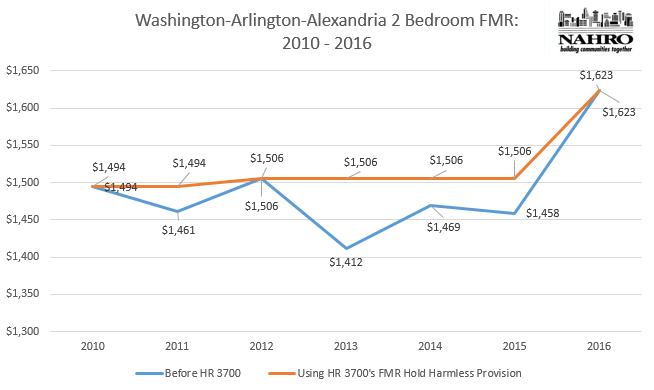
The chart below shows how if a provision allowing for payment standards to be held harmless was in place between 2010 and 2016, then volatility may have been reduced in some instances. The blue line shows the actual Washington-Arlington-Alexandria FMR for 2 Bedroom units. The orange line shows what a payment standard based on that FMR would have been, had it been held harmless.

WashDCHoldharmlessFMRChart-2010-2016

The HOTMA provision has the ability to reduce volatility in certain instances, though holding FMR payment standards harmless may have budget implications. Another point to remember is that when the payment standard starts being held harmless matters. In the chart above, if the payment standard starts being held harmless in 2013, then the volatility that results from increases in the FMR will still occur.

Although the chart above shows a payment standard based on a FMR being held harmless, the same principle would apply to payment standards based on SAFMRs.

[1] – 80 Fed. Reg. 77,124 (December 11, 2015).