HUD-VASH Second Round Funding Announced

Yesterday, HUD and the United States Department of Veterans Affairs (VA) announced a second round of HUD-VASH funding. HUD-VASH combines vouchers from HUD with case management and clinical services provided by VA. Since 2008, more than 79,000 vouchers have been awarded. This round of funding provides 108 vouchers and $871,056 worth of funding.

A list of PHAs that have been awarded HUD-VASH vouchers can be found at HUD’s press release here.

GAO Publishes Report on HUD Management

On August 19, the United States Government Accountability Office (GAO) made publicly available a report it wrote for congressional requesters. The report found that HUD has “not consistently incorporated requirements and key practices  identified by GAO to help ensure effective management into its operations.”

The report identified five management functions and discusses how completely HUD implemented prior GAO recommendations. Selected excerpts can be found below:

Performance planning and reporting – “HUD met most of the requirements in the GPRA Modernization Act of 2010 for its strategic plan and annual performance plan and report . . . [b]ut HUD’s strategic plan does not clearly link HUD’s goals and objectives with federal priority goals.”

Information technology management – “HUD has not demonstrated that it has the capacity to effectively plan for and manage IT projects.”

Human capital management – “HUD has made progress in developing new human capital plans and mostly followed key principle and practices for strategic workforce planning, succession planning, and training planning.”

Financial management – “HUD did not follow seven of eight key practices for financial management.”

Acquisition management – “HUD partially followed key practices for acquisition relating to organizational alignment and human capital.”

The report recommends that HUD take the following eight actions:

  1. Link HUD’s goals and objectives with federal priority goals;
  2. Describe why HUD’s goals were not met and HUD’s plans for achieving them;
  3. Establish procedures and time frames to reach out to Congress and stakeholders to ensure that the strategic plan meets statutory requirements;
  4. Establish a process and schedule to review and update HUD’s human capital strategic plan; strategic workforce plan; and succession plan;
  5. Establish a process and schedule to update policies and procedures to help ensure that policies and procedures for key management functions remain current and complete;
  6. Formalize lines of communication between the Chief Information Officer and the agency head;
  7. Designate entities within program offices for fraud risk management activities; and
  8. Develop written policies for conducting program evaluations.

Thanks to PHADA for bringing this report to our attention.

The full report can be found here. The PDF can be found here.

The highlights page can be found here.

FMRs, SAFMRs, and Volatility

Our friends at the National Housing Conference (NHC) and the Public Housing Authorities Director’s Association (PHADA) have written a blog post with a series of beautiful maps on historical Small Area Fair Market Rent (SAFMR) volatility on NHC’s Open House Blog. Here’s a map from the blog post on the Washington-Arlington-Alexandria HUD Metro Fair Market Rent (FMR) area.

https://nahroblog.org/wp-content/uploads/2016/08/d5a51-washington-arlington-alexandria252c2bdc-va-md2bhud2bmetro2bfmr2barea.jpg

I recommend looking at the blog post to read their take on SAFMRs and volatility and to see the other maps.

Here are a couple of points that I would like to note to further this conversation.

The methodology for calculating Fair Market Rents (and SAFMRs) is changing

In calculating the final FY 2016 FMRs HUD switched from a “historical-based annualized change in gross rent trend factor [to] a forward-looking forecast . . . [that] uses a model that forecasts national rent and utility [Consumer Price Index] indices based on economic assumptions used in the formulation of the President’s Budget.”[1] Since the methodology has changed, we need a time horizon of a few years to see if the volatility remains as bad a problem as before the methodological change.

Additionally, Peter Kahn, the Director of HUD PD&R‘s Economic Market Analysis Division, has stated the following:

We are looking at ways throughout the proposed ’17 FMR process of addressing that . . . variability in general. When the proposed ’17 FMRs are out, the . . . you can read that preamble and see that we are trying to take steps to address that variability. (See the YouTube clip where he said that here.)

Will HUD be successful in addressing this volatility? I don’t know, but it’s good that they’re aware of the problem and are taking steps to address the issue.

The passage of the Housing Opportunity Through Modernization Act of 2016 (HOTMA) may give PHAs a tool in managing volatility of payment standards based on both FMRs and SAFMRs

HOTMA has a provision that allows PHAs to hold harmless households that live in areas that receive lower FMRs. Section 107(b) of HOTMA states that “no public housing agency shall be required as a result of a reduction in the fair market rental to reduce the payment standard applied to a family continuing to reside in a unit for which the family was receiving assistance . . . at the time the fair market rental was reduced.” It is NAHRO’s understanding that this provision will apply to payment standards based on FMRs and SAFMRs.

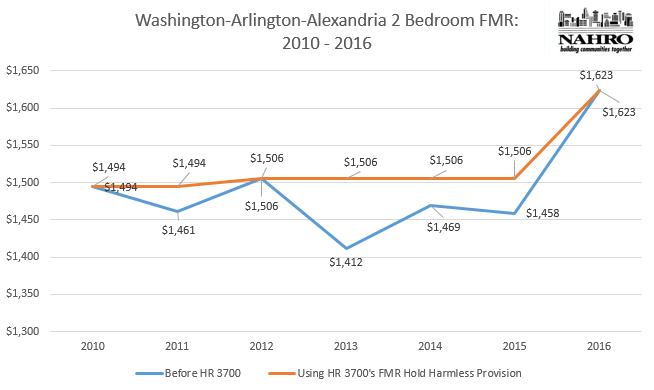
The chart below shows how if a provision allowing for payment standards to be held harmless was in place between 2010 and 2016, then volatility may have been reduced in some instances. The blue line shows the actual Washington-Arlington-Alexandria FMR for 2 Bedroom units. The orange line shows what a payment standard based on that FMR would have been, had it been held harmless.
WashDCHoldharmlessFMRChart-2010-2016

The HOTMA provision has the ability to reduce volatility in certain instances, though holding FMR payment standards harmless may have budget implications. Another point to remember is that when the payment standard starts being held harmless matters. In the chart above, if the payment standard starts being held harmless in 2013, then the volatility that results from increases in the FMR will still occur.

Although the chart above shows a payment standard based on a FMR being held harmless, the same principle would apply to payment standards based on SAFMRs.

[1] – 80 Fed. Reg. 77,124 (December 11, 2015).

HUD Publishes Notice on Availability of $5 million for TPVs in Low-Vacancy Areas

Today, HUD published a notice (PIH 2016-12) titled “Funding Availability for Tenant-Protection Vouchers for Certain At-Risk Households in Low-Vacancy Areas — Fiscal Year 2016.” The notice makes available the $5 million set-aside  for “certain at-risk households in low-vacancy areas for Fiscal Year (FY) 2016” from the $130 million appropriated for Tenant Protection Vouchers (TPVs) in general.

The $5 million in TPV assistance is available for the purpose of assisting “residents residing in low-vacancy areas and who either are or may have to pay rents greater than 30 percent of household income” because of the following:

  1. The maturity of a HUD-insured, HUD-held or section 202 loan that would have required the permission of the Secretary prior to loan prepayment;
  2. The expiration of a rental assistance contract for which the tenants are not eligible for enhanced voucher or tenant protection assistance under existing law; or
  3. The expiration of affordability restrictions accompanying a mortgage or preservation program administered by the Secretary.

The TPV assistance may be provided as either enhanced vouchers or project-based voucher (PBV) assistance.

NAHRO’s next issue of The Monitor (members only) will have additional details on the notice.

The full notice can be read here.

NAHRO submits Small Area FMR Comments

NAHRO has submitted comments on HUD’s notice titled “Establishing a More Effective Fair Market Rent System; Using Small Area Fair Market Rents in Housing Choice Voucher Program Instead of the Current 50th Percentile FMRs.”

HUD’s proposed rule would mandatorily impose the use of Small Area Fair Market Rent (SAFMR) areas in 31 metropolitan areas, if it were implemented as currently written.

In NAHRO’s comments, we stated that PHAs should have the discretion to use either SAFMRs or FMRs depending on what made sense in a PHA’s rental housing market. NAHRO’s reasons to oppose the mandatory imposition of SAFMRs in certain areas can be divided into three broad categories: tenant welfare concerns; tenant choice concerns; and administrative burden concerns. NAHRO also noted that additional research needed to be done before mandatorily implementing SAFMRs and responded to specific solicitations about the rule from HUD.

Read NAHRO’s SAFMR comments here.

Read the proposed rule here.

Read NAHRO’s prior post on HUD’s SAFMR proposed rule here.

UPCS-V: Updated Decision Trees

HUD has posted updated UPCS-V Decision Trees on the HUD REAC Oversight and Evaluation (OED) website.

Feedback on either the UPCS-V Decision Trees or the UPCS-V Protocol (version 1.0) can be sent to OED@hud.gov.

The updated Decision Trees can be found here.

HUD Information Collection: Alternative Inspections – Housing Choice Voucher Program

On Monday, HUD will publish in the Federal Register a 30-Day Notice of Proposed Information Collection titled “Alternative Inspections – Housing Choice Voucher Program.” The purpose of this information collection is to allow PHAs to submit a request to HUD to use an alternative inspection standard under Section 8 other than the alternative HOME and LIHTC standards (which do not require a request to HUD). The notice allows for an additional 30 days of comment.

Read the full pre-publication copy of the notice here.

Full Time Workers and Housing Affordability

The blog of the Harvard Joint Center for Housing Studies has a great post on how the affordable housing supply is not meeting the needs of many full time workers in many cities. The post has a chart comparing the income needed to afford one bedroom units at Fair Market Rents (FMRs) with median full time wages. Here’s a portion of the chart.

JCHSChartAffordabiltyForWorkers

The FMRs used are the ones estimated by HUD for 2015. As many Housing Choice Voucher Program Managers know, HUD FMRs frequently undervalue the true prices of rental markets, so the true difference between wages and the income needed to afford units at FMRs may be greater than this chart suggests.

The full blog post with the full chart can be found here.

Why Don’t HCV Program Participants Live Near Better Schools?

I saw in a Furman Center e-mail a link to a research paper titled “Why Don’t Housing Voucher Recipients Live Near Better Schools? Insight from Big Data.” While I haven’t gone through the entire paper, here’s a short excerpt from the abstract:

We find that families with vouchers are more likely to move toward a better school in the year before their oldest child meets the eligibility cutoff for kindergarten, suggesting salience matters. Further, the magnitude of the effect is larger in metropolitan areas with a relatively high share of affordable rental units located near high-performing schools and in neighborhoods in close proximity to higher-performing schools. Results suggest that, if given the appropriate information and opportunities, more voucher families would move to better schools when their children reach school age.
Read the entire paper here.

HUD Posts Revised New Administrative Fee Formula Webcast

HUD has posted a webcast on the Revised New Administrative Fee Formula. We have updated our previous post on Administrative Fee Formula links to reflect this.

Watch the webcast about the revised new administrative fee formula here.