HUD PIH to Hold Call on CARES Act Reporting Requirements and CDC Eviction Notice Declaration

In an email sent earlier today, HUD’s Office of Public and Indian Housing (PIH) announced that it will hold a call to discuss CARES Act reporting requirements and the Centers for Disease Control (CDC) eviction notice order. The call will occur at 2 pm ET on Sept. 15, 2020. Information on the call can be found below.

Step 1: Dial into the conference.
Dial-in: 888-251-2949 or 215-861-0694
Access Code: 3278449##
Need an international dial-in number?
If the automated recording indicates the conference is full, please use overflow information:
Dial in: 888-251-2949 or 215-861-0694
Access Code: 5358782#

Step 2: Join the conference on your computer.
Entry Link: https://ems8.intellor.com/login/832237

A calendar invitation can be found here.

HUD to Release Additional Mainstream Voucher Funding

Earlier today, HUD released a new Mainstream voucher notice titled “Mainstream Vouchers – Non-Competitive Opportunity for Additional Vouchers Authorized by the CARES Act, Temporary Waivers and Alternative Requirements, and Modified 2020 Housing Assistance Payment (HAP) Renewal Calculation” (PIH 2020-22). This notice does the following:

  1. Allows any PHA with a Housing Choice Voucher (HCV) program to apply for new Mainstream vouchers;
  2. Provides Mainstream-voucher-specific waivers; and
  3. Modifies the Housing Assistance Payment (HAP) renewal formula for Mainstream vouchers.

The deadline for applying for new voucher funding is Dec. 31, 2020. The additional flexibilities offered in this notice may be used until Dec. 31, 2020. Additional information on the new notice can be found below.

Continue reading

HUD Publishes Mod. Rehab. CARES Act Waiver Notice

Earlier today, HUD published a notice titled ‘Section 8 Moderate Rehabilitation Program – CARES Act Supplemental HAP Funding Allocation and COVID-19 Waivers and Alternative Requirements” (PIH 2020-20). This notice allocates additional funding for PHAs with Moderate Rehabilitation (Mod. Rehab.) programs and establishes voluntary waivers and alternative requirements that may be used by PHAs. This notice only applies to the Mod. Rehab. program administered by the Office of Public and Indian Housing and does not apply to the Section 8 Moderate Rehabilitation Single Room Occupancy (SRO) program.

Continue reading

New PIH Notice on Rent Reasonableness

Earlier today, HUD published a notice titled “Rent Reasonableness – Defining Assisted Units for the Housing Choice Voucher and Project-Based Voucher Programs” (PIH 2020-19). This notice updates guidance on which units may be considered “assisted” for the purpose of rent reasonableness requirements.

In general, the rent to an owner–in the context of a Housing Choice Voucher (HCV) Housing Assistance Payments (HAP) contract–must be reasonable. In determining that the rent to an owner for a HCV unit (including project-based voucher [PBV] units) is reasonable, a PHA must ensure that the rent for the applicable unit does not exceed rent for other comparable unassisted units. In certain instances, owners charge below market rents to protect families from rent increases that result solely from a conversion action (e.g., opting out of a Multifamily Section 8 project-based contract). These units are considered “assisted units” and are excluded from a rent reasonableness determination.

This notice broadens the assisted unit standard to “all projects undergoing any conversion action that triggers eligibility for an award of tenant protection vouchers (TPVs).” It also clarifies that “units with restricted rents” are still “excluded from rent reasonableness determinations until the PHA is notified by the owner or otherwise determines that the rent restriction has expired.” Additionally, the language defining “unassisted units” has been refined, but remains essentially the same.

The full notice may be found here.

HUD to Hold Webinar on Helping Tenants Access Economic Impact Payments

The Department will hold a webinar discussing how organizations can ensure that tenants are able to access their stimulus payments. According to an email sent by the Office of Public and Indian Housing (PIH), “[t]he CARES Act . . . includes stimulus payments to help families deal with the economic impacts from the COVID-19 crisis.” The email also states that “Americans risk missing out on the stimulus payments provided through the recent CARES Act . . . [and] [i]n order to receive the stimulus payment they must file a form by October 15, 2020 in order to receive it this year, or file a 2020 tax return next year to receive it in 2021.

The email includes the following resources for the webinar:

The webinar will be on August 26, 2020 at 1 pm ET. A calendar invitation with log in information for the webinar can be found here.

HUD Publishes FY 2021 FMRs

Over the weekend, HUD published a list of fiscal year (FY) 2021 Fair Market Rents (FMRs). The FMR is the basis for defining the payment standard amount in the Housing Choice Voucher (HCV) program. The Department also uses FMRs for certain other HUD programs. A FMR is “the amount that would be needed to pay the gross rent (shelter rent plus utilities) of privately owned, decent, and safe rental housing of a modest (non-luxury) nature with suitable amenities.” It set at a level to estimate the 40th percentile gross rent (i.e., it is set at a level to allow a program participant to be able to rent a unit from 40 percent of the appropriate available stock in the area). Comments on FMR methodology or requests for FMR reevaluation must be submitted by Sept. 30, 2020. New FY 2021 FMRs will become effective on October 1, 2020.

The Department uses a several step process to calculate the FMRs. First, HUD begins with the U.S. Census Bureau’s 5-year American Community Survey (ACS) data collected between 2014 and 2018. The Department then updates this base year rent data with a 1-year recent mover factor based on the 1-year 2018 recent mover gross rent. The data is only updated if the recent mover factor increases the base year rent data. For both the base year data and the recent mover trend factor, alternative methods may be used for areas that do not have statistically reliable data. The Department then updates this data by using the annual change in gross rents measured through the Consumer Price Index (CPI) from 2018 to 2019. Finally, the Department trends forward the data using one of three models to bring the data from a 2019 estimate to a 2021 forecast. The model used to trend forward the data is based on which model “generates the lowest Root Mean Square Error (RMSE) statistic.”

Once the data has been forecast to FY 2021, the Department takes additional steps. First, the Department adjusts the data, which is typically for two-bedroom units, to create FMRs for other unit sizes. Second, the Department limits the amount of decrease an FMR may have from one year to the next. The current year’s FMR may be no less than ninety percent of the prior year’s FMR. Additionally, the FMRs are subject to the lower of a state or national floor for the FMR.

Small Area FMRs have a distinct methodology employed when being calculated, including their own alternative methods if the data for an area does not meet a statistical check.

Public housing agencies may request that HUD recalculate their FMRs for specific areas. Agencies may fund local surveys of rent and may use their administrative fees to fund these surveys. For a recalculation, a PHA must supply HUD with data more recent than the 2018 ACS data used in calculating FY 2021 FMRs. In early October, HUD will post a list of areas requesting reevaluations. Data for the reevaluations must be submitted by Friday, January 8th. The Department will then post revised FMRs. Data submitted after January 8, 2021 will be incorporated into FY 2022 FMRs.

The full notice can be found here.

The FY 2021 FMRs can be found here.

Reminder: Mobility Webinar Today at 2 pm ET

The National Association of Housing and Redevelopment Officials with our friends, CLPHA, is sponsoring a free webinar on HUD’s new mobility demonstration put on by Mobility Works, the Center on Budget and Policy Priorities, and Opportunity Insights. The free webinar is at 2 pm ET today. Registration for the free webinar can be found here.

On July 15, HUD released a notice implementing the $50 million Housing Choice Voucher Mobility Demonstration. This important demonstration will enable selected public housing agencies to implement or expand programs that help families to use housing vouchers to locate in “high-opportunity” neighborhoods, which research shows can significantly improve adult and child well-being on several key measures, including children’s chances of attending college.

Housing agencies participating in the program will receive new housing vouchers as well as funding to provide robust mobility services to families with children. Agencies will also participate in a rigorous evaluation of the effectiveness of their mobility programs.

Please join us for this free webinar on August 11, 2020 2:00 pm – 3:30 pm ET to discuss the details of HUD’s demonstration notice, as well as the lessons that experienced practitioners and researchers have learned about developing effective housing mobility programs.

AGENDA

Moderator, Demetria McCain, Inclusive Communities Project

I. The requirements of the HUD NOFA:
● Doug Rice, Senior Fellow, Center on Budget and Policy Priorities
● Megan Haberle, Deputy Director, Poverty & Race Research and Action Council

II. Developing a regional housing mobility plan:
● Andrea Juracek, Executive Director, Housing Choice Partners
● Jeffery Patterson, CEO of the Cuyahoga Metropolitan Housing Authority

III. Reflections on working with researchers on a mobility evaluation:
● Sarah Oppenheimer, Opportunity Insights
● Andrew Lofton, Seattle Housing Authority

Registration for the free webinar can be found here.

HUD Conference Call on REAC Physical Inspections

Earlier today, HUD sent an email to PHA Executive Directors informing them that HUD would host a conference call to “provide an update on REAC [HUD’s Real Estate Assessment Center] physical inspections.” The call will occur on Thursday, August 13th at 12 pm ET. Call in information can be found below.

Step 1: Dial into the conference.
Dial-in: 888-251-2949 or 215-861-0694
Access Code: 3667922##
If the automated recording indicates the conference is full, please use overflow information:
Dial in: 888-251-2949 or 215-861-0694 Access Code: 4035985#

Step 2: Join the conference on your computer.
Entry Link: https://ems8.intellor.com/login/831227

The calendar invitation for this event can be found here.

HUD to Restart Physical REAC Inspections

Earlier today, HUD published a press release titled “Secretary Carson Announces HUD Will Safely Resume Physical Inspections.” In the press release, Secretary Carson notes that “[p]hysical inspections are vital in ensuring the health and safety of the Americans who reside in properties enrolled in HUD’s programs.” He also states that he is ” . . . very pleased to announce . . . [that] they are resuming.”

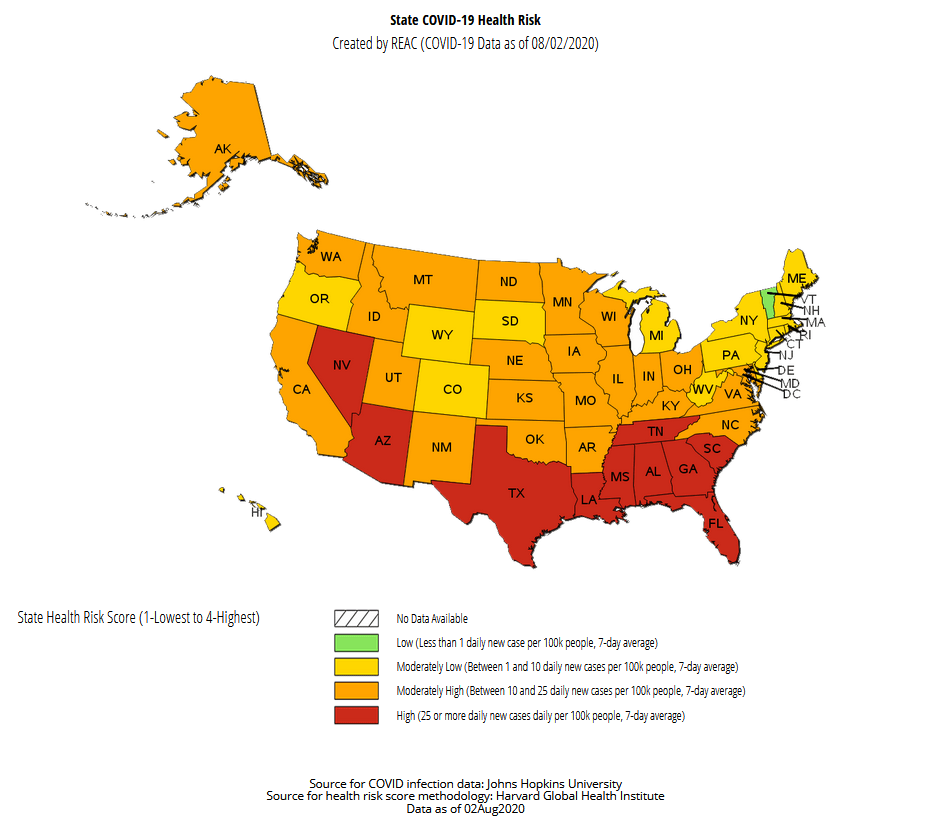
The press release notes that to keep residents and staff safe, HUD will implement a system of prioritization of inspections based on COVID-19 data and health risk scoring methodology (with the data taken from Johns Hopkins University and the methodology from the Harvard Global Health Institute. The Real Estate Assessment Center (REAC) has developed a heat map that categorizes localities into four categories of risk along with an associated color:

  • Low Risk – Green;
  • Moderately Low Risk – Yellow;
  • Moderately High Risk – Orange; and
  • High Risk – Red.

According to the press release, “REAC will provide a listing on its website of low-risk counties 45 days prior to the start of physical inspections. At the end of the 45-day period, REAC will provide a 14-day notification to priority properties in that county to inform families that an inspection will take place.” The first outreach about inspections will start after Sept. 21, 2020. A list of safe counties for inspections will be posted on REAC’s website.

HUD’s press release can be found here.

REAC’s website can be found here.

HUD to Host Call on CARES Act HCV Funding

Earlier today, the Department sent an email to PHA executive directors announcing a conference call on Thursday, August 6th at 2 pm ET to discuss HUD’s release of HCV CARES Act funding. The call will be recorded and uploaded to YouTube within a week of it occurring.

The call in information may be found below:

Step 1: Dial into the conference.
Dial-in: 888-251-2949 or 215-861-0694
Access Code: 6514321##
If the automated recording indicates the conference is full, please use overflow information:
Dial in: 888-251-2949 or 215-861-0694
Access Code: 1670463#

Step 2: Join the conference on your computer.
Entry Link: https://ems8.intellor.com/login/830869

A calendar invitation for the call can be found here.