Why the 4% LIHTC Matters: Housing Commission of Anne Arundel County

Freetown Village

The Low-Income Housing Tax Credit (LIHTC) is one of the most effective tools for creating new and critically needed affordable housing, and accounts for the vast majority of all affordable rental housing created in the United States. This is one in a series of articles that show how public housing authorities (PHAs) and community development agencies have successfully used federal tax credits and tax-exempt bonds to build and/or preserve public housing and affordable housing, and to increase the sustainability of their communities.

Housing Commission of Anne Arundel County: Freetown Village

Freetown Village is an existing community built in 1977 on 9.6 acres in Pasadena, Maryland. It is currently owned and operated as public housing by the Housing Commission of Anne Arundel County (HCAAC).  The property includes 154 family apartments, ranging in size from one-bedroom to four-bedroom apartments. The current unit mix is 24 one-bedroom units, 48 two-bedroom units, 60 three-bedroom units, and 22 four-bedroom units, contained in 15 two-story townhome-style residential buildings, and two three-story garden-style buildings.

Freetown Village needs modernization and upgrades. The Rental Assistance Demonstration (RAD) Program provides an opportunity to access private capital in order to address the property’s physical needs and secure a more stable funding source for rental assistance long-term. HCAAC will use funding from four key resources of the Maryland Department of Housing and Community Development (DHCD): Tax-Exempt Bonds, 4% Low Income Housing Tax Credits, a soft loan from Rental Housing Works loan, and a construction and permanent loan using DHCD’s Risk Share loan product totaling more than $41.5 million. This project is contingent on the use of tax-exempt bonds and issuance of 4% Low income Housing Tax Credits, which have an anticipated commitment date of early 2018.

Existing units will be upgraded with:

  • New kitchen cabinets and counters
  • New kitchen appliances (refrigerators, ranges, range goods)
  • New bathroom vanities
  • New flooring
  • New entry doors
  • R-49 attic insulation
  • Install LED lighting replacement
  • Replace bathtubs with roll-in showers for Americans with Disabilities Act (ADA) units; other ADA upgrades.

In addition system and common area upgrades will include:

  • New hot water heaters
  • HVAC upgrades
  • Upgraded landscaping features
  • Seal/stripe parking spaces
  • Added insulation
  • LED lighting replacement
  • ADA sidewalk improvements
  • New playground
  • All new flooring in common rooms.

The proposal would also add 36 new homes to Freetown Village, including 24 2BR units (approximately 720 square feet) and 12 3BR units ( approximately 980 square feet). Anne Arundel County’s Workforce Housing requirements mandate 20 of the units would be reserved for households at or below 60 percent of Area Median Income. The other 16 units could be occupied by households up to 120 percent of Area Median Income.

For more information about this project or to share your organization’s 4 percent LIHTC success story, please contact nahro@nahro.org.

Why the 4% LIHTC Matters: Knoxville Community Development Corporation

2009-NorthRidge-Crossing-1024x576
KNOXVILLE’S COMMUNITY DEVELOPMENT CORPORATION (KCDC) RECENTLY ANNOUNCED A $33.1 REHABILITATION INITIATIVE AT THREE AFFORDABLE HOUSING PROPERTIES: LONSDALE HOMES, NORTH RIDGE CROSSING (PICTURED) AND THE VISTA AT SUMMIT HILL. THE IMPROVEMENTS WILL IMPROVE ENERGY EFFICIENCY AND QUALITY OF LIFE FOR RESIDENTS.

The Low-Income Housing Tax Credit (LIHTC) is one of the most effective tools for creating new and critically needed affordable housing, and accounts for the vast majority of all affordable rental housing created in the United States. This is one in a series of articles that show how public housing authorities (PHAs) and community development agencies have successfully used federal tax credits and tax-exempt bonds to build and/or preserve public housing and affordable housing, and to increase the sustainability of their communities.

Knoxville Community Development Corporation: Lonsdale Homes, North Ridge Crossing and The Vista at Summit Hill Properties

Knoxville’s Community Development Corporation (KCDC) recently approved a $33.1 million rehabilitation initiative at three affordable housing properties. In total, 705 units at Lonsdale Homes, North Ridge Crossing and The Vista at Summit Hill will undergo significant improvements with an emphasis on energy efficiency and quality of life for residents. The plans include better insulation, LED lighting, energy-efficient appliances, plumbing repairs, roof replacement and new windows, flooring, cabinets and countertops. The improvements will be funded with a combination of low-income housing tax credits and multifamily housing bonds. “This initiative will yield significant benefits for the three properties and the residents we serve,” KCDC Executive Director and CEO Ben Bentley said. “The physical condition of these properties will be greatly enhanced and that, in turn, leads to lower operational and maintenance costs.”

“These improvements further our mission of providing quality affordable housing for our residents,” Sean Gilbert, KCDC’s Senior Vice President of Housing, added. “KCDC has been able to dramatically impact the quality of life for 705 Knoxville families by utilizing the LIHTC 4% credit/tax-exempt bonds.  If not for these important financing tools, low-income families would be forced to reside in aging units with deteriorating structures and without modern amenities and improved energy efficiency.  Our families will be able to focus on job growth and their children’s education without the distraction of obsolete housing structures.”

The plans are part of KCDC’s transition of its public housing stock to the rental assistance demonstration (RAD) program, which was created by the U.S. Department of Housing and Urban Development (HUD) in 2012 to help agencies continue their housing mission without dependence on federal funds. The program allows housing agencies to leverage public and private debt and equity to reinvest in their properties.

For more information about this project or to share your organization’s 4 percent LIHTC success story, please contact nahro@nahro.org.
HUD Extends Section 3 “Past Due” Reporting Deadline to December 31, 2017

HUD has revised the July 7, 2017 SPEARS Update that set a reporting deadline of July 31, 2017 for “past due” (2013, 2014, 2015, 2016, & some 2017 report years) reports.

On August 14, 2017, HUD issued a SPEARS Update that extended the reporting deadline for “past due” reports to December 31, 2017. The SPEARS Update is available at https://portal.hud.gov/hudportal/documents/huddoc?id=PHAReportDue8-14-17.pdf.

HUD’s Section 3 office is also aware of issues in submitting adjusted reports (6, 9, or 15 month reports) due to the reporting year switching to the PHA fiscal year. It is anticipated that HUD will update the SPEARS system to correct this issue in the very near future.

More information on Section 3 reporting is available at https://portal.hud.gov/hudportal/HUD?src=/program_offices/fair_housing_equal_opp/section3/section3/spears.

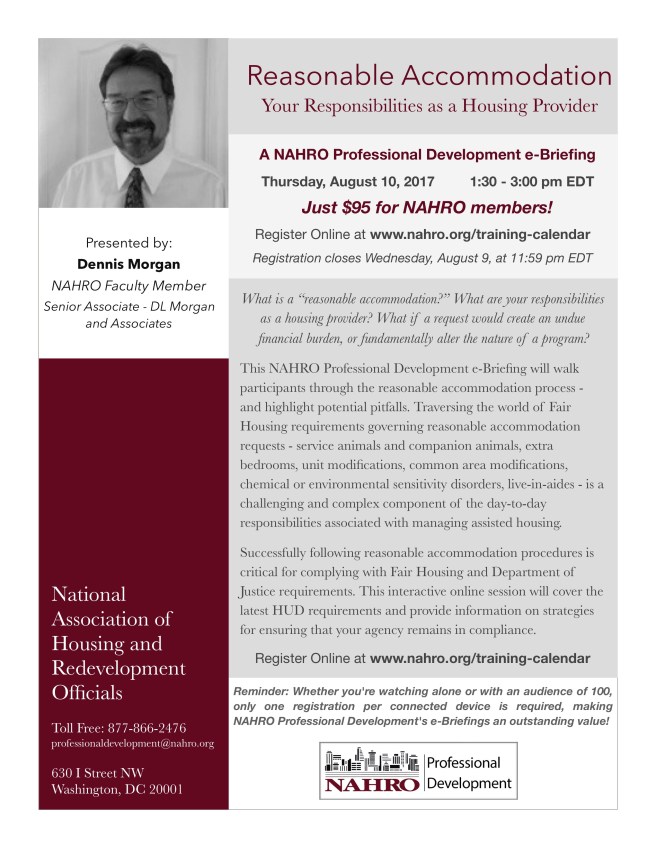
Reasonable Accommodation e-Briefing on August 10 at 1:30pm ET

On August 10 at 1:30pm, NAHRO Professional Development will present an e-Briefing on Reasonable Accommodation. NAHRO Faculty Member Dennis Morgan will answer many of questions – What is a “reasonable accommodation?” What are your responsibilities as a housing provider? What if a request would creat an undue financial burden, or fundamentally alter the nature of a program?

Reminder: Whether you're watching alone or with an audience of 100, only one registration per connected device is required, making NAHRO Professional Development's e-Briefings an outstanding value!

Register Online at www.nahro.org/training-calendar.

Senate Committee Votes Favorably on Three HUD Nominees

This morning the Senate Committee on Banking, Housing, and Urban Affairs voted favorably and sent to the full Senate the HUD nominations of Mr. J. Paul Compton, Jr., to be General Counsel; Ms. Anna M. Farias, to be Assistant Secretary for Fair Housing and Equal Opportunity; Mr. Neal J. Rackleff, to be Assistant Secretary for Community Planning and Development.

The committee conducted individual voice votes for each nominee. Mr. Compton’s nomination went to a roll call vote (15 favorable, 7 opposed.) Sens. Brown and Menendez spoke after the vote. Sen. Brown voted “opposed” on all three HUD nominees because of concerns with the nominees’ application and enforcement of the Affirmatively Furthering Fair Housing (AFFH) rule. Sen. Menendez only voted “opposed” on General Counsel nominee, Mr. Compton, because of AFFH concerns where Mr. Compton’s written question answers backtracked on the support for AFFH Mr. Compton expressed during the hearing.

Past Due Section 3 Reports Due July 31, 2017

On July 7, 2017, HUD’s Economic Opportunity Division of the Office of Fair Housing and Equal Opportunity issued a notice regarding Section 3 reporting due dates for PHAs. Reporting due dates for PHAs are now based on the PHA fiscal year end (FYE), and generally are due 60 days after the PHA FYE. Non-PHAs that are recipients of Section 3 funding will continue to submit annual reports as they have done so in the past.

However the notice did provide specific dues dates for past due reports. Past due Section 3 reports for 2013, 2014, and 2015 must be submitted by July 31, 2017. Also Section 3 reports for 2016 are due 60 days after the PHA FYE, if not already submitted. For 2017 and beyond, Section 3 reports are due 60 days after PHA FYE.

The process of for electronically submitting your Section 3 reports can be found on the HUD website.

Housing Organization and Education Partnerships Survey

As part of NAHRO’s work to improve the educational outcomes of the children that your agencies serve and as part of NAHRO’s ongoing partnership with the Public and Affordable Housing Research Corporation (PAHRC), we ask for your participation in an education partnership survey. Below are the details.

The work our HAs and housing partners do expands well beyond just providing stable housing. We know that connecting the housing sector to other areas like education can create the impact necessary to improve life outcomes. In order to obtain a more comprehensive understanding of the landscape of housing organizations involved in this critical work, we have partnered with PAHRC and Stewards of Affordable Housing for the Future (SAHF) to collect data.

You may have already received a brief survey from PAHRC, but we would like to remind you to add your housing organization’s story by answering this brief five to nine question survey.  All data will be aggregated and no single organization’s data will be identifiable or shared. If the survey does not appear, you can copy this link and paste it into your web browser http://www.surveygizmo.com/s3/2715688/f0550dd524bf

The survey asks about education services and related programs you provide directly to your residents or provide through partnerships with other organizations. It also inquires about the challenges related to providing these services or why they might be too difficult for your housing organization to provide at all. Even if you do not currently provide education services, we still encourage you to take the survey. If you are a public housing authority that administers multiple housing authorities, please note in the comments which services are provided for each housing authority.

This survey is part of a larger research project being conducted by PAHRC, a HAI Group company; the Council of Large Public Housing Authorities (CLPHA); and Stewards of Affordable Housing for the Future (SAHF) to build knowledge on how housing organizations are working to improve education outcomes for residents and the tools used in the most successful programs. The initiative is funded by the Bill & Melinda Gates Foundation and the John D. and Catherine T. MacArthur Foundation.

We know you may have received other surveys regarding your education efforts and want you to know that we are working with the industry groups and partner non-profit organizations to coordinate our efforts. It is exciting that there has been a growing interest in this work and how we can better it, and we greatly appreciate you assisting in the effort to highlight your work and contribute to the field at large.

Thank you for your time! We appreciate your help in improving knowledge about the many services housing agencies provide to their community. Please contact kstater@housingcenter.com or kmelwain@housingcenter.com with any questions.

Free Smoking Cessation Webinar – July 20 at 1pm ET

The Smoking Cessation Leadership Center (SCLC), in collaboration with the CDC Tips From Former Smokers™ Campaign, the National Center for Health in Public Housing (NCHPH), and the National Association of Community Health Centers (NACHC) are pleased to invite you to this free webinar, “Comprehensive Tobacco Cessation in Public Housing Community Health Centers : Beyond Policy Adoption and Implementationon Thursday, July 20, 2017, at 1:00pm EDT (90 minutes).

We are honored to have the following speakers presenting on this topic for us:

  • Bill Blatt, MPH, National Director of Tobacco Programs, American Lung Association
  • Elizabeth A. Davis, MD, Chief of Adult Medicine, Medical Director of Addiction Medicine, South End Community Health Center
  • John Kane, Senior Project Coordinator, Boston Housing Authority
  • Jose Leon, MD, Chief Medical Officer, National Center for Health in Public Housing

Webinar Objectives:

  1. Review tobacco use disorders data in public housing primary care
  2. Discuss key components of successful implementation of the non-smoking policy in public housing
  3. Describe the smoking cessation interventions provided by South End Community Health Center
  4. Learn how to talk to multi-unit housing residents about quitting smoking, including why they should quit, and learn about locally available programs and resources to help them

REGISTER HERE:

https://cc.readytalk.com/r/7ombg8t9bo76&eom

RAD Seminar in Washington, DC – August 16-18, 2017

NAHRO Professional Development with MARC-NAHRO are offering a special training opportunity – Rental Assistance Demonstration (RAD) Seminar with Proficiency Test.

The seminar will be held in conjunction with MARC-NAHRO’s Annual Conference, August 16-18, 2017, in Washington, DC. See details below.

For additional information and to register, go to www.marcnahro.orgRAD Flyer


NAHRO Submits Regulatory Reform Comments to HUD

On June 14, NAHRO submitted its comment letter to HUD’s request for comment on Reducing Regulatory Burden; Enforcing the Regulatory Reform Agenda Under Executive Order 13777.

NAHRO identified many regulations that would make good candidates for streamlining. Each of the regulations met at least one of the following reasons for streamlining:

(a) The regulation results “in the elimination of jobs, or inhibits job creation”;

(b) The regulation is “outdated, unnecessary, or ineffective”;

(c) The regulation imposes “costs that exceed benefits”; or

(d) The regulation creates a “serious inconsistency or otherwise interferes with regulatory reform initiatives and policies.”

The regulations listed are non-exhaustive. NAHRO’s comment letter is a start of a conversation between the Department and NAHRO. Given the limited time to compile this list, NAHRO expects to identify additional avenues for further regulatory streamlining, which we will share with the HUD.

NAHRO’s comment letter is organized into three sections: Public Housing and Section 8 recommendations; Community Planning and Development; and recommendations on cross-cutting programs and initiatives. Within each major section are topic headers with NAHRO’s recommendation on each topic.