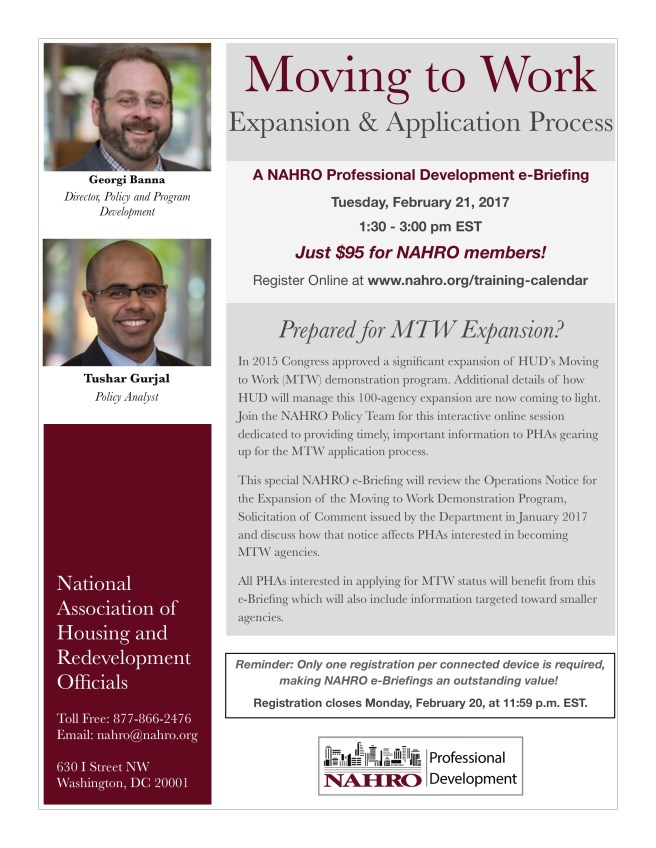
MTW Expansion e-Briefing on Tuesday February 21!

HUD Press Release (February 8, 2017):
HUD OFFERS GRANTS TO CLEAN UP LEAD-BASED PAINT HAZARDS
Funding to protect children from lead poisoning
WASHINGTON – The U.S. Department of Housing and Urban Development has announced that it is making grants available to help eliminate dangerous lead-based paint hazards from lower income homes in order to protect young children. Additionally, this funding will provide an opportunity for local communities to establish and support programs to control other housing-related health and safety hazards.
Unsafe and unhealthy homes affect the health of millions of people of all income levels, geographic areas, and walks of life in the U.S. These homes affect the economy directly, through increased utilization of health care services, and indirectly, through lost wages and increased school days missed. The housing improvements communities will make will help prevent injuries and illnesses, reduce associated health care and social services costs, reduce absentee rates for children in school and adults at work, and reduce stress, all which help to improve the quality of life.
HUD’s Office of Lead Hazard Control and Healthy Homes promotes local efforts to eliminate dangerous lead paint hazards and other housing-related health hazards from lower income homes, stimulate private sector investment in lead hazard control, support cutting-edge research on methods for assessing and controlling housing-related health and safety hazards, and educate the public about the dangers of hazards in the home.
The grants to States, local governments and the private sector are being offered through HUD’s Lead-Based Paint Hazard Control Program, and Lead Hazard Reduction Demonstration Program. In these grant programs, HUD is providing additional funding (healthy homes supplemental funds) to identify and remediate, in homes where lead-based paint hazards are being controlled, other housing-related health hazards.
HUD expects to make approximately 32 awards under these programs. This estimate assumes funding at the same level as Fiscal Year 2016. The actual number of awards made under this funding notice will depend on the amount of Congress appropriates in the Fiscal Year 2017 budget, the number of eligible applicants, and other factors.
HUD requires prospective grantees to submit their applications electronically at www.grants.gov. Any changes to HUD-published funding notices will be made available to the public through a Federal Register publication and published on this government-wide portal. Applicants are urged to sign up for Grants.gov’s notification service to receive periodic updates or changes to these grant offerings.
###
On February 7, 2017,  NAHRO will present, Moving Forward: A Review of 2016 Regulation and
Legislation, part of NAHRO’s Housing Rules!! series.
The NAHRO Policy team will discuss
many areas that HUD and Congress addressed during 2016 and NAHRO reviewed in detail
in NAHRO’s Regulatory and Legislative Year in Review – 2016, which will provide a solid regulatory and legislative foundation as we work with the new Administration and new Congress to keep our affordable housing agenda moving forward.
Registration information for this e-Briefing and other professional development offerings is available through the NAHRO Professional Development calendar.

NAHRO’s Call for Session Proposals for the 2017 Summer Conference is now open.
Share your experience as a housing and community development professional by submitting a session proposal for consideration as a presentation at the 2017 NAHRO Summer Conference in Indianapolis, IN. We are looking for sessions on current and emerging issues, best practices, and strategies to handle challenges facing the industry.
Session proposals should fall under one of the following identified topic tracks – Public Housing, Section 8/HCV, H/CD Finance, Community Development, Commissioners, Organizational Management and International.
Deadline to submit: March 15 and proposals must be submitted thru NAHRO’s on-line submission tool.
Submissions should be complete with a clear and concise session title, description, three learning objectives and identified panelists.
 Tomorrow NAHRO will present This Just in from Washington. It’s a new era in Washington; a new Congress and a new Administration will have major impacts on housing and community development programs. Join NAHRO’s Congressional Relations team for an interactive session that will help you navigate the new Congress and its relationship with the new Administration. John Bohm and Tess Hembree will give you an update on FY2017 appropriations, preview FY2018, outline potential legislative action on HCD programs, and discuss ways in which you can be the most effective advocate in this rapidly changing political climate.
Registration information for this e-Briefing is available through the NAHRO Professional Development calendar.
In 2016, the Department of Housing and Urban Development (HUD) was very busy setting forth new rules and regulations and providing updated notices and guidances on many of the HUD administered affordable housing programs. The year has also been marked by many legislative victories and a few challenges.
NAHRO has drafted and compiled this Regulatory and Legislative Year in Review – 2016 to provide a primer of the topics on the forefront of the affordable housing industry. It can also provide you, your public housing agencies (PHAs) and local redevelopment agencies (LRAs) and your stakeholders with current information on many of the programs used and administered by HUD and the affordable housing community.
The full Regulatory and Legislative Year in Review – 2016, along with the individual topic one-pagers, is available on the NAHRO website. For the most up-to-date versions and information visit the NAHRO website and the NAHRO blog.
NAHRO Policy and Congressional teams are also conducting two e-Briefings through NAHRO Professional Development. The first is This Just in from Washington on January 31, 2017, where NAHRO’s Congressional team will give you an update on FY2017 appropriations, preview FY2018, outline potential legislative action on HCD programs, and discuss ways in which you can be the most effective advocate in this rapidly changing political climate. The second is part of the Housing Rules! Series, Moving Forward: A Review of 2016 Regulation and Legislation on February 7, 2017, where NAHRO’s Policy team will discuss many areas that HUD and Congress addressed during 2016 and NAHRO reviewed in detail in NAHRO’s Regulatory and Legislative Year in Review – 2016, which will provide a solid regulatory and legislative foundation as we work with the new Administration and new Congress to keep our affordable housing agenda moving forward. Registration information for both of these e-Briefings is available through the NAHRO Professional Development calendar.
On January 20, the Trump Administration issued a “Regulatory Freeze Pending Review” memo that applies to all Federal agencies, including the U.S. Department of Housing and Urban Development (HUD). This memo is similar to memos issued by previous administrations as they come into office, and NAHRO had expected this regulatory freeze.
Generally, the regulatory freeze requires agencies to withdraw any regulations that have not yet been published in the Federal Register and to extend the effective date by 60 days of any regulations that have not become effective as of January 20, 2017. The Director of the Office of Management and Budget (OMB) can issue exceptions to the regulatory freeze in emergency situations and to address urgent health, safety, financial, or national security issues.
The regulatory review not only applies to regulations but also any “guidance document.” A “guidance document” is any substantive action or an agency statement that states a policy on a statutory, regulatory, or technical issue that is normally published in the Federal Register.
NAHRO will continue to monitor the effects of the regulatory freeze and has reached out to HUD staff on how this regulatory freeze will affect specific regulations. As more information becomes, available NAHRO will share it with our members through The NAHRO Blog and the Monitor.
For any specific questions or concerns, please contact Georgi Banna, NAHRO’s Director of Policy and Program Development, at gbanna@nahro.org. As always for the most up-to-date information of the affordable housing and community development regulations and legislation, follow The NAHRO Blog and check the NAHRO website.
PHADA and NAHRO are pleased to announce that on January 18th the U.S. Court of Federal Claims found in favor of nearly 350 public housing authorities that brought a lawsuit against the federal government challenging HUD’s reduction of their FY 2012 operating fund subsidies based on the amount of Plaintiffs’ so-called “excess” operating reserves. The President’s FY 2012 budget proposal included an Operating Fund request of just $3,961,850 which was $1 billion short of the amount needed to pay the aggregate estimated operating subsidy eligibility amount. HUD devised an “allocation adjustment” based on the level of savings agencies had accumulated in their operating fund reserves. As proposed, this allocation adjustment would have offset the aggregate amount of operating fund subsidies to which PHAs were entitled in 2012 by the amount of the PHAs’ “excess” operating reserves up to $1 billion. At the Department’s behest, Congress approved the plan, changing the aggregate amount of reserves that could be used as an offset to $750 million.
With PHADA and NAHRO as the lead Plaintiffs, a lawsuit was filed on January 3, 2013. Collaborating with PHADA and NAHRO, Coan & Lyons, a Washington, DC law firm, prepared the case based on the claim that HUD’s offset breached the Annual Contributions Contract (ACC of the PHA Plaintiffs in 2012 when “rather than reducing their subsidy payments by a uniform percentage (pro-rata basis), it first offset each PHA’s payment by a figure that varied from one PHA to another – the amount of its excess operating reserves.”
Judge Elaine D. Kaplan stated in her decision that HUD “breached its [contractual] obligations under the ACCs when it applied the [excess] operating [reserves] offset in response to the 2012 Appropriations Act, rather than the pro rata reduction prescribed by” HUD’s regulations. As noted by Judge Kaplan, the plaintiffs requested compensatory damages of almost $136 million.
The Court has ordered the attorneys to file a status report by February 17, suggesting how the Court should proceed. Carl Coan, III, Plaintiffs’ lead attorney, believes that the next logical step will be to calculate the exact damages to which the Plaintiffs are entitled and submit them to the Court for approval. Assuming the parties can agree on the amount of damages, the Court will enter a final judgment and order awarding Plaintiffs their damages.
Tim Kaiser, PHADA Executive Director said, “We appreciate the Court’s decision. We tried to dissuade HUD from implementing this unfair and damaging plan as soon as we heard about it. HUD decided to go ahead and it left us with no alternative but to organize a legal action to enforce the existing contract between HUD and its many PHA partners.”
John Bohm, Acting Chief Executive Officer of NAHRO stated “NAHRO applauds the Court’s ruling on this matter. This responsible decision addresses the critical concerns raised by housing authorities across the country, and we hope that it will serve as a benchmark for future decision-making on these matters.”
The Court’s ruling may be accessed here.
###
For any specific questions or concerns, please contact Georgi Banna, NAHRO’s Director of Policy and Program Development, at gbanna@nahro.org. As always for the most up-to-date information of the affordable housing and community development regulations and legislation, follow The NAHRO Blog and check the NAHRO website.
In an effort to improve the educational outcomes of students living in public housing agencies and local redevelopment agencies, HUD has release a “Data-Sharing Road Map.” This Road Map will provide PHAs practical guidance, such as starting the data-sharing conversation and negotiating the data-sharing agreement, to establish partnerships with their local school districts. The Data-Sharing Road Map is based on the experience of PHAs that have successfully developed data-sharing agreements with their local school district.
NAHRO continues to partner with the Campaign for Grade-Level Reading and HUD on promoting and improving the education outcomes of children living in HUD-assisted properties.
The United States Senate Committee on Banking, Housing, and Urban Affairs will hold a confirmation hearing for HUD Secretary-Designate Carson at 10 am ET on Thursday, January 12, 2017. The hearing will be held at the Dirksen Senate Office Building in Room 538.
The confirmation hearing will be webcast live on the Senate Committee on Banking, Housing, and Urban Affairs hearing website. Dr. Carson’s written testimony is also posted, here, on the Senate Banking Committee website.
John Bohm, NAHRO Acting CEO, is attending the hearing and additional coverage of the confirmation hearing will be available for members in the January 15 Monitor.
 The NAHRO Blog: Legislative & Policy Updates from Washington, DC