UPCS-V Conference Call Recording Now Available

HUD REAC’s Oversight and Evaluation Division (OED) has made available a recording of the UPCS-V conference call with UPCS-V Demonstration participants.

The link to the recording can be found on OED’s webpage.

A direct link to the recording can be found here.

New Proposed Administrative Fee HUD FAQ posted

HUD has posted a new proposed administrative fee frequently asked questions (FAQ) document on its Housing Choice Voucher New Administrative Fee Formula Proposed Rule webpage. The new FAQ answers four questions:

  1. How is the benefit load calculated?
  2. How will the formula be applied to MTW sites?
  3. How are “per unit fees” and “total funding” calculated under the proposed rule formula and the existing formula?
  4. What does HUD mean by fee “received” under the current formula? How does proration fit in to the comparisons between the proposed formula and the existing formula?

Read the FAQ here.

For additional HUD analysis tools of the new proposed administrative fee formula, see our prior post.

New CRS Report on Federal Spending Trends

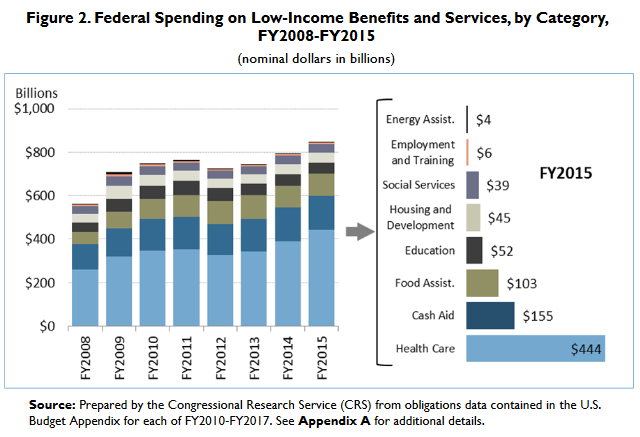
The Congressional Research Service recently created a report titled “Federal Benefits and Services for People with Low Income: Overview of Spending Trends, FY2008-FY2015.” The report is the latest in a series that attempts to identify and discuss programs and services oriented toward low-income populations, while focusing on aggregate spending trends.

The report contains some interesting charts that show how spending on housing compares to other categories of federal spending. The chart below from page 6 of the report shows spending by category. Notice that health care spending dwarfs the other categories, while “housing and development” is in the middle.

Federal-Spending-Chart-FY2015-CRS-Report

Read the full report here.

HUD Offering $2 million in ROSS Grants to Help Students Navigate College and Continuing Education Financial Aid Assistance

On August 2, HUD announced $2 million in grants to “help low-income families and young people apply for federal aid for college and other post-secondary educational opportunities.” The program is being funded through the Resident Opportunities and Self Sufficiency (ROSS) Program. The program will allow up to six public housing agencies (PHAs) to support “Education Navigators.”

HUD’s ROSS for Education Program is known as Project SOAR (Students + Opportunities + Achievements = Results).  It will “support hundreds of young people between the ages of 15 – 20 to apply for [the] U.S. Department of Education’s Free Application for Federal Student Aid (FAFSA).” HUD is also working with the Department of Education to share data about FAFSA completion and is working with the White House’s Social and Behavioral Sciences Team to develop methods to increase completion rates of the FAFSA among students with housing assistance.

Read HUD’s full press release here.

Read HUD’s Notice of Funding Availability (NOFA) here.

Read more about how behavioral economics can be used to “nudge” applicants receiving housing assistance to seek Federal Student Aid here.

Moving On from Supportive Housing Toolkit

Corporation for Supportive Housing (CSH) has developed a new Moving On Toolkit for supportive housing providers, Continuums of Care, PHAs, state and local government agencies and other organizations that would like to plan, develop, sustain and evaluate Moving On initiatives within their communities. Moving On initiatives provide rental subsidy and transition assistance to tenants who are able and want to move out of supportive housing and into a new apartment. The toolkit outlines the various phases and steps in the Moving On process and offers numerous links and helpful resources, including descriptions of previous or existing Moving On projects and practical tools or templates developed by implementing organizations. According to CSH, the fundamental goal of Moving On is to promote the highest levels of independence and choice for tenants. HUD has previously provided public support for Moving On but current initiatives only exist on a small scale through scattered pilots.

HUD Releases Renewable Energy Toolkit

HUD recently released their Renewable Energy Toolkit to help recipients of HUD Community Planning and Development (CPD) grants to integrate renewable energies into their affordable housing programs. These include groups receiving HOME, CDBG, HOPWA, or ESG dollars. The toolkit walks users through 4 phases of incorporating renewable energy in their affordable housing developments: feasibility analyses, prioritizing and soliciting renewable energy projects, project evaluation and selection, and implementation. HUD hopes to encourage grantees to integrate renewable energy into more affordable housing developments as it helps to maintain affordability through reduced energy costs, which can facilitate improved operations and maintenance.

HOTMA Signed by President, NAHRO Releases In-Depth Summary

On July 29, President Obama signed the Housing Opportunity Through Modernization Act (HOTMA/HR 3700) officially making it law. HUD is now in charge of implementation. The law provides common-sense reforms to our industry and contains numerous provisions supported by NAHRO. NAHRO will be working closely with HUD as they begin the implementation process.

On August 2, NAHRO released an In-Depth Summary (members only) of the law and the provisions found within. NAHRO also previously released a one-pager (members only) of the specific provisions NAHRO has supported and promoted over the years.

We encourage all NAHRO members to thank their Senators and Representatives for getting this important piece of legislation passed. More information on how to thank your members of Congress can found at NAHRO’s Advocacy Action Center as a part of our August Advocacy Month.

On a personal note, we’d also like to thank all of you for helping get this passed. Your outreach and efforts paid off, and we wouldn’t be at juncture without all of you!

Administration Announces Steep Decline in Veteran Homelessness

Today–HUD, the U.S. Department of Veterans Affairs (VA), and the U.S. Interagency Council on Homelessness (USICH) announced that the number of veterans experiencing homelessness in the United States has declined significantly since 2010. According to HUD’s Point-in-Time (PIT) estimates, there has been a 47 percent decrease in the number of veterans experiencing homelessness since 2010 and a 17 percent decrease since 2015.

HUD believes that this decline is a function of partnerships between HUD and VA, USICH, and other partners at all levels of government (i.e., federal, state, and local) and the HUD-VASH program. The partnerships were a result of Opening Doors, the federal strategic plan to prevent and end homelessness.

Read HUD’s full press release here.

Read more about Opening Doors here.

View HUD’s PIT Estimates of Veteran Homelessness in the U.S. here.